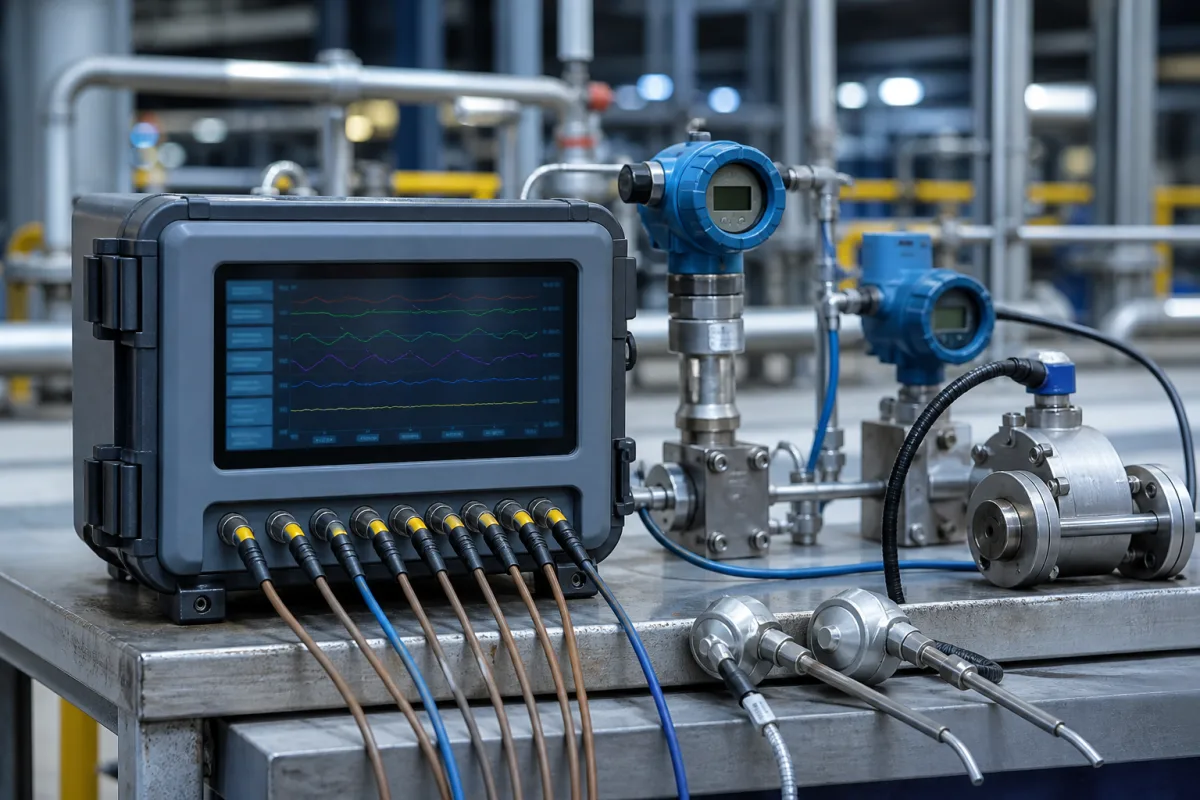
Measurement and monitoring · Inputs, channels, sample interval, memory, accuracy and calibration
A data logger records sensor readings over time. Ask three things first: which signals and how many channels, how often and for how long it must record, and what accuracy, calibration and data retrieval you need.
Stand-alone and networked data loggers for temperature, humidity, thermocouple, voltage, current and bus signals in industrial, cold-chain, environmental and test use. Full data acquisition systems, SCADA software and cables are outside this page.
CNFX editorial research · Sources checked October 12, 2026 · 4 sources
The US National Park Service, comparing temperature and humidity loggers, notes that memory is quoted either as paired readings or as total individual readings, so divide by the number of active channels to compare; enabling more channels gives fewer sets of readings. Battery life depends on battery type and sampling rate, display and alarm features use power, and for trend monitoring it suggests enough battery for a full year. [1]
Renke's WiFi temperature and humidity logger, for example, stores 65,000 groups with a recording interval set from 1 minute to 1 hour. [2]
Editorial calculation: at 1-minute intervals, 65,000 records last 65,000 minutes, about 45 days; at the 15-minute interval NPS used for comparison, they last 975,000 minutes, about 677 days or 1.9 years. [2][1] Check that battery life, not just memory, covers the same period.
Give the supplier the signals, channel count, interval, run time between downloads, power source, environment, accuracy and calibration needs, alarms and how data must be retrieved or uploaded.
02
Check inputs, accuracy, isolation and calibration
NPS notes that accuracy depends on sensor type, quality and calibration and can vary across the range; a one-point calibration checks mid-range only, while two or more points cover more of the range; NPS writes that “Manufacturer recommended recalibration times range from 6 months to 3 years, with most advocating annual calibration”. [1]
Renke states ±0.5 °C and ±3% RH accuracy at 25 °C and 60% RH, 0.1 °C and 0.1% RH resolution, and long-term drift of 0.1 °C and 1% RH per year or less. [2] Accuracy and resolution are different numbers; compare both.
For multi-channel test logging, Chroma's 51101 series lists 8- and 64-channel models, eight thermocouple types, per-channel cold-junction compensation, voltage adaptors to ±10 V and ±480 V DC, 1,000 V DC channel-to-channel isolation and up to 5 samples per second per channel; Chroma notes that multiplexed loggers slow per channel as channels are added, while its design does not. [3]
Editorial calculation: 64 channels × 5 samples/s = 320 samples/s, or 27,648,000 samples per day; check storage, PC software and file handling for that volume. [3]
03
Compare what suppliers offer
Suppliers linked to this page list temperature and humidity loggers, multi-channel and signal loggers, and remote monitoring loggers. [2][3]
Renke lists WiFi and Ethernet temperature and humidity loggers; Hairuis lists USB, GSM and WiFi temperature and humidity loggers, thermocouple, PT100, 4–20 mA and 0–30 V loggers; HLY lists single-use and reusable cold-chain loggers and 4G trackers; Rika and Tsingsense list loggers for weather stations; GINTEC lists DCT20S and C2000 loggers for structural monitoring; ICP DAS lists eLogger software and EZ Data Logger devices; Vhandy lists CAN-bus data recorders; Lonnmeter lists data loggers among measuring instruments; Chroma lists thermal and multi-function loggers. [2][3]
04
Write minimum logger specs for a regulated cold store
Guidelines from the US National Institute of Standards and Technology (NIST), funded by the Centers for Disease Control and Prevention, set minimum data logger features for a vaccine refrigerator held at 2 °C to 8 °C: a detachable probe kept in a liquid-filled bottle (cable over 1 m preferred); at least one reading per 15 minutes; memory for 4,000 readings, about 39 days at that rate, with recording stopping when full; −20 °C to 40 °C operating range; ±0.5 °C uncertainty (accuracy) from −1 °C to 15 °C; ±0.1 °C resolution; and at least 6 months of battery life. [4]
It also asks for a display with a high/low alarm indicator, user-adjustable alarms set at 2 °C and 8 °C, and software that downloads over a port such as USB, graphs the data, shows total time outside the limits and exports csv, Excel or txt files. Download at least weekly and at once after any alarm. [4]
Editorial calculation: a week at one reading per 15 minutes is 672 readings (7 × 24 × 4), 16.8% of the 4,000-reading minimum; 4,000 × 15 minutes = 60,000 minutes, 41.7 days, against NIST's stated figure of about 39 days. [4]
USB, WiFi, Ethernet or cellular; PC or cloud. [2][3]
Interface, software, data export.
06
Fill the specification fields with values for your application
A data logger quotation needs values for your signals and use. The table explains each field, gives published values where a reviewed source states them, and says what to obtain from the supplier.
Explore company information and manufacturing capabilities, then discuss the scope of your project with a relevant supplier.
Share this page
Compiled and source-reviewed by the CNFX editorial team.
Published product pages show what a company offers, not tested performance. Confirm the legal seller, factory and scope for your order. How we source and review
· Page last updated 13 October 2026
Buyer questions
How long will a data logger record before memory is full?
Divide capacity per channel by readings per hour; 65,000 records last about 45 days at 1-minute intervals and about 1.9 years at 15 minutes. [2][1]
How often should a data logger be calibrated?
NPS reports manufacturer recommendations from 6 months to 3 years, “with most advocating annual calibration”; multi-point calibration covers more of the range. [1]
Why does channel isolation matter?
When channels sit at different voltages, such as cells in a battery, isolation lets each channel measure without interference; one logger series lists 1,000 V DC between channels. [3]
What minimum data logger specs does NIST give for vaccine refrigerators?
NIST's CDC-funded guidelines list at least one reading per 15 minutes, memory for 4,000 readings, ±0.5 °C uncertainty from −1 °C to 15 °C, ±0.1 °C resolution and at least 6 months of battery life. [4]
Sources and what still needs a direct check
Sources checked 2026-10-12. The National Park Service note compares temperature and humidity loggers for museums; its selection criteria are applied here beyond museums. Renke and Chroma are suppliers listed on this page; their values are catalogue figures.