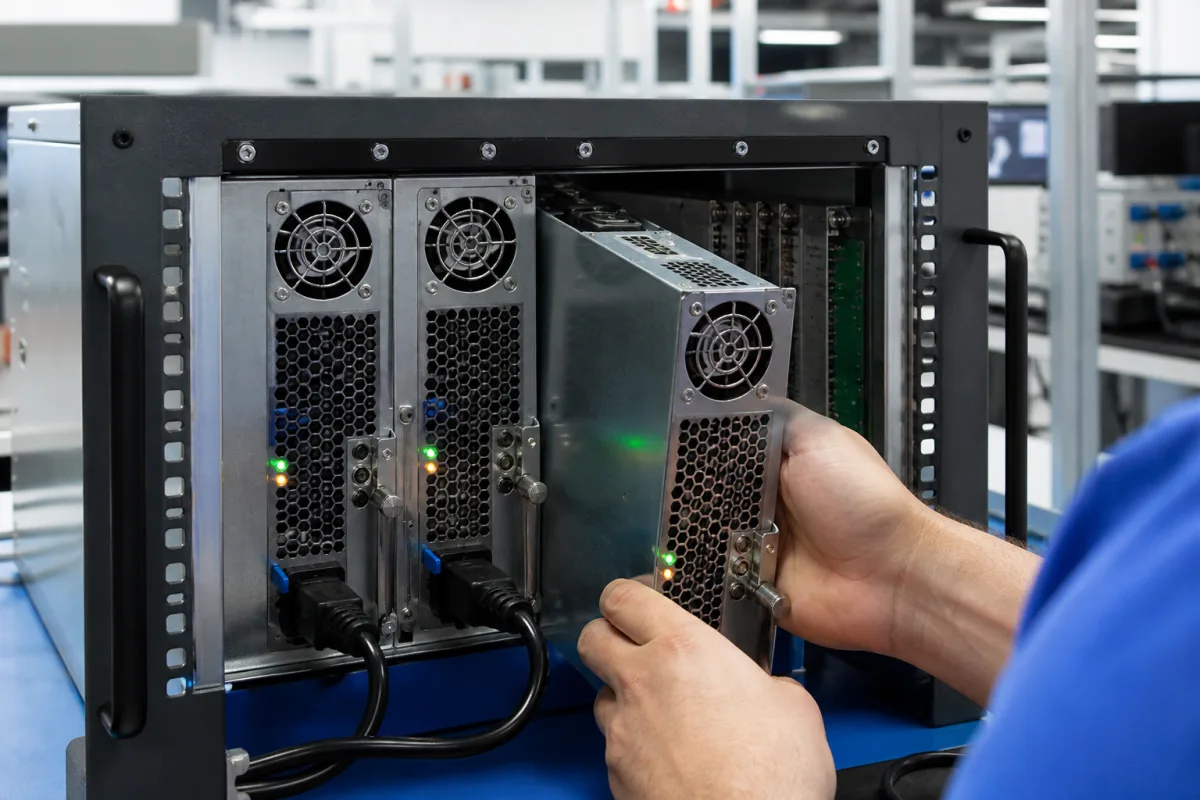
Redundant power supply (hot-swap plug-in modules run N+1 in an equipment chassis)
Hot-swap redundant power supply modules for equipment chassis · N+1 module count, active and forced current sharing, ORing FETs and diodes, PMBus monitoring, airflow direction and 1U plug-in formats
A redundant power supply here means two or more plug-in modules feeding one output bus in a chassis, rack shelf or instrument, sized so the equipment keeps running when one module fails and so that module can be pulled and replaced without shutting down. Specify the load and the redundancy (N+1 or 1+1), how the modules share current and block reverse current, how they report their state, and how they fit the chassis airflow.
Hot-swappable AC-DC and DC-DC power supply modules used in N+1 or 1+1 redundant arrangements in equipment chassis, rack shelves and instruments, with their current sharing, ORing and monitoring. DIN-rail power supplies for control cabinets are covered on the Industrial DIN-Rail Power Supply Unit page; chassis- and frame-mounted AC-DC supplies on the Power supply module page; DC UPS buffering of PLC supplies on the PLC control cabinet page; blind-mate connectors for plug-in modules on the Hot-swap connector page; processor core rails on the Voltage regulator module (VRM) page.
CNFX editorial research · Sources checked October 12, 2026 · 4 sources
How many modules: the load, the module rating and the parallel limit
Murata's D1U54P front-end modules come in 650 W and 1500 W versions in a 1U format of 54.5 × 40 mm; both press releases say the units are "capable of N+1 redundancy" with active current sharing, up to eight in parallel. The 650 W model is 228.6 mm (9 in) long and gives a 12 VDC main output with a 12 VDC / 2 A standby output; the 1500 W model is 12.66 in long with optional 12, 5 or 3.3 VDC standby outputs. [1][2]
Editorial calculation for a 3,000 W, 12 V load: with 1,500 W modules, two carry the load and a third gives N+1, so three modules each run at about 1,000 W (67%) while all are healthy. With 650 W modules, five (3,250 W) carry the load and a sixth gives N+1, each running at about 500 W (77%). [1][2]
Editorial calculation from the eight-in-parallel limit: N+1 with eight modules leaves seven to carry the load, about 4,550 W with 650 W modules or 10,500 W with 1,500 W modules. Check whether a given model's derating with temperature or input voltage lowers those figures. [1][2]
Give the supplier the steady and peak load per output, the redundancy wanted (N+1, 1+1, or N+N on two AC feeds), input voltage and frequency, and the number of module slots in the chassis.
02
Sharing current and blocking a failed module
Two functions decide whether a redundant set works: the modules have to divide the load, and a module that fails short or is pulled must not drag the bus down. TI states that "Redundant power sources must have the equivalent of a diode OR to prevent reverse current during faults and hotplug." Its TPS2419 controller drives an external N-channel MOSFET to provide "the reverse current protection of an ORing diode with the efficiency of a MOSFET", for N+1 supplies and redundant buses. [4]
Kepco describes its HSF modules as hot-swappable plug-in supplies "designed to be combined with an N+1 fault-tolerant power system", in 1U and 3U housings, and says they can also be used on their own as a multi-output supply. The Control Design listing prints the power range as "501,500 W", which reads as 50–1,500 W with a lost dash; confirm the range with Kepco. [3]
Monitoring, swapping and cooling a module in a running chassis
Murata gives both D1U54P models an I²C/PMBus interface and front-panel LED status indicators, overvoltage, overcurrent and overtemperature protection, and a variable-speed fan whose airflow direction, front to back or back to front, is chosen when ordering. [1][2]
TI's TPS2419 has an enable pin that lets the system force the MOSFET off "under light-load, high noise conditions", and a programmable turn-off threshold. [4]
Match the module airflow to the chassis fans, and ask which status signals (PMBus registers, LEDs, alarm pins) the chassis controller will read to flag a failed module.
04
Redundant power module order details
Paste it into your enquiry below or into an email to a maker, then replace every bracket.
Load: [steady and peak W per output; voltages]
Redundancy: [N+1; 1+1; two AC feeds]
Modules: [rating; slots in chassis; parallel limit]
Sharing and ORing: [active or forced sharing; FET or diode]
Input: [AC range; DC input]
Monitoring: [PMBus; LEDs; alarm signals]
Cooling: [airflow direction; ambient]
Mechanics: [1U or other; length; connector]
Quantity: [modules; spares]
Explore company information and manufacturing capabilities, then discuss the scope of your project with a relevant supplier.
Share this page
Compiled and source-reviewed by the CNFX editorial team.
Each manufacturer above links to the page on that company's own website where the product is listed, with the date we checked it. How we source and review
· Page last updated 13 October 2026
Buyer questions
What does N+1 mean for module count?
Enough modules to carry the load (N) plus one spare running in parallel, so one can fail or be pulled; Murata's D1U54P modules allow up to eight in parallel. [1][2]
Why do redundant supplies need ORing?
TI says redundant power sources must have the equivalent of a diode OR to prevent reverse current during faults and hotplug. [4]
On Murata's D1U54P, front to back or back to front is specified at the time of order. [2]
Sources and what still needs a direct check
Sources checked 2026-10-12. Murata announced its D1U54P front-end modules in two press releases; Control Design listed Kepco's HSF series; TI publishes the TPS2419 ORing controller page.