Industry-Verified Manufacturing Data (2026)

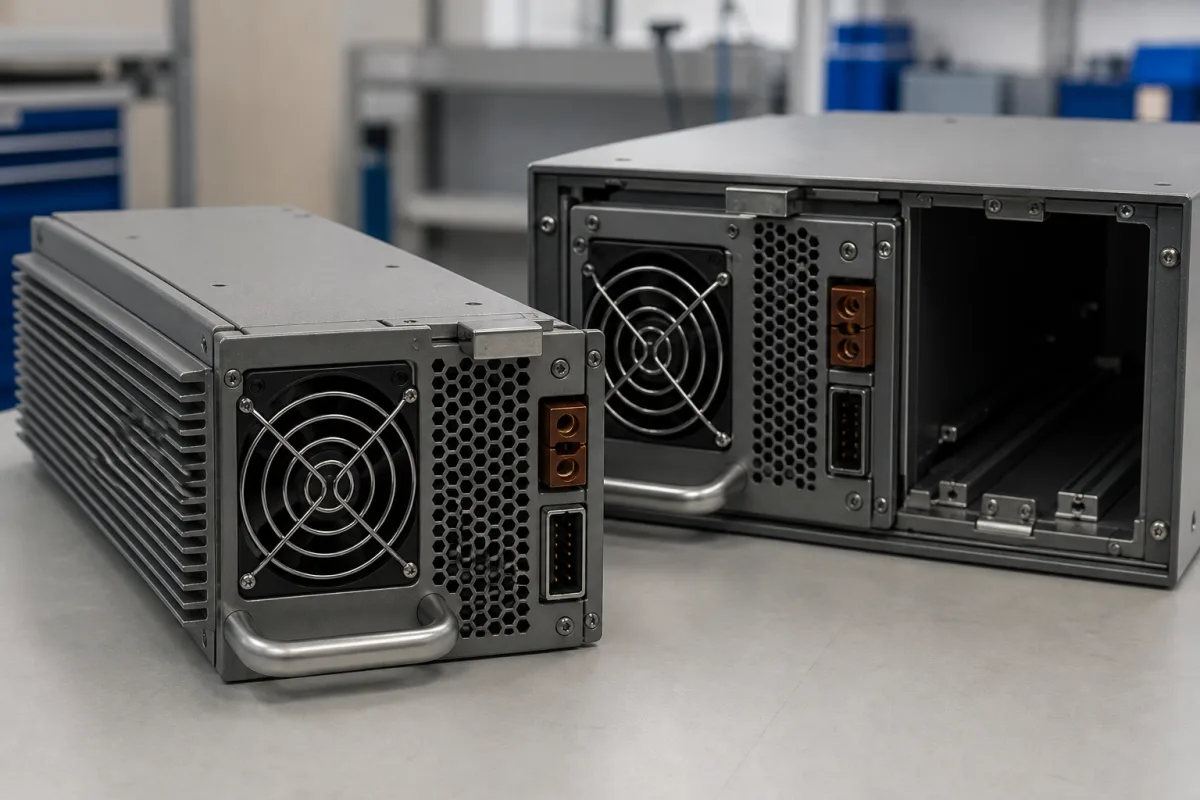
Power Conversion Module

Based on aggregated insights from multiple verified factory profiles within the CNFX directory, the standard Power Conversion Module used in the Electrical Equipment Manufacturing sector typically supports operational capacities ranging from standard industrial configurations to heavy-duty production requirements.

Technical Definition & Core Assembly

A canonical Power Conversion Module is characterized by the integration of Power Stage Circuitry and Control Circuit Board. In industrial production environments, manufacturers listed on CNFX commonly emphasize Printed Circuit Board (PCB) construction to support stable, high-cycle operation across diverse manufacturing scenarios.

Electronic component that converts electrical power from one form to another within a redundant power supply system

Product Specifications

Technical details and manufacturing context for Power Conversion Module

Definition
A power conversion module is a critical electronic component within redundant power supply systems that transforms input electrical power (typically AC or DC) into the specific voltage, current, and frequency required by connected equipment. It ensures stable, regulated power delivery while providing isolation, protection, and efficiency optimization functions.
Working Principle
The module receives input power and uses switching transistors (typically MOSFETs or IGBTs) controlled by pulse-width modulation (PWM) circuits to convert the power. This involves rectification, filtering, and regulation stages to produce clean, stable output power with minimal losses. Advanced modules include feedback loops for voltage regulation, protection circuits for overcurrent/overvoltage conditions, and communication interfaces for system monitoring.
Common Materials
Printed Circuit Board (PCB), Semiconductors (MOSFETs/IGBTs), Magnetic components (transformers/inductors), Capacitors (electrolytic/ceramic), Heat sink (aluminum/copper)
Technical Parameters
  • Power rating indicating maximum output capacity (W) Per Request
Components / BOM
  • Power Stage Circuitry
    Performs the actual power conversion using switching transistors and magnetic components
    Material: Semiconductors, ferrite cores, copper windings
  • Control Circuit Board
    Provides PWM control signals, feedback regulation, and protection logic
    Material: PCB with integrated circuits, resistors, capacitors
  • Input/Output Connectors
    Provides electrical interface for power input and output connections
    Material: Copper alloy with plating (tin/gold)
  • Thermal Management System
    Dissipates heat generated during power conversion to maintain safe operating temperatures
    Material: Aluminum heat sink, thermal interface material
Engineering Reasoning
85-264 VAC input, 12-48 VDC output, 40-60 Hz frequency, -40°C to +85°C ambient temperature
Input voltage exceeding 275 VAC for >100 ms, output current exceeding 125% rated capacity for >30 seconds, junction temperature >150°C
Design Rationale: Semiconductor thermal runaway due to excessive switching losses (P_loss = I²R + C·V²·f), dielectric breakdown in capacitors at >600 V/mm field strength, copper trace electromigration at current density >10⁶ A/cm²
Risk Mitigation (FMEA)
Trigger Input voltage transient exceeding 400 Vpk for 50 μs
Mode: MOSFET gate oxide breakdown with V_GS > ±20 V threshold
Strategy: TVS diode clamping at 350 V with 1.5 kJ surge rating, RC snubber network with 100 Ω/100 nF values
Trigger Ambient temperature rise to 95°C with 80% humidity
Mode: Electrolytic capacitor ESR increase from 0.1 Ω to >1.0 Ω causing thermal runaway
Strategy: Polymer aluminum capacitors with 5000-hour 105°C rating, forced air cooling at 2.5 m/s velocity

Industry Taxonomies & Aliases

Commonly used trade names and technical identifiers for Power Conversion Module.

Applied To / Applications

This component is essential for the following industrial systems and equipment:

Industrial Ecosystem & Supply Chain DNA

Complementary Systems
Downstream Applications
Specialized Tooling

Application Fit & Sizing Matrix

Operational Limits
pressure: Not applicable (electronic component)
other spec: Input voltage range: 85-264V AC, 120-370V DC
temperature: -40°C to +85°C
Media Compatibility
✓ Clean air environments ✓ Dry industrial enclosures ✓ Controlled humidity cabinets
Unsuitable: High moisture or corrosive chemical atmospheres
Sizing Data Required
  • Input voltage and frequency
  • Required output power (kW)
  • Redundancy configuration (N+1, 2N, etc.)

Reliability & Engineering Risk Analysis

Failure Mode & Root Cause
Thermal runaway
Cause: Inadequate cooling, dust accumulation on heat sinks, or aging thermal interface materials causing semiconductor junction temperatures to exceed safe limits, leading to component degradation and catastrophic failure.
Electrolytic capacitor degradation
Cause: High operating temperatures, voltage stress, or ripple current exceeding specifications causing electrolyte evaporation, increased equivalent series resistance (ESR), and eventual open or short circuit failure.
Maintenance Indicators
  • Audible high-pitched whining or buzzing from inductors/transformers indicating magnetic core saturation or winding insulation breakdown
  • Visible discoloration, bulging, or electrolyte leakage from capacitors on the PCB
Engineering Tips
  • Implement predictive maintenance through regular thermal imaging scans to identify hot spots and monitor capacitor ESR trends using specialized test equipment
  • Maintain clean, filtered air intake with proper airflow management, ensuring ambient temperature remains within manufacturer's specifications and derating components appropriately for elevated temperatures

Compliance & Manufacturing Standards

Reference Standards
IEC 61000-6-2: Electromagnetic compatibility - Generic standards - Immunity standard for industrial environments UL 60950-1: Safety of Information Technology Equipment EN 55032: Electromagnetic compatibility of multimedia equipment - Emission requirements
Manufacturing Precision
  • Output Voltage Regulation: +/-2% of nominal voltage under full load
  • Thermal Performance: Operating temperature stability within +/-5°C across specified ambient range
Quality Inspection
  • Hi-Pot (Dielectric Withstand) Test: 1500V AC applied between input and output for 60 seconds
  • Load Regulation Test: Verify output voltage remains within tolerance from 10% to 100% rated load

Factories Producing Power Conversion Module

Verified manufacturers with capability to produce this product in China

✓ 97% Supplier Capability Match Found

T Technical Director from Canada Jan 10, 2026
★★★★★
"Testing the Power Conversion Module now; the technical reliability results are within 1% of the laboratory datasheet."
Technical Specifications Verified
P Project Engineer from United States Jan 07, 2026
★★★★☆
"Impressive build quality. Especially the technical reliability is very stable during long-term operation. (Delivery took slightly longer than expected, but technical support was excellent.)"
Technical Specifications Verified
S Sourcing Manager from United Arab Emirates Jan 04, 2026
★★★★★
"As a professional in the Electrical Equipment Manufacturing sector, I confirm this Power Conversion Module meets all ISO standards."
Technical Specifications Verified
Verification Protocol

“Feedback is collected from verified sourcing managers during RFQ (Request for Quote) and factory evaluation processes on CNFX. These reports represent historical performance data and technical audit summaries from our B2B manufacturing network.”

14 sourcing managers are analyzing this specification now. Last inquiry for Power Conversion Module from Poland (1h ago).

Supply Chain Compatible Machinery & Devices

Circuit Breaker Arc Chute

Electrical component that extinguishes arcs in circuit breakers

Explore Specs →
Medium Voltage Switchgear Assembly Line

Automated production system for assembling medium voltage electrical switchgear.

Explore Specs →
Motor Terminal Block

Electrical connection interface for motor windings

Explore Specs →
PLC Control System

A digital industrial computer control system that monitors inputs, makes decisions based on a custom program, and controls outputs to automate industrial processes.

Explore Specs →

Frequently Asked Questions

What is the primary function of this power conversion module?

It converts electrical power from one form to another within redundant power supply systems, ensuring continuous and reliable power delivery in industrial applications.

What materials are used in the construction of this module?

It uses a Printed Circuit Board (PCB), Semiconductors like MOSFETs/IGBTs, Magnetic components (transformers/inductors), Capacitors (electrolytic/ceramic), and an aluminum/copper heat sink for thermal management.

How does the thermal management system work in this module?

The thermal management system, including an aluminum or copper heat sink, dissipates heat generated by power components like MOSFETs/IGBTs, ensuring optimal performance and longevity in demanding electrical environments.

Can I contact factories directly on CNFX?

CNFX is an open directory, not a transaction platform. Each factory profile provides direct contact information and production details to help you initiate direct inquiries with Chinese suppliers.

Get Quote for Power Conversion Module

Request technical pricing, lead times, or customized specifications for Power Conversion Module directly from verified manufacturing units.

Your business information is encrypted and only shared with verified Power Conversion Module suppliers.

Thank you! Your message has been sent. We'll respond within 1–3 business days.

Need to Manufacture Power Conversion Module?

Connect with verified factories specializing in this product category

Add Your Factory Contact Us
Previous Product
Power Controller (SSR/PID)
Next Product
Power Converter