Industry-Verified Manufacturing Data (2026)

Load Sharing Controller

Based on aggregated insights from multiple verified factory profiles within the CNFX directory, the standard Load Sharing Controller used in the Electrical Equipment Manufacturing sector typically supports operational capacities ranging from standard industrial configurations to heavy-duty production requirements.

Technical Definition & Core Assembly

A canonical Load Sharing Controller is characterized by the integration of Current Sensing Circuit and Control Logic Unit. In industrial production environments, manufacturers listed on CNFX commonly emphasize Printed Circuit Board (PCB) construction to support stable, high-cycle operation across diverse manufacturing scenarios.

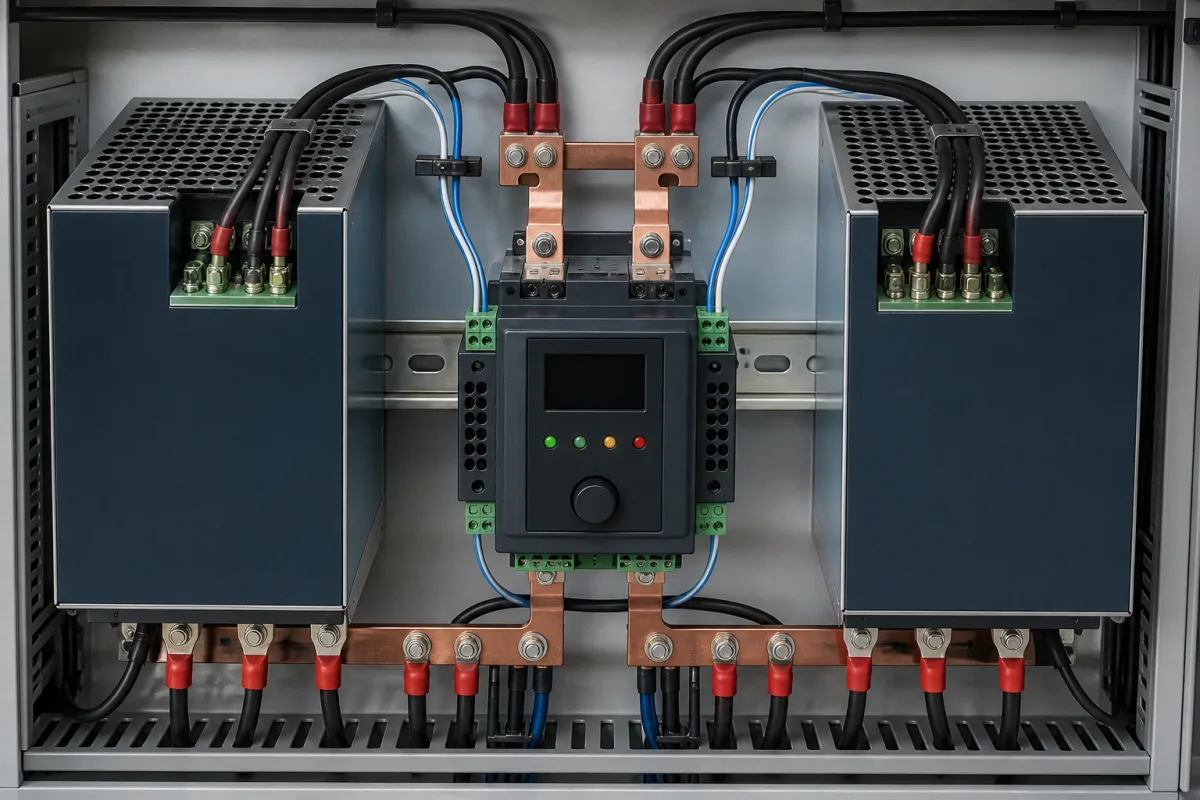
An electronic control unit that manages power distribution between multiple power supplies in a redundant configuration.
Product Specifications

Technical details and manufacturing context for Load Sharing Controller

Definition
A load sharing controller is a critical component within redundant power supply systems that monitors and regulates the electrical load distribution between two or more parallel-connected power supplies. It ensures balanced current sharing to prevent overloading of individual units, optimizes system efficiency, and maintains stable output voltage during operation and during transitions between power sources.
Working Principle
The controller continuously monitors the output current of each connected power supply unit. Using feedback signals, it adjusts the internal reference voltages or control signals of each unit to force them to share the total load current proportionally. This is typically achieved through active current balancing algorithms, often using a master-slave configuration or a democratic current sharing bus.
Common Materials
Printed Circuit Board (PCB), Semiconductor components (ICs, transistors), Copper conductors, Plastic housing
Technical Parameters
  • Maximum current sharing capability per power supply unit (A) Customizable
Components / BOM
  • Current Sensing Circuit
    Measures output current from each power supply unit
    Material: PCB with shunt resistors or current transformers
  • Control Logic Unit
    Processes current data and generates control signals
    Material: Microcontroller or dedicated IC
  • Signal Conditioning Circuit
    Filters and amplifies sensor signals for processing
    Material: PCB with operational amplifiers and passive components
Engineering Reasoning
24-48 VDC input voltage, 0-100 A per channel current sharing, -40°C to +85°C ambient temperature
Input voltage below 18 VDC or above 60 VDC, current imbalance exceeding 15% between channels, junction temperature exceeding 125°C
Design Rationale: Semiconductor thermal runaway due to excessive current density (Joule heating exceeding 1.5 W/mm²), dielectric breakdown in MOSFET gate oxide at voltages exceeding 20 V/μm
Risk Mitigation (FMEA)
Trigger Common-mode voltage transient exceeding 100 V/μs slew rate
Mode: Gate oxide puncture in current-sharing MOSFETs
Strategy: Integrated TVS diodes with clamping voltage of 58 V and response time <1 ns
Trigger Current sensor drift exceeding ±2% full-scale accuracy
Mode: Load imbalance causing thermal stress concentration
Strategy: Redundant Hall-effect sensors with 0.5% accuracy and automatic calibration every 1000 hours

Industry Taxonomies & Aliases

Commonly used trade names and technical identifiers for Load Sharing Controller.

Applied To / Applications

This component is essential for the following industrial systems and equipment:

Industrial Ecosystem & Supply Chain DNA

Complementary Systems
Downstream Applications
Specialized Tooling

Application Fit & Sizing Matrix

Operational Limits
voltage: 9-36 VDC
humidity: 0-95% non-condensing
temperature: -40°C to +85°C
current per channel: 0-30A
Media Compatibility
✓ DC power supplies ✓ Battery backup systems ✓ Uninterruptible power supplies (UPS)
Unsuitable: High-voltage AC distribution (>600V AC)
Sizing Data Required
  • Total system power requirement (W)
  • Number of redundant power channels
  • Maximum current per channel (A)

Reliability & Engineering Risk Analysis

Failure Mode & Root Cause
Electronic Component Degradation
Cause: Thermal cycling and voltage spikes from power supply fluctuations, leading to capacitor failure or semiconductor breakdown in control circuits.
Communication Interface Failure
Cause: Corrosion or physical damage to connectors/cables from moisture ingress or vibration, disrupting data exchange between controller and connected equipment.
Maintenance Indicators
  • Erratic or inconsistent load distribution between connected units, indicated by fluctuating output readings or alarms
  • Unusual audible buzzing/humming from the controller enclosure or visible overheating signs like discoloration
Engineering Tips
  • Implement regular thermal imaging inspections to identify hot spots in electronic components before catastrophic failure
  • Establish preventive replacement schedules for electrolytic capacitors and backup batteries based on manufacturer MTBF data and operating environment

Compliance & Manufacturing Standards

Reference Standards
ISO 9001:2015 Quality Management Systems CE Marking (Machinery Directive 2006/42/EC) IEC 61508:2010 Functional Safety of Electrical/Electronic/Programmable Electronic Safety-related Systems
Manufacturing Precision
  • Load Cell Accuracy: +/-0.5% of full scale
  • Response Time: +/-10 milliseconds
Quality Inspection
  • Functional Safety Test (SIL verification)
  • Environmental Stress Screening (Temperature/Humidity/Vibration)

Factories Producing Load Sharing Controller

Verified manufacturers with capability to produce this product in China

✓ 98% Supplier Capability Match Found

P Project Engineer from Singapore Jan 09, 2026
★★★★★
"The Load Sharing Controller we sourced perfectly fits our Electrical Equipment Manufacturing production line requirements."
Technical Specifications Verified
S Sourcing Manager from Germany Jan 06, 2026
★★★★★
"Found 21+ suppliers for Load Sharing Controller on CNFX, but this spec remains the most cost-effective."
Technical Specifications Verified
P Procurement Specialist from Brazil Jan 03, 2026
★★★★★
"The technical documentation for this Load Sharing Controller is very thorough, especially regarding technical reliability."
Technical Specifications Verified
Verification Protocol

“Feedback is collected from verified sourcing managers during RFQ (Request for Quote) and factory evaluation processes on CNFX. These reports represent historical performance data and technical audit summaries from our B2B manufacturing network.”

17 sourcing managers are analyzing this specification now. Last inquiry for Load Sharing Controller from USA (59m ago).

Supply Chain Compatible Machinery & Devices

Transformer Winding Machine

Industrial machine for winding copper wire onto transformer cores

Explore Specs →
Circuit Breaker Trip Unit

Protective control module for electrical circuit breakers

Explore Specs →
Circuit Breaker Arc Chute

Electrical component that extinguishes arcs in circuit breakers

Explore Specs →
Medium Voltage Switchgear Assembly Line

Automated production system for assembling medium voltage electrical switchgear.

Explore Specs →

Frequently Asked Questions

What is the primary function of a Load Sharing Controller?

The Load Sharing Controller manages power distribution between multiple power supplies in redundant configurations to ensure balanced load sharing, prevent overloading of individual supplies, and maintain system reliability.

What are the key components in a Load Sharing Controller's BOM?

The Bill of Materials typically includes a Control Logic Unit for decision-making, a Current Sensing Circuit to monitor power draw, and a Signal Conditioning Circuit to process and stabilize electrical signals for accurate load management.

How does a Load Sharing Controller improve system reliability?

By continuously monitoring and redistributing loads across multiple power supplies, it prevents single-point failures, extends equipment lifespan through balanced utilization, and maintains uninterrupted operation during supply fluctuations or failures.

Can I contact factories directly on CNFX?

CNFX is an open directory, not a transaction platform. Each factory profile provides direct contact information and production details to help you initiate direct inquiries with Chinese suppliers.

Get Quote for Load Sharing Controller

Request technical pricing, lead times, or customized specifications for Load Sharing Controller directly from verified manufacturing units.

Your business information is encrypted and only shared with verified Load Sharing Controller suppliers.

Thank you! Your message has been sent. We'll respond within 1–3 business days.

Need to Manufacture Load Sharing Controller?

Connect with verified factories specializing in this product category

Add Your Factory Contact Us
Previous Product
Lithium-Ion Battery Module Assembly and Testing System
Next Product
Magnetic Field Coil