Editorial Technical Reference

Voltage Monitoring Circuit

This page explains how Voltage Monitoring Circuit is classified within Electrical Equipment Manufacturing. Technical values and manufacturer relationships are research references; confirm the current specification and supplier evidence for each order.

Technical Definition & Core Assembly

Electronic circuit that continuously measures and reports voltage levels within a redundant power supply system.
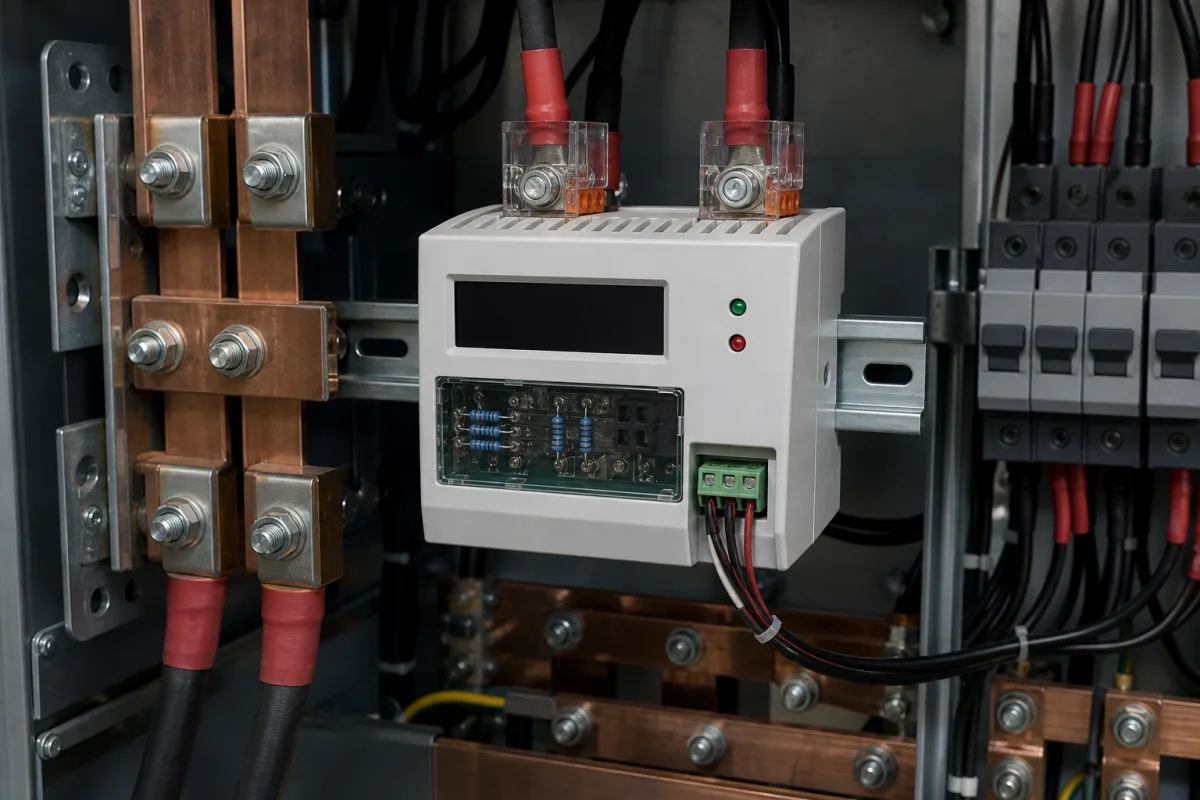
Voltage Monitoring Circuit in a manufacturing environment
Representative product image. Confirm appearance and specifications with the manufacturer.

Product Specifications

Technical details and manufacturing context for Voltage Monitoring Circuit

Definition
The Voltage Monitoring Circuit is a specialized electronic component designed for integration into redundant power supply systems. Its primary function is to continuously measure and report the voltage levels from multiple power sources, ensuring that the system can detect fluctuations, deviations from set thresholds, and potential failures in real time. By providing accurate and timely data to the control system, it enables seamless power switching and enhances overall system reliability.

This circuit operates by sampling voltage levels from each power source using voltage dividers, comparators, and analog-to-digital converters. It compares these readings against predefined reference voltages or thresholds. When voltages fall outside acceptable ranges, the circuit triggers alerts or signals to the power management controller, initiating failover to backup power sources to prevent downtime.

Key parameters include an input voltage range of 9–36 V DC, monitoring accuracy of ±0.5%, response time of ≤10 ms, and an operating temperature range of -40 to 85 °C. It consumes a supply current of ≤5 mA and provides galvanic isolation up to 1500 V DC for safety. The ingress protection rating is IP54–IP65 per IEC 60529, and the output interface is an analog 0–10 V DC signal. The compact dimensions are 50×25×10 mm, with a weight of ≤20 g, making it suitable for PCB mounting in space-constrained industrial applications.

This directory entry provides reference values that must be verified with the legal manufacturer or supplier for the specific model and application. The circuit is intended for use in redundant power systems where precise voltage monitoring is critical. It is not a standalone power supply but a monitoring component that interfaces with control systems. Always confirm model-specific specifications, standards compliance, and suitability for your environment before procurement.
Working Principle
The circuit uses voltage dividers to scale down input voltages from multiple power sources to levels suitable for comparators and analog-to-digital converters. It samples these voltages continuously and compares them against reference thresholds. If a voltage deviates beyond acceptable limits, the circuit generates an alert or signal to the power management controller, which then initiates failover to a backup source. The response time is ≤10 ms, ensuring rapid fault detection. The circuit also provides galvanic isolation up to 1500 V DC to protect downstream electronics.
Common Materials
Semiconductor components (ICs, transistors), Resistors, Capacitors, Printed circuit board (PCB)
Technical Parameters
ParameterTypical rangeNotes & selection driver
Input Voltage Range9–36 V DCWide range for redundant power systems
Voltage Monitoring Accuracy±0.5 %Ensures precise voltage reporting
Response Time≤10 msFast fault detection
Operating Temperature Range-40–85 °CSuitable for industrial environments
Supply Current≤5 mALow power consumption
Isolation Voltage1500 V DCGalvanic isolation for safety
Ingress Protection RatingIP54–IP65Protection against dust and waterIEC 60529
Output Interface0–10 V DCAnalog output for monitoring
Dimensions (L×W×H)50×25×10 mmCompact footprint for PCB mounting
Weight≤20 gLightweight for easy integration

Ranges are indicative industry figures for RFQ preparation, not a supplier commitment. Confirm every value and standard with the legal manufacturer before ordering.

Components / BOM
  • Voltage Divider Network Part
    Scales down high voltage signals to measurable levels for the monitoring IC
    Material: Precision resistors
  • Comparator IC Part
    Compares measured voltage against reference thresholds to detect abnormalities
    Material: Semiconductor integrated circuit
  • ADC (Analog-to-Digital Converter)
    Converts analog voltage readings to digital signals for processing
    Material: Semiconductor integrated circuit
  • Signal Conditioning Circuit
    Filters and prepares voltage signals for accurate measurement
    Material: Capacitors, resistors, operational amplifiers
  • Galvanic Isolation
    Keeps the monitored high-voltage rails electrically separate from the logic side, rated 1500 V DC.

Application & selection

Application Fit & Sizing Matrix

Operational Limits
accuracy: ±0.5% of reading
temperature: -40°C to +85°C
response time: <10ms
voltage range: 0-60V DC
operating humidity: 0-95% RH non-condensing
Media Compatibility
✓ DC power distribution systems ✓ UPS backup systems ✓ Industrial control panels
Unsuitable: High-voltage AC transmission lines (>1kV)
Sizing Data Required
  • Nominal system voltage
  • Required measurement accuracy
  • Communication interface requirements

Risk, maintenance & compliance

Reliability & Engineering Risk Analysis

Failure Mode & Root Cause
Component degradation due to thermal stress
Cause: Excessive heat from poor ventilation, high ambient temperatures, or overcurrent conditions causing capacitor drying, resistor drift, or semiconductor junction failure
Signal drift or loss from contact/connection issues
Cause: Corrosion at terminal connections, vibration-induced loosening of connectors, or oxidation of sensing contacts leading to intermittent or inaccurate voltage readings
Maintenance Indicators
  • Erratic or fluctuating voltage readings on display when input voltage is stable
  • Audible buzzing or humming from the circuit enclosure indicating component arcing or transformer saturation
Engineering Tips
  • Implement regular infrared thermography scans to identify hot spots and ensure adequate cooling airflow around critical components
  • Establish periodic calibration and connection integrity checks using torque wrenches on terminals and contact resistance measurements

Indicative industry ranges for design and RFQ preparation. Confirm the exact figures and applicable standard with the manufacturer before specifying.

Compliance & Manufacturing Standards

Applicable Standards
IEC 61010-1: Safety requirements for electrical equipment for measurement, control, and laboratory use ANSI C12.1: Code for Electricity Metering EN 50160: Voltage characteristics of electricity supplied by public distribution networks

Quoted from the published standard.

Manufacturing Precision
  • Voltage measurement accuracy: +/-0.5% of full scale
  • Temperature stability: +/-0.1% per °C over operating range
Quality Inspection
  • Calibration verification against certified reference standards
  • Insulation resistance test at 500V DC for 1 minute
Technical documentation
Request current drawings, revision history, and a signed specification sheet.
Manufacturing capability
Verify equipment lists, process limits, capacity, and representative production evidence.
Inspection readiness
Confirm test methods, calibrated equipment, sampling plans, and traceable reports.
Supplier transparency
Check the legal entity, factory address, ownership, certifications, and direct contacts.

Compare the published product scope and source details, then include your specifications and quantity in an enquiry.

Manufacturers of Voltage Monitoring Circuit

Manufacturer profiles associated with Voltage Monitoring Circuit.

Sourcing Voltage Monitoring Circuit from China?
Tell us your specification and target quantity — we will match it against manufacturer records and come back with the factories that fit.
Request manufacturers We manufacture this

Explore company information and manufacturing capabilities, then discuss the scope of your project with a relevant supplier.

Buyer enquiry

Request manufacturing insight for Voltage Monitoring Circuit

Ask for use case, specification boundaries, supplier type, and RFQ preparation information for this product.

Where it goes
Straight to the CNFX editorial desk, and to the manufacturer if this product is linked to a claimed profile. Nothing is broadcast to a supplier list.
Your details stay here
We do not sell or rent enquiry data, and we do not add you to a mailing list. Used only to answer this request.
No commission, no middleman
CNFX is a directory. We take no cut of any order and never negotiate on a supplier's behalf.
What to include
Share your product specifications, quantity, destination and target delivery date.

Your business information is used only to process this request.

Thank you! Your message has been sent. We'll respond within 1–3 business days.
Sorry, we couldn't send your message. Please try again, or email us at [email protected].

Frequently Asked Questions

What is the input voltage range of this voltage monitoring circuit?

The input voltage range is 9–36 V DC, suitable for redundant power systems. However, you must verify the exact range for your specific model with the manufacturer.

How does the circuit detect voltage faults?

It samples voltage levels using voltage dividers and comparators, comparing them against reference thresholds. If a voltage falls outside the acceptable range, it triggers an alert or signal to the power management controller within ≤10 ms.

What is the output interface of this circuit?

The output interface is an analog 0–10 V DC signal, which can be connected to a control system for monitoring. Confirm compatibility with your system's input requirements.

Is this circuit suitable for outdoor or harsh environments?

The ingress protection rating is IP54–IP65 per IEC 60529, indicating protection against dust and water. However, suitability depends on the specific model and installation conditions; verify with the manufacturer.

Related equipment

Applied To / Applications

This component is essential for the following industrial systems and equipment:

Data Basis

Editorial classification, named public sources where available, and source-reviewed manufacturer records.

Preliminary Technical Classification
This page supports structured research, RFQ preparation, and supplier evaluation. It does not replace buyer-led supplier qualification, standards review, or technical approval.

Need to Manufacture Voltage Monitoring Circuit?

Compare manufacturer profiles with relevant product and process capability.

Previous Product
Wire Tensioning System
Last Product
Get QuotesChat