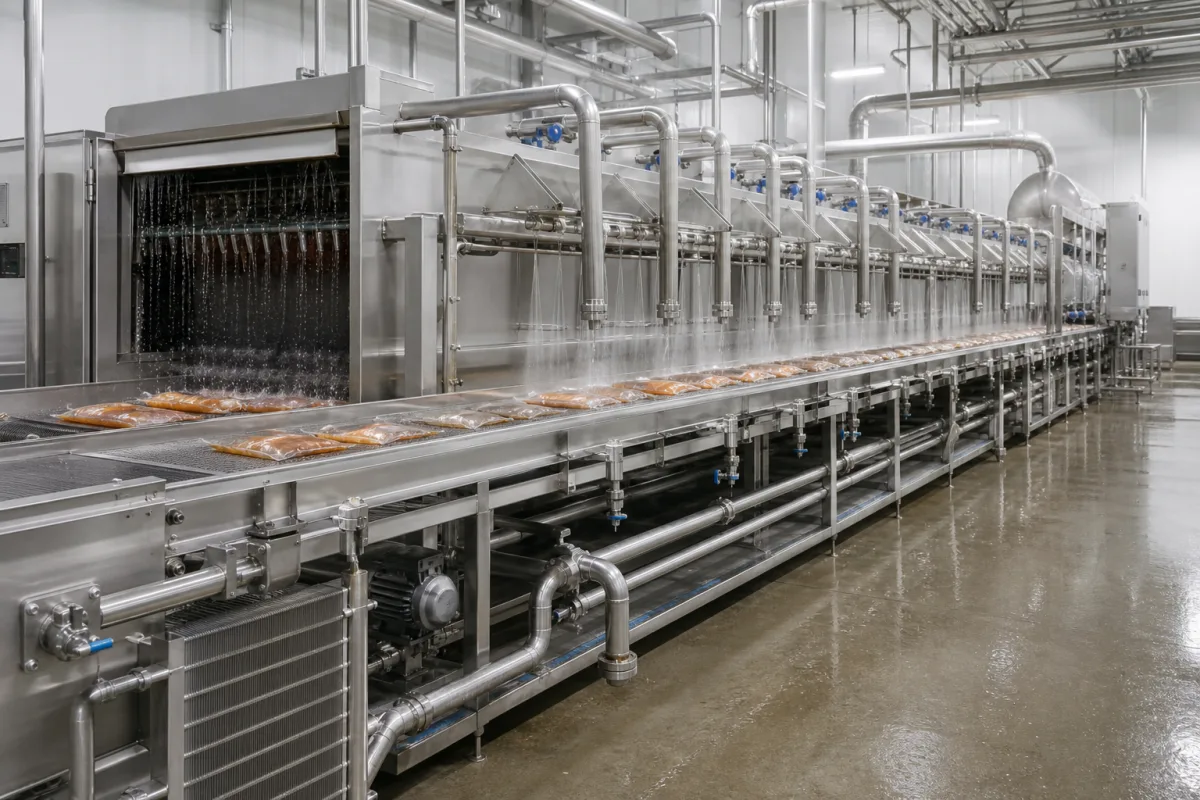
Cooling zone for cooked and packed foods: chilled-water spray section for vacuum-sealed pouches and cook-in bags on a conveyor
The chilled-water section after cooking or in-pack pasteurizing · the FSIS cooling clock for cooked meat in bags, why water beats air at the surface, continuous spray against batch tumble chilling, and sanitizer in recirculated water
Cooked meats, sauces, soups and ready meals that are sealed into vacuum pouches or cook-in bags before heating leave the oven, water cooker or in-pack pasteurizer hot right through. The cooling zone is the section that takes that heat out: a mesh conveyor carries the packs under rows of chilled-water spray headers, or through a chilled-water bath, while the water is collected, re-chilled and sprayed again. It decides how fast the product passes through the temperatures at which spore-forming bacteria grow, so the time the slowest-cooling pack takes to reach each temperature matters more than the water temperature on its own.
Chilled-water cooling sections for sealed food packs — vacuum pouches, cook-in bags and sealed trays of cooked meat, poultry and prepared foods — after cooking or in-pack heat treatment: spray headers over a conveyor, immersion or tumble chilling, water collection, re-chilling and sanitizing. The cooling zones of tunnel pasteurizers for beverages in bottles and cans are covered on the Cooling section of a tunnel pasteurizer page, the hot spray side of food pouch tunnels on the Hot-water spray heating zone for in-pack pasteurizing page, and whole in-pack heat-treatment tunnels on the Automated food sterilization tunnel for sealed trays and pouches of chilled foods page. Heat exchangers as equipment are covered on the Heat exchanger page; vacuum coolers for produce, blast-air chillers and freezers are outside this page.
CNFX editorial research · Sources checked October 12, 2026 · 5 sources
The FSIS cooling clock for cooked meat: 120 to 80 °F in one hour or less
For cooked ready-to-eat meat and poultry in the United States, the cooling zone's job is set by USDA FSIS's stabilization guideline, revised in December 2021. Its purpose is to prevent or limit the growth of spore-forming Clostridial pathogens while the product cools, against a recommended performance standard of no more than 1-log growth of C. perfringens. [1]
The 2021 revision states that cooling in stage 1 of its Option 1.2 should take the product from 120 to 80 °F in one hour or less; establishments that had not been monitoring that step need initial validation data showing the product can do it. [1] FSIS explains the tightening: in verification it found establishments on the older option taking two to four hours between 120 and 80 °F, and pathogen modelling found such processes exceeding the 1-log C. perfringens standard. [1]
Large products get a separate rule. For large-mass non-intact products over 4.5 inches in size or over 8 pounds, where FSIS identifies a scientific gap, establishments may keep the older parameters — cooling from 120 to 55 °F in 6 hours or less with continuous chilling to 40 °F — until further research is complete. [1] FSIS adds that its guidelines describe best practices and are not requirements in themselves. [1]
Editorial calculation: 120 °F ≈ 48.9 °C, 80 °F ≈ 26.7 °C, 55 °F ≈ 12.8 °C and 40 °F ≈ 4.4 °C, so the one-hour step asks for about 22 K of fall at the pack's slowest point.
Editorial note: the time is measured at the slowest-cooling point of the largest pack, not in the spray water. Ask the supplier for core-temperature curves on your heaviest pack at your belt loading, and for the water temperature and flow those curves were run at.
02
Water against air at the pack surface, and where that advantage runs out
CSIRO researchers working on vacuum-packed beef cuts for Meat & Livestock Australia report that the surface heat transfer coefficient in ice/water is about 10 times that in air, but because the thermal conductivity of the meat is fixed, the advantage of immersion over air chilling shrinks for large cuts. [2]
The same work describes the range of water treatments after packing, from a brief 30-second spray or dip in cold water to counter the heating from the shrink tunnel, to immersion for hours in chilled water. Cuts were run through a cold-water spray tunnel for 0, 5, 30 and 60 minutes before cartoning, and topsides were immersed in an agitated ice/water bath for 1, 2 and 3 hours; the test criterion was a centre temperature below 0 °C within 24 hours. [2] For 7.4 kg vacuum-packed cuts, all of the immersion and air regimes tested reached 0 °C or below at the centre within 24 hours, and air chilling for only slightly longer than ice/water was just as effective apart from a slower initial fall of surface temperature. [2]
Editorial note: the result separates two jobs a water cooling zone can do. A short spray takes surface heat out quickly — after a shrink tunnel, or to pull a thin pouch through a temperature band — while for a thick pack the core time is set by conduction through the product, and a longer zone or a following air chiller does the remaining work.
Continuous spray conveyor or batch tumble chiller for cook-chill bags
Not every plant cools packs on a through-conveyor. DC Norris's belt tumble chiller for pumped cook-chill bags is a batch machine: a flighted belt massages the filled bags while circulating them in chilled water, water is also sprayed over the bags, and the belt lifts them out into tote bins at the end. DC Norris states that it cools liquid foods from 85 °C to below 4 °C in 30–60 minutes, with cooling times dependent on product and bag type. [3]
DC Norris says the chilled water is recycled for multiple batches, so no surge tank is needed for emptying and refilling, and that a 500 kg batch unloads in 60 seconds. [4] Its two published sheets differ on sizes and glycol duty: the technical data sheet lists three standard sizes from 500 to 1,500 kg with glycol at 250 L/min at 0–1 °C, while the single-page leaflet lists four sizes from 300 to 1,000 kg and glycol at 350 L/min at 1 °C for the 500-litre machine. [3][4] Both give mains water at 100 L/min at 3 bar and cleaning steam at 100 kg/h at 4 bar for the 500-litre size. [3][4] Confirm the figures for the size being quoted.
Editorial calculation: falling from 85 °C to 4 °C is 81 K; over 30–60 minutes that is an average of about 1.35–2.7 K per minute for the bag contents. That is DC Norris's figure for liquid foods in its own bags, not a rate to expect for solid cooked meat, whose core is limited by conduction as the CSIRO work shows.
04
Sanitizer residual in recirculated cooling water
A cooling zone recirculates the same water over pack after pack, so the water itself has to be kept sanitary. For low-acid foods thermally processed in hermetically sealed containers, FDA's 21 CFR 113.60(b) requires container cooling water to be chlorinated or otherwise sanitized as necessary for cooling canals and recirculated supplies, and says there should be a measurable residual of the sanitizer at the water discharge point of the container cooler. [5]
That rule is written for low-acid canned foods; chilled cooked products in pouches fall under other rules, but the same exposure exists wherever a sealed pack is cooled in recirculated water. Editorial note: for a pouch cooling zone, specify where the sanitizer is dosed, where its residual is measured (the discharge point, in FDA's wording for canned foods), how the collection tank and spray headers are cleaned, and how leaking packs are detected and removed.
05
What a cooling-zone quotation needs from you
Paste it into your enquiry below or into an email to a maker, then replace every bracket.
Packs: [type — vacuum pouch, cook-in bag, sealed tray; heaviest pack mass and thickness; packs per hour]
Temperatures: [pack core temperature at entry; target core temperature and the time allowed; regulatory cooling option followed]
Cooling medium: [spray, immersion or tumble; water temperature; flow; glycol or chilled-water supply available]
Conveyor: [belt width and type; dwell time; loading pattern]
Water hygiene: [sanitizer type; dosing and residual measurement point; tank and header cleaning]
Evidence: [core-temperature curves on our heaviest pack]
Explore company information and manufacturing capabilities, then discuss the scope of your project with a relevant supplier.
Share this page
Compiled and source-reviewed by the CNFX editorial team.
Each manufacturer above links to the page on that company's own website where the product is listed, with the date we checked it. How we source and review
· Page last updated 13 October 2026
Buyer questions
How fast must cooked meat be cooled under the FSIS guideline?
The 2021 revision sets 120 to 80 °F in one hour or less for stage 1 of Option 1.2; large non-intact products over 4.5 inches or 8 pounds may use 120 to 55 °F in 6 hours with continuous chilling to 40 °F. [1]
Why cool packs in water rather than air?
CSIRO reports a surface heat transfer coefficient in ice/water about 10 times that in air, though for large cuts conduction inside the meat limits the gain. [2]
How quickly can cook-chill bags be chilled?
DC Norris states 85 °C to below 4 °C in 30–60 minutes for liquid foods in its belt tumble chiller, depending on product and bag type. [3]
Does recirculated cooling water need a sanitizer?
For low-acid canned foods, 21 CFR 113.60(b) requires chlorinated or otherwise sanitized recirculated cooling water with a measurable residual at the cooler's discharge point. [5]
Sources and what still needs a direct check
Sources checked 2026-10-12. Cooling times and the C. perfringens standard come from USDA FSIS's Federal Register notice on its 2021 revised stabilization guideline; water against air from CSIRO's paper for Meat & Livestock Australia on chilling vacuum-packed cuts; batch tumble chilling figures from DC Norris's two Belt Tumble Chiller sheets; cooling-water sanitizing from FDA's 21 CFR 113.60.