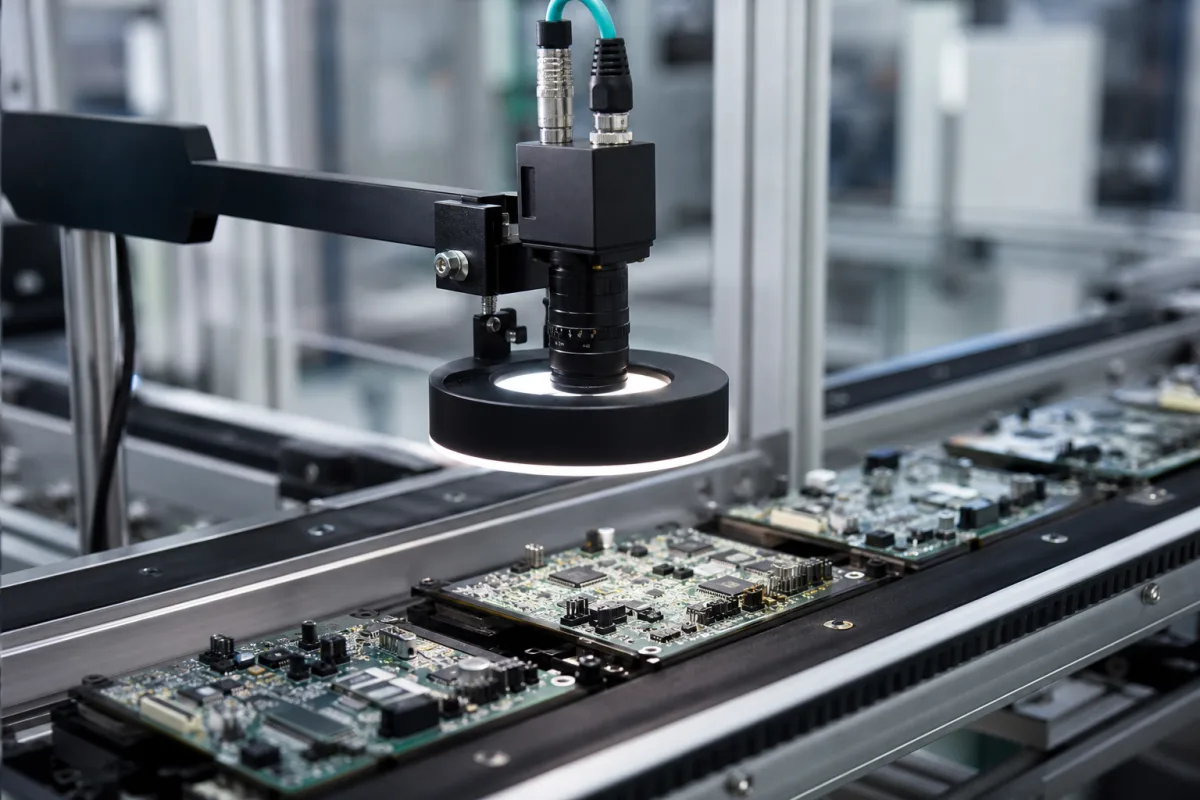
Vision camera module for inline inspection: compact GigE Vision area-scan camera with C-mount lens
GigE Vision area-scan cameras for inline inspection · Sensor and pixel size, frame rate against link bandwidth, PoE and M12 connectors, IP67 housings and EMVA 1288 sensor data
This page covers compact area-scan cameras used on production lines for inspection, measurement and guidance: a sensor head with a C-mount lens, a GigE Vision interface over Ethernet with power over Ethernet, and trigger I/O, in a housing that can be sealed. Ask three things first: which sensor, pixel size and frame rate fit your field of view and line speed, whether the link bandwidth carries that frame rate, and which EMVA 1288 sensor figures the supplier publishes.
Compact area-scan machine-vision cameras with GigE Vision interfaces and C-mount lenses for inline inspection, measurement and guidance. Embedded and OEM camera modules with USB, MIPI CSI-2, GMSL or DVP output are covered on the Camera module page. Line-scan cameras, smart cameras with on-board inspection software and night-vision modules are outside this page.
CNFX editorial research · Sources checked October 12, 2026 · 3 sources
LUCID's Triton 5.0 MP camera lists a Sony IMX264 global-shutter CMOS sensor of 11.1 mm (Type 2/3″), 2448 × 2048 px with 3.45 µm pixels, 22 fps at 5.0 MP, or 24 fps with no link throughput reserve, and states that it recommends a 10% device-link throughput reserve for stream reliability. It uses a 1000BASE-T GigE M12 (8-pin X-coded) connector with PoE (IEEE 802.3af) or 12–24 VDC external power, consumption of 3.1 W (typ.) via PoE and 2.5 W externally, an 8-pin M8 GPIO connector, a 128 MB image buffer, a 12-bit ADC, and GigE Vision v2.0 compliance. [1]
Editorial calculation: 2448 × 2048 = 5,013,504 pixels per frame; at 22 fps and 8 bits per pixel that is about 882 Mbit/s, close to the 1 Gbit/s link, and at 24 fps about 963 Mbit/s, which is why the stated rate depends on the reserve. The active area is 2448 × 3.45 µm ≈ 8.45 mm by 2048 × 3.45 µm ≈ 7.07 mm, a diagonal of about 11.0 mm against the 11.1 mm LUCID states. [1]
The same data list a C-mount lens mount, 29 × 29 × 45 mm size, 67 g, IP67 when used with an IP67 lens tube and cables, operating temperature of −20 to 55 °C ambient, storage at −30 to 60 °C, 20–80% non-condensing humidity, shock and vibration tests to DIN EN 60068-2-27, -2-64 and -2-6, EMC immunity to DIN EN 61000-6-2, 8 kV ESD, and synchronisation by software trigger, hardware trigger or PTP (IEEE 1588). [1] LUCID describes the Triton family as GigE Vision and GenICam compliant PoE cameras in a die-cast aluminium 29 × 29 mm case with M12 GigE and M8 GPIO connectors. [2]
Give the supplier the field of view, smallest defect or feature to resolve, part speed and parts per minute, working distance, lighting, colour or mono, trigger source, cable length and the ingress protection needed at the station.
02
Compare cameras on EMVA 1288 sensor data
The European Machine Vision Association describes EMVA 1288 as the standard for measurement and presentation of specifications for machine vision sensors and cameras, defining a unified method to measure, compute and present them; release 4.0 became effective in June 2021, replacing release 3.1 of December 2016, which had limited the standard's linear model to cameras with a linear response and no pre-processing, and companies that self-certify compliance may use the "EMVA standard 1288 compliant" logo. [3]
LUCID publishes EMVA 1288 results for the Triton 5 MP: for the mono model, 71.61 dB dynamic range, 40.23 dB maximum SNR, 10,540 e⁻ saturation capacity, an absolute sensitivity threshold of 3.99 photons at 527.5 nm, 2.13 e⁻ temporal dark noise, 3.15 e⁻/s dark current, 0.63 e⁻ DSNU, 0.64% PRNU and linearity error of +0.25/−0.46%; for the colour model, 71.64 dB, 40.24 dB, 10,587 e⁻ and 4.43 photons. [1]
Editorial note: compare EMVA 1288 tables from different suppliers only for the same sensor mode and release of the standard, and ask which release the measurements follow. [3]
03
LUCID Triton 5 MP sensor, frame rate, interface and protection
Published data below are for one camera; ask other suppliers for the same items.
Explore company information and manufacturing capabilities, then discuss the scope of your project with a relevant supplier.
Share this page
Compiled and source-reviewed by the CNFX editorial team.
Each manufacturer above links to the page on that company's own website where the product is listed, with the date we checked it. How we source and review
· Page last updated 13 October 2026
Buyer questions
Can GigE carry 5 MP at 22 fps?
LUCID lists 22 fps at 5.0 MP with a 10% link reserve and 24 fps with none; at 8 bits per pixel 22 fps is about 882 Mbit/s of a 1 Gbit/s link (editorial calculation). [1]
What is EMVA 1288?
The EMVA's standard for measuring and presenting machine vision sensor and camera specifications; release 4.0 has been in effect since June 2021. [3]
Can a GigE camera be IP67?
LUCID's Triton is IP67 when used with an IP67 lens tube and cables, with M12 GigE and M8 I/O connectors. [1]
Sources and what still needs a direct check
Sources checked 2026-10-12. LUCID publishes its own camera data and EMVA 1288 results; the EMVA describes its own standard.