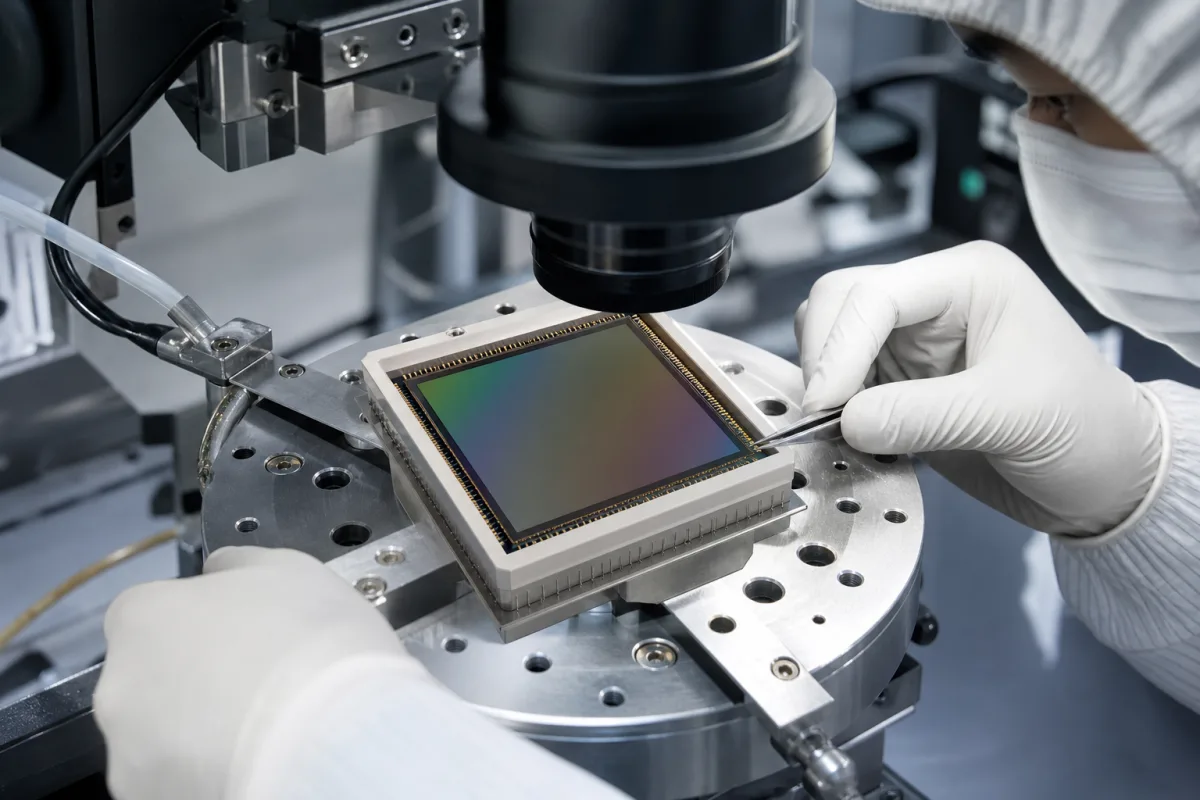
CMOS image sensors · Global or rolling shutter, resolution and optical format, pixel size, frame rate, output interface, colour or mono, illumination structure
An image sensor converts light focused by a lens into an array of electrical signals and then into digital image data for a camera or vision system. Settle three things before choosing one: global or rolling shutter for how your subject moves, the resolution, optical format and pixel size your lens and field of view need, and the frame rate and output interface the camera electronics can take.
CMOS image sensors for industrial, machine-vision, scientific and embedded cameras, area-scan, as bare die or packaged chips. Complete camera modules, industrial cameras, line-scan cameras and non-imaging photodetectors are outside this page; camera modules, industrial cameras and line-scan cameras have their own pages.
CNFX editorial research · Sources checked October 12, 2026 · 5 sources
Pick global or rolling shutter, resolution and optical format
Sony describes its Pregius and Pregius S global-shutter CMOS sensors as capturing fast-moving objects without distortion, with a column A/D conversion circuit for fast, low-noise processing, for machine-vision inspection, traffic monitoring and infrastructure inspection. Pregius S uses a back-illuminated pixel structure that cuts pixel size to 2.74 µm square — about 63% of earlier front-illuminated models — and fits about 24.45 million effective pixels into a C-mount 1.2-type sensor. Sony's IMX927 series lists 105 megapixels at 100 fps. [1]
Sony describes its rolling-shutter industrial sensors as low noise, with noise removal before and after A/D conversion, and high sensitivity from a back-illuminated structure. The range runs from a 1-type 9-megapixel IMX533 to a 4.2-type 151-megapixel IMX411, which Sony says covers about 17 times the area at the same pixel size. [2]
Sony notes that a larger sensor means a bigger camera but fewer captures and higher recognition accuracy for wide-area imaging. [2][1]
Give the supplier the shutter type, resolution, optical format and lens mount, pixel size, colour or mono (and any special filter such as polarisation or near-infrared), frame rate at full resolution and with region of interest, bit depth, output interface and lane count, supply voltages, package, operating temperature and quantity.
02
Check pixel size, frame rate and output interface
Sony's industrial sensor lineup filters by pixel size (from 2.74 to 9.0 µm), maximum frame rate (from under 30 to 240 fps and above) and output interface: SLVS, SLVS-EC, sub-LVDS, MIPI CSI-2 and CMOS parallel. For Pregius S, Sony's SLVS-EC interface with an embedded clock reads high-resolution data at high speed, alongside a 5 Gbps-compatible product range for USB 3.0 and 5GigE cameras. [1][2]
Editorial calculation: 105 million pixels at 100 fps is 1.05 × 10¹⁰ pixels per second, about 10,500 MB/s at 8 bits per pixel, so the camera interface and any frame grabber behind it must carry that rate or the camera must use a region of interest or lower frame rate. [1]
03
Ask for EMVA 1288 data: quantum efficiency, noise, saturation and dynamic range
EMVA Standard 1288, Release 4.0 Linear (16 June 2021), defines a unified method to measure, compute and present characterisation data for machine-vision image sensors and cameras. A data sheet is EMVA 1288 compliant only if it reports all mandatory measurements and the standard summary data sheet, and the publisher may choose to give "typical data, data of an individual component, guaranteed data, or even guaranteed performance over life time of the component", provided the nature of the data is clearly indicated; data from other procedures must be marked as outside the standard. Release 4.0 is offered free of charge under a CC 4.0 BY-ND licence. [3]
The standard expresses the signal-to-noise ratio through the quantum efficiency η and the dark noise σd in electrons: at high exposure SNR approaches √(ημp) and at low exposure it rises linearly. The absolute sensitivity threshold is the photon count giving SNR = 1, the saturation capacity μe.sat = η μp.sat is lower than the full-well capacity because the signal clips at the maximum digital value, and dynamic range is the ratio of saturation to the absolute sensitivity threshold. Dark current is given in e⁻/(pixel·s), and spatial non-uniformities are reported as DSNU (dark) and PRNU (photo response). [3]
Editorial calculation: with assumed σd = 30 e⁻ and negligible quantisation noise, the threshold in electrons is about √(900 + 0.25) + 0.5 ≈ 30.5 e⁻, or about 61 photons at η = 0.5; with an assumed saturation capacity of 10,000 e⁻, DR ≈ 10,000 / 30.5 ≈ 328, about 50 dB, and SNR at saturation is about √10,000 = 100. Compare sensors on these measured values at the same gain and wavelength, not on pixel size alone. [3]
Ask for the EMVA 1288 summary data sheet at your gain and wavelength: quantum efficiency, temporal dark noise, saturation capacity, absolute sensitivity threshold, dynamic range, dark current, DSNU and PRNU, and which of the data types named in the standard the values are.
04
Work out optical format and data rate from a sensor's pixel count and pitch
Two ams (now ams OSRAM) releases give full figures for global-shutter machine-vision sensors. The CMOSIS CMV50000, launched on 7 November 2016, has 7,920 × 6,002 pixels of 4.6 µm in an 8-transistor pixel architecture, 64 dB optical dynamic range at full resolution and up to 68 dB in subsampled 4k mode, 30 frames/s at 12-bit depth at full resolution or in binned 4k mode, up to 60 frames/s with subsampling to 4k, and an HDR mode using odd/even row dual exposure; ams positioned it to replace high-pixel-count CCD sensors. The CSG14k, introduced on 6 November 2018 for the 1-inch optical format, has a 3,840 × 3,584 array of 3.2 µm pixels (66% smaller than the previous 10-bit generation), 12-bit output, global shutter with true correlated double sampling, a sub-LVDS interface compatible with the CMV family, low-power and low-noise configuration modes, and a 218-pin LGA package of 22 × 20 × 3 mm. [4][5]
Editorial calculation: 7,920 × 4.6 µm by 6,002 × 4.6 µm is an active area of about 36.4 × 27.6 mm, so the CMV50000 needs medium-format optics; at 30 frames/s and 12 bits its raw data rate is about 17 Gbit/s. The CSG14k's 3,840 × 3.2 µm by 3,584 × 3.2 µm is about 12.3 × 11.5 mm, a diagonal of about 16.8 mm, matching its 1-inch lens class. A 64 dB dynamic range is a ratio of about 1,600 to 1; compare it with the EMVA 1288 figures each supplier should provide. [4][5][3]
Gpixel lists its GMAX global-shutter CMOS sensors and SmartSens lists global-shutter and line-scan sensors; ask each for its EMVA 1288 summary data sheet.
Ask each supplier for the datasheet with resolution, optical format, pixel size, frame rate by readout mode, quantum efficiency, full-well capacity, dark noise, output interface and package. [1][2]
06
Pixel array, illumination structure, shutter, ADC, interface and test data
The first five rows follow Sony's sensor pages; the last row is what EMVA 1288 asks the maker to publish.
2 companies list this product among what they make. Company figures are quoted from each
company's own website; every card states where the relationship came from.
Gpixel Changchun Optotech Inc.
Manufacturing site to be confirmed for the order
Its website lists the GMAX series of global-shutter CMOS image sensors.
Explore company information and manufacturing capabilities, then discuss the scope of your project with a relevant supplier.
Share this page
Compiled and source-reviewed by the CNFX editorial team.
Each manufacturer above links to the page on that company's own website where the product is listed, with the date we checked it. How we source and review
· Page last updated 13 October 2026
Buyer questions
What is the difference between global and rolling shutter sensors?
Sony describes global-shutter sensors as capturing fast-moving objects without distortion, and its rolling-shutter sensors as low noise and high sensitivity with large formats. [1][2]
Sony's rolling-shutter range includes a 4.2-type 151-megapixel IMX411. [2]
What is EMVA 1288?
A free standard that sets how image sensors and cameras are measured and how quantum efficiency, dark noise, saturation capacity, dynamic range, DSNU and PRNU are reported. [3]
Is saturation capacity the same as full-well capacity?
No; EMVA 1288 notes that saturation capacity is lower because the signal clips at the maximum digital value before the pixel saturates. [3]
How do you work out an image sensor's optical format from its specification?
Multiply pixel count by pixel pitch on each axis: 3,840 × 3,584 pixels of 3.2 µm gives about 12.3 × 11.5 mm, a 16.8 mm diagonal, which the maker matches to 1-inch lenses. [5]
Sources and what still needs a direct check
Sources checked 2026-10-12. Sony Semiconductor Solutions' global-shutter and rolling-shutter industrial image sensor pages are used to show what an image sensor specification covers; values for your order must come from the supplier's datasheet.