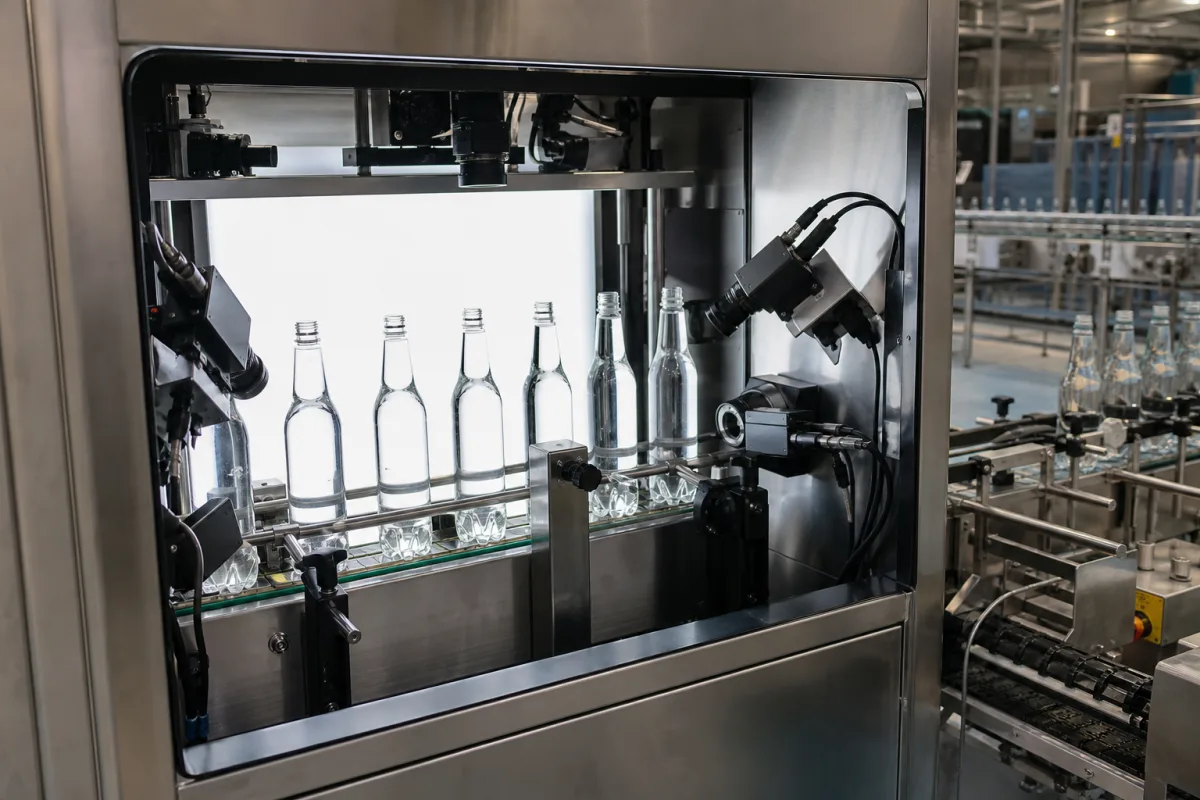
Inspect the empty container before it reaches the filler
Before filling a beverage bottle, the inspection station must examine the container regions and residues relevant to that bottle. Base, outer base edge, sidewall, finish and residual liquid need a defined set of views or sensing modules. Establish that coverage for each bottle type and verify the rejected bottle leaves the line.
In-line empty-bottle inspection before beverage filling, including optical checks for container damage and foreign material and the specified residual-liquid detection modules. Filled-container level, cap and label checking is covered on 9075, and net-content reject limits on 156. A bottle washing machine and a stand-alone reject arm are separate supplies.
CNFX editorial research · Sources checked October 18, 2026 · 3 sources
Map the defect locations onto the inspection views
Miho’s David 2 is configured for inspection after the washer and before the filler, with glass or PET, returnable or non-returnable bottles. Its standard sidewall arrangement uses two cameras; the dual arrangement uses four and is described for relief structures, embossing, swing-top bottles and permanent ACL markings. Select the configuration using representative bottle features. [1]
Miho describes a base-inspection filter package for optically active foils with a glass-bottle scope and limits for PET. Give the supplier the actual container material and the target foreign material, rather than assigning one optical result to both bottle materials. [1]
The separate miho CBD outer-base inspection uses ring lighting viewed from underneath to cover the edge beyond the standard transmitted-light base view. Ask the supplier to mark the transition from the base view to the outer base edge and the sidewall view on the proposed bottle. [2]
02
Separate optical views from residual-liquid sensing
HEUFT’s InLine II IR description assigns high-frequency detection to residual lye and infrared detection to oil and varnish. It separately describes optical base, finish and sidewall inspection. Specify the residue and its detection method with the supplier. [3]
Ask which residues, container colours and bottle-base features are included in the offered test. Record the defect location, residue condition and acceptance evidence for each module. A camera view of the base and a residual-liquid sensing module have different detection tasks. [3]
Miho’s foil-detection limitation and HEUFT’s separate residue methods make a single category-wide “detection accuracy” percentage inadequate for selection. Agree results by named defect or residue and bottle condition, with the proposed machine configuration identified. [1][3]
03
Check coverage at the required spacing and confirm removal
HEUFT describes purposeful bottle rotation between stations and additional sidewall modules for higher outputs. Its description ties complete views to the presentation and gap between containers. Supply the required line speed and spacing with the bottle range. [3]
HEUFT also describes product tracking, reject verification and test programs for examining detection performance. Agree test bottles for the base, heel, finish, sidewall and each residue check, and record both the inspection decision and the physical reject outcome. Run conforming bottles with the expected scuffing, embossing and other permitted variation to measure false rejects separately. [3]
For changeover, retain the bottle recipe, optical settings and agreed test-container checks. Miho saves its focus adjustment by bottle type, illustrating why an accepted setting belongs with the specific bottle rather than only with the machine name. [1]
04
Send a bottle and defect coverage schedule
Paste it into your enquiry below or into an email to a maker, then replace every bracket.
Bottles: [material; returnable/non-returnable; colour; dimensions; base shape; embossing/ACL; finish]
Position: [after washer/rinser; before filler; conveyor height; required line speed and spacing]
Defects: [base; outer base/heel; sidewall; sealing surface; thread; named foreign material]
Residues: [lye; oil/varnish or other specified liquid; condition; required sensing evidence]
Configuration: [views and bottle rotation; optics/illumination; residue modules; recipes; supplied handling]
Rejection: [tracking; reject type; confirmation; rejected-bottle destination; line response]
Acceptance: [defined faulty/conforming test bottles; counts and results per check; false rejects; changeover verification]
Utilities: [issued electrical and pneumatic requirements; enclosure/cleaning limits; dimensions and access]
Explore company information and manufacturing capabilities, then discuss the scope of your project with a relevant supplier.
Share this page
Compiled and source-reviewed by the CNFX editorial team.
Each manufacturer above links to the page on that company's own website where the product is listed, with the date we checked it. How we source and review
· Page last updated 18 October 2026
Buyer questions
Does a base camera cover the outer bottle-base edge?
Miho describes CBD as an additional view of the outer base beyond the standard transmitted-light base inspection. Confirm the coverage transition on the actual bottle. [2]
Is residual lye detection the same as optical contamination inspection?
HEUFT describes high-frequency lye detection separately from its optical inspections and infrared residue method. Specify the residue and the offered detection module. [3]
Sources and evidence scope
Sources checked 2026-10-18. Miho documents its configurable empty-bottle inspector and a separate outer-base inspection option. HEUFT explains optical and residue modules, presentation and reject verification. These are named manufacturer implementations; the required bottle and defect schedule determines the proposed acceptance test.