X-ray tubes and tube assemblies · Focal spots and anode power, anode and housing heat storage, continuous power, leakage radiation limit
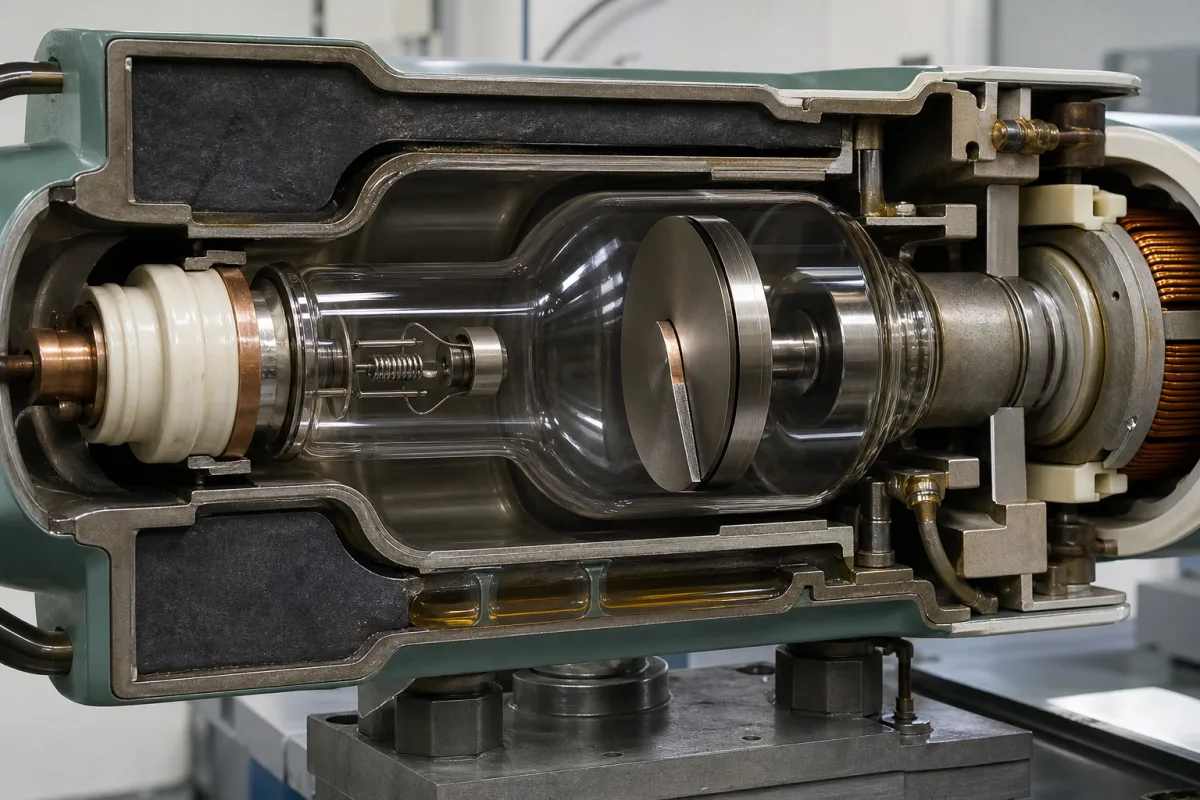
An X-ray tube produces X-rays by accelerating electrons from a heated filament onto a metal target; in radiography and fluoroscopy tubes the target is a rotating anode inside a vacuum envelope (insert), mounted in an oil-filled, shielded housing like the cut-away assembly pictured. Ask three things first: which focal spot sizes it offers and what power each can take, how much heat the anode and the complete housing assembly can store and dissipate for your workload, and what leakage radiation and filtration the assembly meets.
Rotating-anode X-ray tubes (inserts) and X-ray tube housing assemblies for radiography and fluoroscopy, and X-ray tubes for industrial inspection. X-ray generators, collimators, complete X-ray systems, detectors and anode targets supplied as materials are outside this page.
CNFX editorial research · Sources checked October 12, 2026 · 5 sources
Varex's A-134 is a 71 mm, 150 kV rotating anode insert for heavy-duty general radiography and fluoroscopy, with a 12° rhenium-tungsten-molybdenum target and nominal focal spots of 0.6 and 1.2 (IEC 60336). Its nominal anode input power is 32 kW on the small focal spot and 76 kW on the large one (IEC 60613), and its rating charts note that exposure power equals kV × mA, for example 70 kV × 300 mA = 21 kW. [1]
Siemens Healthineers' SV 150/40/80C-100 tube assembly, for radiography and fluoroscopy, has a 150 kV nominal voltage (110 kV for fluoroscopy), 0.6 and 1.0 focal spots, a 12° anode, nominal anode input power of 40 and 80 kW at 150/180 Hz rotation (IEC 60613:1989) and 47 and 85 kW radiographic (IEC 60613:2010), with filament currents up to 5.1 A. [2]
Editorial note: smaller focal spots give sharper images but take less power, so check the single-load and serial-load rating charts for the exposure times and kV-mA combinations you will use, not only the nominal kW.
Give the supplier the application (radiography, fluoroscopy, angiography, industrial inspection), generator type and frequency, maximum kV, focal spots needed, typical and peak exposure techniques and workload per hour, the housing and cooling arrangement, mounting to the collimator and system, and the regulatory requirements in your market.
02
Check anode and housing heat storage and cooling
Varex rates the A-134 anode at 222 kJ (300 kHU) maximum heat content. Siemens Healthineers rates the SV 150/40/80C-100 anode at 450 kJ (600 kHU) and the complete tube assembly at 1.800 MJ (2.530 MHU), with a nominal continuous input power of 300 W without a fan and 450 W with one at 20–25 °C ambient, and publishes heating and cooling curves for anode and assembly. [1][2]
Editorial calculation: both datasheets put 1 kHU at about 0.74–0.75 kJ (222 ÷ 300 and 450 ÷ 600). A 21 kW exposure lasting 0.1 s puts about 2.1 kJ into the anode, about 1% of the A-134's 222 kJ; fifty such exposures in quick succession add about 105 kJ, almost half its capacity before cooling, which is why serial-load and cooling curves matter for busy rooms. [1][2]
At 450 W continuous with a fan, the Siemens assembly would take about 1,800,000 ÷ 450 ≈ 4,000 s (just over an hour) to shed its full rated assembly heat if no further load were applied; the published cooling curves give the actual behaviour. [2]
03
Check which IEC editions the focal spot and power ratings follow
The Varex and Siemens Healthineers data sheets on this page quote focal spots per IEC 60336 and nominal anode input power per IEC 60613 [1][2]. IEC 60613:2010 "applies to X-ray tube assemblies either with a rotating anode X-ray tube or a stationary anode X-ray tube, intended for use in medical diagnosis" and covers definitions and conditions of electrical and loading characteristics during and after energization; its third edition was published on 27 January 2010. IEC 60336:2020 applies to focal spots in medical diagnostic X-ray tube assemblies at tube voltages up to and including 150 kV, with nominal focal spot values from 0,1 to 3,0; its fifth edition, published on 17 December 2020, introduced digital detectors and replaced the 2005 edition. [4][5]
Both data sheets on this page sit at the 150 kV top of IEC 60336's scope, with nominal focal spots of 0.6 and 1.2 (Varex) or 0.6 and 1.0 (Siemens Healthineers) [1][2]. Because the 2020 edition changed the measurement to digital detectors [5], ask a supplier which edition its focal spot values were measured to, and for the measurement report if you are qualifying a replacement tube.
Nominal anode input power, such as Varex's 32 kW and 76 kW, is defined under IEC 60613 [1][4]. When comparing tubes, ask for the power at the same exposure time and anode speed from each maker's rating charts, since Varex notes that exposure power is kV × mA and reads limits off the charts [1].
Editorial calculation: the 0.6 to 1.2 focal spot pair on the Varex insert sits within IEC 60336's 0,1 to 3,0 range; the large spot's 76 kW is about 2.4 times the small spot's 32 kW. [1][5]
Item
IEC 60613:2010
IEC 60336:2020
Subject
Electrical and loading characteristics of X-ray tube assemblies
Focal spot dimensions and related characteristics
Scope limit
Rotating or stationary anode tubes for medical diagnosis
Up to and including 150 kV; nominal focal spot values 0,1 to 3,0
Edition and date
Edition 3, 27 January 2010 (replaced 1989 edition)
Edition 5, 17 December 2020 (replaced 2005 edition)
Changes noted
Adapted to present technology
Digital detectors and discretization errors; fewer normative requirements
Values are from the Standard Norge catalogue pages for IEC 60613:2010 and IEC 60336:2020; the full standards were not reviewed.
04
Check leakage radiation and filtration
US rule 21 CFR 1020.30(k) limits leakage radiation from the diagnostic source assembly, measured 1 m from the source in any direction and averaged over 100 cm², to 0.88 mGy air kerma (100 mR) in one hour at the leakage technique factors. [3]
Siemens Healthineers states leakage radiation of its SV 150/40/80C-100 assembly as no more than 0.8 mGy/h at 150 kV, 450 W and 1 m (IEC 60601-1-3), with 1.5 mm Al permanent inherent filtration plus 1 mm Al removable filtration at 75 kV, and an assembly weight of about 26 kg. [2] Editorial note: ask for the leakage test conditions and certificate of the exact assembly and housing combination you will install.
05
Compare what suppliers offer
Suppliers linked to this page list X-ray tubes; each card links to the page reviewed.
Listings include metal-ceramic, glass-envelope and panoramic X-ray tubes for industrial non-destructive testing and security inspection, and X-ray tubes among X-ray machine accessories. Ask each supplier for the tube type (rotating or stationary anode), focal spots, rating and cooling curves, housing heat capacity, leakage test data and the clearances held for medical use.
06
Trace the tube assembly parts
This is a functional reference built from the sources cited; it is not one maker's specification.
Fill the specification fields with values for your system
An X-ray tube quotation needs values for your system and workload. The table explains each field, gives published values where a reviewed source states them, and says what to obtain from the supplier.
Explore company information and manufacturing capabilities, then discuss the scope of your project with a relevant supplier.
Share this page
Compiled and source-reviewed by the CNFX editorial team.
Published product pages show what a company offers, not tested performance. Confirm the legal seller, factory, regulatory clearances and scope for your order. How we source and review
· Page last updated 13 October 2026
Buyer questions
What is anode heat capacity in kHU?
It is the heat the anode can store; Varex rates its A-134 at 222 kJ (300 kHU) and Siemens its SV 150/40/80C-100 anode at 450 kJ (600 kHU). [1][2]
How much leakage radiation is allowed from an X-ray tube housing?
US rule 21 CFR 1020.30(k) allows no more than 0.88 mGy air kerma in one hour at 1 m. [3]
How is exposure power calculated?
Varex notes exposure kW equals kV × mA, for example 70 kV × 300 mA = 21 kW. [1]
Which standards define X-ray tube focal spot and anode power ratings?
IEC 60336 (current edition 2020) covers focal spot measurement for diagnostic tubes up to 150 kV with nominal values from 0.1 to 3.0, and IEC 60613 (edition 2010) covers the electrical and loading characteristics, including nominal anode input power. [5][4]
Sources and what still needs a direct check
Sources checked 2026-10-12. Varex Imaging and Siemens Healthineers are X-ray tube makers; their datasheets give values for their own products. 21 CFR 1020.30 is a US performance standard for diagnostic X-ray systems.