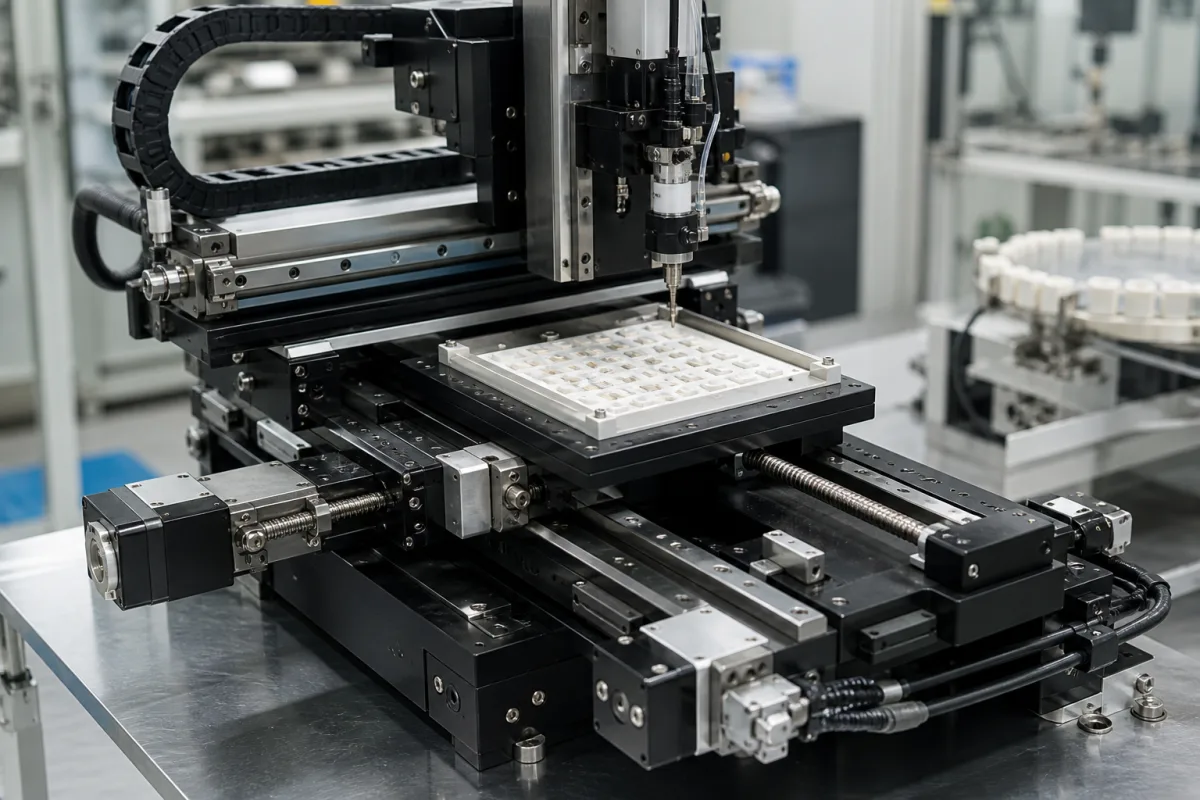
Multi-axis motion stages · accuracy versus repeatability, unidirectional versus bidirectional figures, ISO 230-2 test points, screw lead, speed and resolution
An XYZ positioning stage stacks linear axes, such as ball-screw or linear-motor driven slides on linear guides with servo or stepper motors, to move a tool or workpiece to programmed points in three directions, for dispensing, placement, inspection and assembly. Ask three things first: how the maker measured accuracy and repeatability (where, how many points, which direction), what speed and resolution the drive gives with your load, and how mounting and heat will change the result in your machine.
Multi-axis XY tables and XYZ stages built from ball-screw, belt or linear-motor modules with motors and controllers for automation, dispensing, placement and inspection. Single-axis linear guides and ball screws as components, piezo nanopositioners and full gantry robots for heavy loads are outside this page except where compared.
CNFX editorial research · Sources checked October 12, 2026 · 4 sources
Novanta defines accuracy as the difference between the position commanded by the controller and the load position measured by an independent instrument such as a laser interferometer, and notes that accuracy varies along the travel because of machining, mounting and encoder errors. Averaging scattered measurements, as with RMS or 3-sigma methods, can make a datasheet figure look better than the stage performs; Novanta follows ISO 230-2:2006, which requires 20 target points plus the home position over the full travel. [1]
Repeatability is the ability to return to a commanded position. Novanta says unidirectional repeatability figures are better than bidirectional ones, that buyers should ask which is quoted, and that “typical” values may come from controlled tests rather than ordinary installation. [1] Dover Motion likewise notes that bidirectional variance is higher and that quoting unidirectional repeatability alone can mask large backlash; it measures with a laser interferometer over repeated approaches from both directions. [2]
Editorial note: for a stacked XYZ stage, ask for accuracy and bidirectional repeatability of each axis and, if the process depends on it, of the combined tool point, measured on stages taken from stock and mounted as you will mount them.
Give the supplier the travel on each axis, load and its centre of gravity, required accuracy and bidirectional repeatability, speed and acceleration, cycle (points per minute), mounting surface and orientation, environment (temperature, dust), controller interface, cable management and safety requirements.
02
Size speed and resolution from the drive
Dover Motion explains that leadscrew-driven stages generate frictional heating, causing thermal expansion and positional drift that depends on speed and duty cycle, and that where very high repeatability is needed a linear motor with a linear encoder in closed loop removes leadscrew effects, limited then by encoder resolution and thermal effects. From laser interferometer testing it reports its anti-backlash leadscrew stages at below 0.5 µm unidirectional and below 1 µm bidirectional repeatability (typ.). [2]
Editorial calculation: a ball screw with 10 mm lead turned at 3,000 rpm moves the carriage 10 × 3,000 / 60 = 500 mm/s; with a motor encoder of 10,000 counts per revolution, one count is 10 mm / 10,000 = 1 µm of travel, before screw lead error, backlash and thermal growth. Halving the lead to 5 mm doubles resolution and thrust per torque but halves top speed. Lead, speed and encoder counts are assumed examples; use the stage maker's figures and your load.
03
Read a full stage specification line by line
ALIO Industries' specification for its AI-XBS-10000-UII 100 mm ball-screw linear stage shows the set of figures a buyer can ask any supplier for. It is driven by a frameless torque motor and precision ball screw with an anti-backlash nut, with a non-contact optical linear encoder and dual recirculating ball rail bearings. Footnotes on the sheet tie performance values to stated conditions. [3]
The sheet lists accuracy, repeatability, straightness, flatness and angular errors separately, and gives the bidirectional (not only unidirectional) repeatability, which is what the measurement guidance above asks buyers to check. [3][1][2]
Editorial calculation: ±12 arc-sec of pitch over a 100 mm offset from the stage (Abbe arm) is 100 mm × 12 / 206,265 ≈ 5.8 µm of potential error at the tool point, larger than the ±2 µm accuracy of the upgraded grade.
Specification (ALIO AI-XBS-10000-UII)
Standard
Ultra
Travel
100 mm (±50 mm)
100 mm
Linear displacement accuracy
±5 µm
±2 µm
Bidirectional repeatability
±1.0 µm
±1.0 µm
Backlash
0 nm
0 nm
Resolution
About 4.88 nm after 4096 interpolation (1–5000 nm digital optional)
Same
Straightness in Y / flatness
±3 µm / ±3 µm
±2 µm / ±2 µm
Pitch, yaw, roll
±12 arc-sec each
±12 arc-sec each
Maximum velocity / peak acceleration
0.3 m/s / 0.5 g
Same
Payload horizontal / vertical
150 kg / 80 kg
Same
Operating temperature / humidity
0–50 °C / 10–80% non-condensing
Same
Ask each supplier for the same lines: travel, accuracy and repeatability (bidirectional, with test method), backlash, resolution, straightness, flatness, pitch/yaw/roll, speed, acceleration, payload by orientation and environment.
04
Check how payload falls when a Z axis is stacked
Zaber Technologies lists its XY and XYZ systems as families built from its own linear stages, each with a maximum travel, a payload for the XY configuration, a lower payload for the XYZ configuration and a maximum speed. Families range from screw-driven compact and steel-bodied stages to direct-drive linear-motor stages, with linear encoder or dust cover options on some. [4]
Editorial calculation: the XYZ payload is 20% of the XY payload for the LSQ and LRQ families (10 kg of 50 kg), 5% for the LRM (2.5 kg of 50 kg) and 75% for the LRT (120 kg of 160 kg), so a vertical axis can set the load limit of the whole stage. The LDA and LDM linear-motor families list Z travel of 25 mm and 60 mm against 150 mm and 210 mm in X and Y. [4]
Give the supplier the payload mass and centre of gravity on the top axis, whether the Z axis lifts it, the travel on each axis and the speed needed, and ask which payload figure (XY or XYZ) its quotation is based on. [4]
XY tables and XYZ stages from ball-screw, belt and linear-motor modules
The listing reviewed covers XY tables and XYZ stages built from ball-screw and belt-driven linear modules, with linear motor modules and motion controllers. Ask for each axis's accuracy and bidirectional repeatability, test method and load rating.
06
Linear guides, ball screw or linear motor, motors, encoders, controller and cable carriers
Drift starts in the drive row: Dover Motion attributes it to frictional heating of the leadscrew and removes it with a linear motor and linear encoder in closed loop. [2]
Part
Role
Fix in the order
Linear guides
Carry and guide each axis.
Rail size, preload, straightness.
Ball screw or linear motor
Drives the carriage; screw heating causes drift. [2]
Travel per axis, measured accuracy, bidirectional repeatability, speed and payload for a stage order
Ask for accuracy with its method (ISO 230-2, 20 points plus home) and repeatability as a bidirectional figure; Z travel, load capacity, motor type, humidity, IP rating, supply and weight have no published value in this table. [1]
1 company lists this product among what they make. Company figures are quoted from each
company's own website; every card states where the relationship came from.
FUYU Technology
Manufacturing site to be confirmed for the order
Lists XY tables and XYZ positioning stages built from ball-screw and belt linear modules, with linear motor modules and controllers.
Explore company information and manufacturing capabilities, then discuss the scope of your project with a relevant supplier.
Share this page
Compiled and source-reviewed by the CNFX editorial team.
Each manufacturer above links to the page on that company's own website where the product is listed, with the date we checked it. How we source and review
· Page last updated 13 October 2026
Buyer questions
What is the difference between accuracy and repeatability?
Novanta defines accuracy as commanded versus independently measured position, and repeatability as the ability to return to a commanded position. [1]
Why ask for bidirectional repeatability?
Dover Motion says unidirectional figures alone can mask large backlash; Novanta says unidirectional figures are the better ones. [2][1]
How many points should accuracy be measured at?
ISO 230-2, as applied by Novanta, requires 20 target points plus home over the full travel. [1]
What should a linear stage specification include besides accuracy?
ALIO's 100 mm stage sheet, for example, lists bidirectional repeatability (±1.0 µm), backlash, resolution, straightness and flatness (±2–3 µm), pitch, yaw and roll (±12 arc-sec), speed, acceleration and payload by orientation. [3]
Does adding a Z axis reduce stage payload?
In Zaber's published families it does: LSQ and LRQ systems list up to 50 kg as XY stages and up to 10 kg as XYZ stages; the LRT family lists 160 kg and 120 kg. [4]
Sources and what still needs a direct check
Sources checked 2026-10-12. Novanta, Dover Motion, ALIO Industries and Zaber Technologies are motion-stage makers; their notes and product pages explain how they specify and test their own stages. ISO 230-2 is cited as Novanta applies it.