Industry-Verified Manufacturing Data (2026)

Bending Tool Assembly

Based on aggregated insights from multiple verified factory profiles within the CNFX directory, the standard Bending Tool Assembly used in the Electrical Equipment Manufacturing sector typically supports operational capacities ranging from standard industrial configurations to heavy-duty production requirements.

Technical Definition & Core Assembly

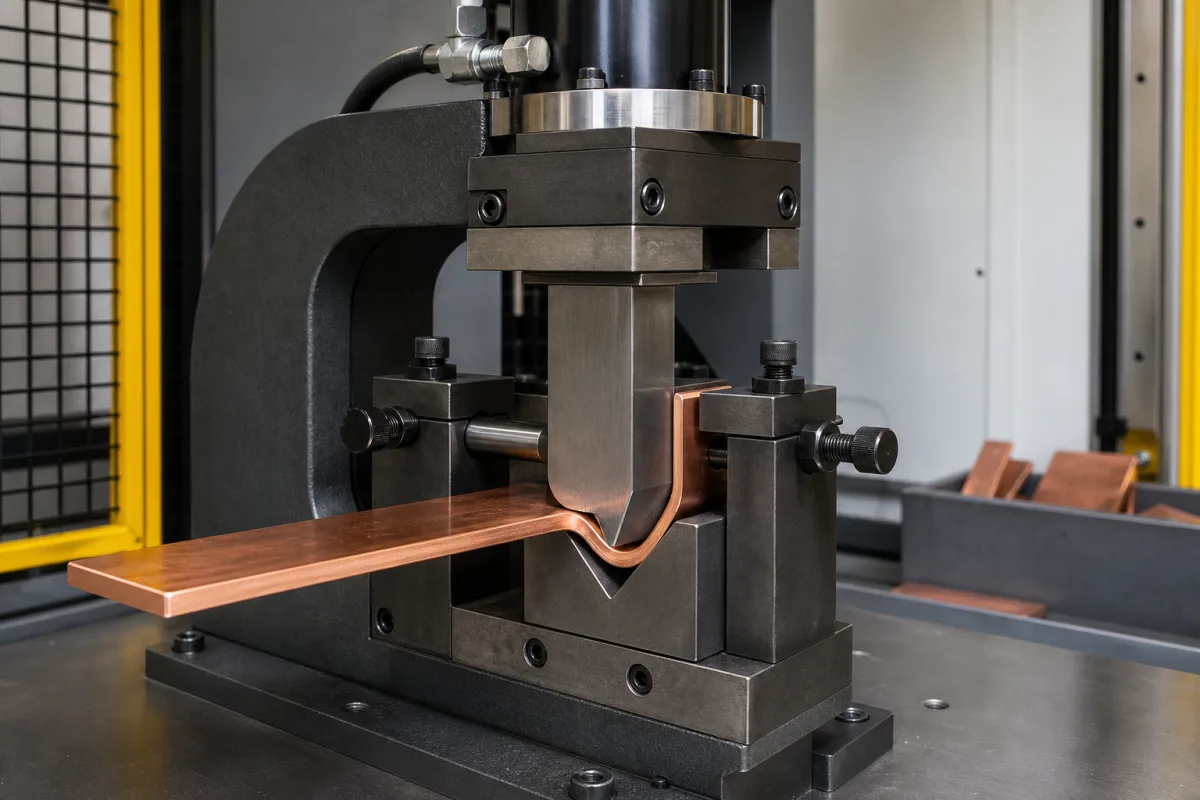
A canonical Bending Tool Assembly is characterized by the integration of Bending Punch and Bending Die. In industrial production environments, manufacturers listed on CNFX commonly emphasize Tool steel construction to support stable, high-cycle operation across diverse manufacturing scenarios.

A specialized assembly within a busbar processing unit designed to precisely bend copper or aluminum busbars to required angles and shapes.
Product Specifications

Technical details and manufacturing context for Bending Tool Assembly

Definition
The Bending Tool Assembly is a critical component of the Busbar Processing Unit responsible for forming busbars into specific configurations. It typically consists of a bending mechanism, tool holders, and positioning elements that work together to create accurate bends according to engineering specifications, ensuring proper electrical connections and mechanical fit in switchgear, distribution panels, and other electrical equipment.
Working Principle
The assembly uses mechanical force applied through hydraulic, pneumatic, or servo-electric actuators to deform busbars around a forming die or mandrel. The tooling is precisely aligned to create clean bends at predetermined locations without damaging the conductive material or compromising its electrical properties.
Common Materials
Tool steel, Carbide inserts, Hardened alloy steel
Technical Parameters
  • Maximum bending capacity for busbar thickness and width (mm) Customizable
Components / BOM
  • Bending Punch
    Applies force to deform the busbar against the die
    Material: Tool steel
  • Bending Die
    Forms the inner radius and shape of the bend
    Material: Hardened alloy steel
  • Tool Holder
    Secures and positions bending tools relative to the busbar
    Material: Steel alloy
  • Back Gauge
    Positions busbar accurately for consistent bend locations
    Material: Steel with wear-resistant coating
Engineering Reasoning
0.5-2.5 kN·m bending torque at 0.1-0.3 m lever arm
3.1 kN·m bending torque causing permanent deformation of tool steel components
Design Rationale: Exceeding yield strength of AISI D2 tool steel (σ_y = 1.9 GPa) at stress concentration points in bending die geometry
Risk Mitigation (FMEA)
Trigger Work hardening of copper busbars beyond 120 HV hardness
Mode: Tool wear acceleration exceeding 0.05 mm/1000 cycles
Strategy: Implement inline Brinell hardness testing with 95 HBW rejection threshold
Trigger Angular misalignment exceeding 0.5° between punch and die centers
Mode: Asymmetric bending causing ±2° angular deviation from specification
Strategy: Install laser alignment system with 0.1° resolution and automatic correction

Industry Taxonomies & Aliases

Commonly used trade names and technical identifiers for Bending Tool Assembly.

Applied To / Applications

This component is essential for the following industrial systems and equipment:

Industrial Ecosystem & Supply Chain DNA

Complementary Systems
Downstream Applications
Specialized Tooling

Application Fit & Sizing Matrix

Operational Limits
pressure: Up to 200 bar hydraulic system pressure
other spec: Maximum bending force: 50 kN, Minimum bend radius: 2x material thickness
temperature: 15°C to 40°C (operating ambient)
Media Compatibility
✓ Copper busbars (electrolytic grade) ✓ Aluminum busbars (6061/6063 alloys) ✓ Copper-clad aluminum busbars
Unsuitable: Corrosive environments with high chloride/sulfur content
Sizing Data Required
  • Busbar thickness (mm)
  • Required bend angle (degrees)
  • Busbar material yield strength (MPa)

Reliability & Engineering Risk Analysis

Failure Mode & Root Cause
Fatigue cracking
Cause: Cyclic loading from repeated bending operations leading to crack initiation and propagation in high-stress areas like tool edges and mounting points.
Wear and dimensional degradation
Cause: Abrasive contact with workpiece materials causing gradual loss of critical tolerances, tool geometry distortion, and surface scoring.
Maintenance Indicators
  • Visible cracks, chips, or deformation on tool surfaces or edges
  • Abnormal noises (grinding, clicking) during operation or inconsistent bending results
Engineering Tips
  • Implement regular dimensional inspections and non-destructive testing (e.g., dye penetrant) to detect early fatigue signs before catastrophic failure
  • Apply appropriate lubricants/coolants during operation and maintain proper alignment to minimize abrasive wear and uneven loading

Compliance & Manufacturing Standards

Reference Standards
ISO 9001:2015 - Quality Management Systems ANSI B11.3 - Power Press Brakes Safety Requirements DIN 8580 - Manufacturing Processes Classification
Manufacturing Precision
  • Bore Diameter: +/-0.02mm
  • Flatness of Mounting Surface: 0.1mm
Quality Inspection
  • Dye Penetrant Test for Surface Cracks
  • Hardness Testing (Rockwell C Scale)

Factories Producing Bending Tool Assembly

Verified manufacturers with capability to produce this product in China

✓ 93% Supplier Capability Match Found

T Technical Director from Germany Jan 18, 2026
★★★★★
"Reliable performance in harsh Electrical Equipment Manufacturing environments. No issues with the Bending Tool Assembly so far."
Technical Specifications Verified
P Project Engineer from Brazil Jan 15, 2026
★★★★☆
"Testing the Bending Tool Assembly now; the technical reliability results are within 1% of the laboratory datasheet. (Delivery took slightly longer than expected, but technical support was excellent.)"
Technical Specifications Verified
S Sourcing Manager from Canada Jan 12, 2026
★★★★★
"Impressive build quality. Especially the technical reliability is very stable during long-term operation."
Technical Specifications Verified
Verification Protocol

“Feedback is collected from verified sourcing managers during RFQ (Request for Quote) and factory evaluation processes on CNFX. These reports represent historical performance data and technical audit summaries from our B2B manufacturing network.”

5 sourcing managers are analyzing this specification now. Last inquiry for Bending Tool Assembly from Germany (1h ago).

Supply Chain Compatible Machinery & Devices

Transformer Winding Machine

Industrial machine for winding copper wire onto transformer cores

Explore Specs →
Circuit Breaker Trip Unit

Protective control module for electrical circuit breakers

Explore Specs →
Circuit Breaker Arc Chute

Electrical component that extinguishes arcs in circuit breakers

Explore Specs →
Medium Voltage Switchgear Assembly Line

Automated production system for assembling medium voltage electrical switchgear.

Explore Specs →

Frequently Asked Questions

What materials are suitable for bending with this tool assembly?

This bending tool assembly is specifically designed for bending copper and aluminum busbars commonly used in electrical equipment manufacturing, with tool steel and carbide components ensuring durability.

How does the back gauge improve bending accuracy?

The back gauge provides precise positioning of busbars before bending, ensuring consistent angles and shapes by controlling the material placement relative to the bending die and punch.

What maintenance is required for the carbide inserts?

Carbide inserts require periodic inspection for wear and proper lubrication during operation. They should be replaced when showing significant wear to maintain bending precision and prevent busbar surface damage.

Can I contact factories directly on CNFX?

CNFX is an open directory, not a transaction platform. Each factory profile provides direct contact information and production details to help you initiate direct inquiries with Chinese suppliers.

Get Quote for Bending Tool Assembly

Request technical pricing, lead times, or customized specifications for Bending Tool Assembly directly from verified manufacturing units.

Your business information is encrypted and only shared with verified Bending Tool Assembly suppliers.

Thank you! Your message has been sent. We'll respond within 1–3 business days.

Need to Manufacture Bending Tool Assembly?

Connect with verified factories specializing in this product category

Add Your Factory Contact Us
Previous Product
Battery Terminal Post
Next Product
Breather