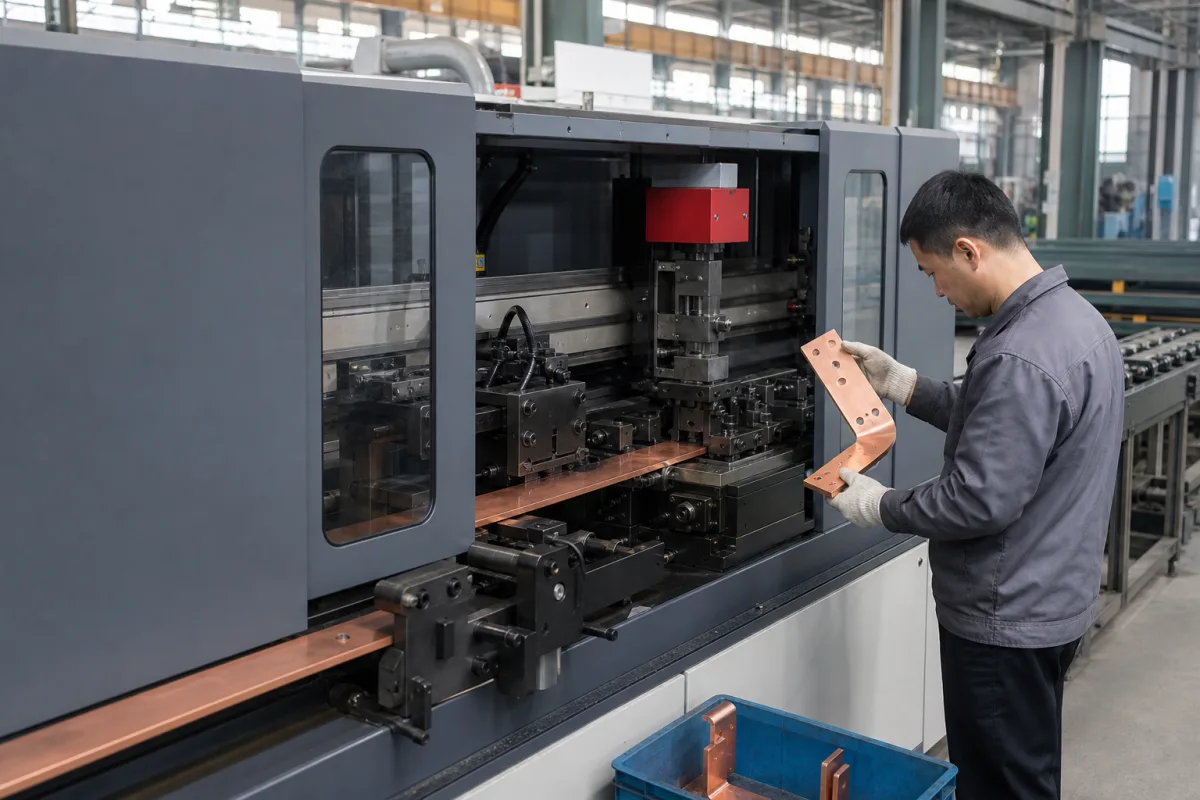
Busbar processing machines for switchgear and panel builders — cutting, punching and bending copper and aluminium bars · maximum bar size, station forces, hole sizes and spacing accuracy, bend types, programmable stoppers, 3-in-1 vs dedicated benders
A busbar processing machine cuts, punches and bends copper and aluminium busbars into the finished, ready-to-bolt conductors used in low- and medium-voltage switchgear, panels, transformers and busway. Ask three things first: the largest bar cross-section and length you process; which operations you need — a combined cut-punch-bend machine or dedicated stations — and at what output; and the hole shapes, bend types and positioning accuracy your drawings call for.
Busbar processing machines — combined cut, punch and bend (3-in-1) machines, dedicated busbar benders, punchers and cutters, NC and CNC — with dies and molds. Busbar itself (see copper busbar), busway systems, general press brakes and turret punches, and cable processing machines are outside this page except where compared.
CNFX editorial research · Sources checked October 11, 2026 · 4 sources
Size the machine to your largest bar and the forces needed
Payapress, a busbar-machine maker, describes its HBC-A120 as cutting, punching and bending copper and aluminium busbars on one wheel-mounted frame, taking bars 15–120 mm wide and 3–12 mm thick up to 4 m long, with 220 kN at the bending station and 160 kN each at cutting and punching. Round holes run from Ø4.5 to 20 mm, with oval and rectangular holes by optional dies, and hole spacing is held to ±0.1 mm. Each station has its own 1.5 kW hydraulic power pack so three operators can work at once, and it uses Siemens HMI and PLC, Duplomatic hydraulic valves and Schneider contactors. [1] For dedicated bending, the maker advises choosing the frame by the largest cross-section — 120 × 12 mm, 160 × 15 mm or 200 × 20 mm for its three benders — with the standard mold giving a 12 or 14 mm forming radius. [2]
Editorial calculation: a 120 × 12 mm bar has a 1,440 mm² cross-section, a 160 × 15 mm bar 2,400 mm² (67% more) and a 200 × 20 mm bar 4,000 mm² (nearly three times as much), so moving up one bar size changes the machine class, not just the dies. [2]
Give the supplier the bar materials (copper, aluminium), largest width, thickness and length, operations (cut, punch, bend, emboss), hole sizes and shapes, bend types and angles, required accuracy, output per shift, NC or CNC control and programming, single or multi-station layout, power supply, footprint and mobility, tooling to include, training and service, and quantity.
02
Choose stations, positioning and bend types
The HBC-A120 bending station makes flat (L-shaped) bends as standard and, with optional molds, double bends to pass one bar over another, edge bends on the narrow side, twist bends to meet a terminal facing the other way, and short end bends. Two versions differ in positioning: one has a programmable length stopper set from a 7-inch screen for repeat batches, the other a manual stopper for varied one-off jobs. Payapress lists its uses as main and distribution bars for low- and medium-voltage switchgear, connections between breakers, contactors and terminals, transformer and generator connections and busway sets. [1] It contrasts a 3-in-1 machine, whose three stations share one footprint, with a dedicated bender that does one job and is lighter and simpler to maintain; its benders run the same five bend types across sizes. [2]
Editorial note: ask the supplier to estimate parts per shift for your busbar set on each layout before choosing between a combined machine and separate stations.
03
Bar size, forces and tooling to request in each quotation
When requesting quotations, ask each supplier for maximum bar size per material and operation, station forces, hole and bend ranges, positioning accuracy, control type and tooling list.
04
Compare a CNC punching line with a combined 3-in-1 machine
For higher output, a dedicated CNC punching line is the alternative to a combined machine. EHRT's datasheet for its FlexPunch series describes three CNC-controlled axes, a hydraulic cylinder with a force of 340 kN, and punching of bar 15-200 mm wide and 3-16 mm thick. [3] The full FlexPunch has 10 tool stations and, with MultiTools 3in1, up to 27 punches plus a separating punch; the FlexPunch compact has 4 stations and up to 9 punches plus one (9 and 3 respectively without MultiTools). Both can take 1-2 thread forming stations. The operator starts the machine, feeds material and removes parts, and EHRT says feeding and removal can be further automated. [3]
Plan the floor space and foundations early: EHRT lists both versions at 7634 mm long, with the FlexPunch 4550 mm wide and 3500 kg and the compact 2500 mm wide and 3300 kg. [3] The maker also notes that workpieces are clamped from the side so punching can run over the entire workpiece, and that punching and bending machines can work from one production file in a shared database. When comparing quotations, ask each supplier for station count, punches per tool, maximum thickness and machine footprint on the same basis. [3]
05
Check a compact processing station for bars up to 125 mm
ERKO lists its BPS 1200 busbar processing station for cutting, bending and punching aluminium, copper and Al-Cu bars 20–125 mm wide and 5–12 mm thick, with bending angles from 5° to 90°. The measuring ruler positions itself automatically during punching, bending and cutting, over bar lengths up to 2,000 mm for cutting and punching and up to 1,600 mm for bending, and a movable cassette holds four punches so no retooling is needed between them. Processing procedures can be saved and recalled. [4]
Editorial calculation: its largest bar, 125 × 12 mm, is 1,500 mm², close to the 1,440 mm² of the 120 × 12 mm 3-in-1 machine above, while its 650 kg is about a fifth of the 3,300–3,500 kg CNC punching lines. Its 630 bar, 3 × 400 V/230 V and 650 kg give one published example for the operating pressure, supply voltage and machine weight fields below. [4][1][3]
BPS 1200 item
Published value
Ask the supplier for
L, C and Z bends
Bars up to 10 mm thick; 40 mm (L, Z) or 45 mm (C) from the edge
Minimum bend distance for your thickness
Minimum cut length
30 mm
Shortest part
Working pressure
630 bar
Hydraulic pressure
Power supply
3 × 400 V/230 V AC; 2 kW
Supply and power
Dimensions
3800 × 2000 × 1700 mm
Footprint
Weight
650 kg with standard equipment
Mass
06
Cutting, punching and bending stations with their hydraulics
Widths, forces, hole range and accuracy against the Payapress figures
Payapress figures fill the width, thickness, force, hole and accuracy rows; cut-length accuracy, pressure, voltage and weight are not stated by Payapress, and the ERKO station above gives one example for the last three.
Field
What it means and published values
Ask the supplier for
Max busbar width
120 mm (3-in-1 example); benders to 200 mm. [1][2]
Jingpeng lists a CNC hydraulic machine for punching, cutting and bending copper busbar; Sunshine lists a 3-in-1 busbar machine alongside CNC bending, CNC punching and shearing and portable busbar machines.
Jinan Jingpeng CNC Machinery Co., Ltd.
Manufacturing site to be confirmed for the order
Lists a CNC hydraulic busbar machine for punching, cutting and bending copper busbar.
Explore company information and manufacturing capabilities, then discuss the scope of your project with a relevant supplier.
Share this page
Compiled and source-reviewed by the CNFX editorial team.
Each manufacturer above links to the page on that company's own website where the product is listed, with the date we checked it. How we source and review
· Page last updated 13 October 2026
Buyer questions
What size busbar can a 3-in-1 machine handle?
Payapress's HBC-A120 takes copper and aluminium bars 15–120 mm wide and 3–12 mm thick, up to 4 m long. [1]
What bend types are possible?
Flat L bends as standard, and double, edge, twist and short end bends with optional molds. [1]
How accurate is hole punching?
Hole spacing is held to ±0.1 mm on the HBC-A120. [1]
How large is a CNC busbar punching line compared with a mobile 3-in-1 machine?
EHRT's datasheet lists its FlexPunch at 7634 mm long, 4550 mm wide and 3500 kg, with 10 tool stations and a 340 kN cylinder for bar up to 200 mm wide and 16 mm thick. [3]
What bar sizes does a compact busbar processing station handle?
ERKO lists its BPS 1200 for copper, aluminium and Al-Cu bars 20–125 mm wide and 5–12 mm thick, bending from 5° to 90° at 630 bar working pressure. [4]
Sources and what still needs a direct check
Sources checked 2026-10-11. Both sources are Payapress pages describing its own machines.