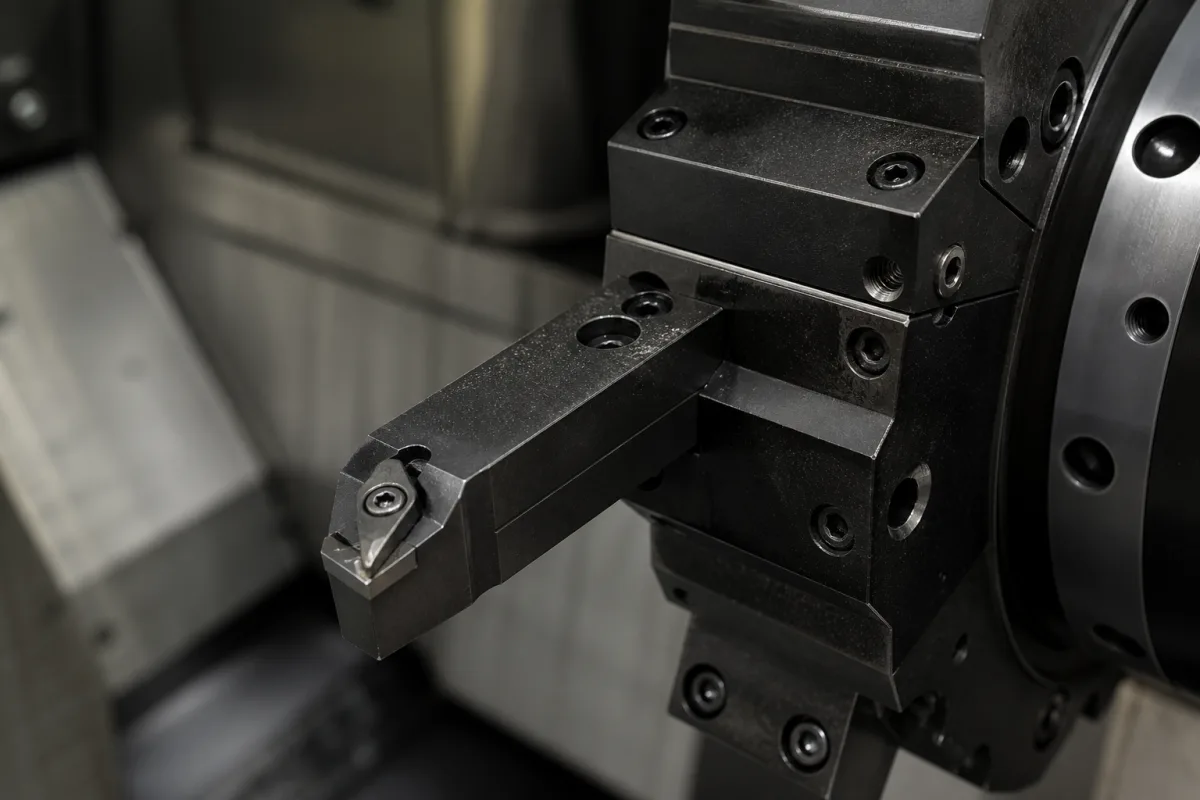
A tool holder connects a cutting tool to a machine spindle or turret. Ask three things first: which spindle or turret interface the machine has, which clamping method suits the tool and the cut, and what runout and balance the speed and tolerance require.
Tool holders for machining centres (BT, CAT, SK and HSK tapers with collet, hydraulic, shrink-fit, Weldon and arbor clamping) and for lathe turrets (VDI and BMT static and driven holders). Cutting tools, inserts, machine spindles and storage carts are outside this page.
CNFX editorial research · Sources checked October 11, 2026 · 5 sources
Holder suppliers list interfaces by standard: JIS B 6339 BT and BBT, DIN 69871, ANSI B5.50 (CAT) and DIN 69893 HSK, with collet, hydraulic, shrink-fit, milling-cutter and boring holders for each. [3] Schunk's HSK-A 63 hydraulic holder is made to DIN ISO 12164-1. [1]
Industry sources quoted by MSC note that HSK and similar interfaces are inherently better balanced than steep tapers, that Weldon side-lock holders are notorious for imbalance, and that shrink-fit and mechanical or hydraulic chucks fare better. [2]
Lathe turrets take different holders: suppliers linked here list VDI and BMT turret holders, BMT40 to BMT65 driven (live) holders for axial and radial milling and drilling, and static OD, face and boring-bar blocks. [5][4]
Give the supplier the machine model and spindle or turret interface, drawbar or pull-stud type, tool shank diameters, maximum speed, coolant route, required runout and balance, and projection lengths.
02
Check runout and balance at your speed
Schunk's HSK-A 63 hydraulic expansion holder for 20 mm shanks lists runout below 0.003 mm at 2.5 × D, balance grade G2.5 at 25,000 rpm or an unbalance below 1 g·mm, h6 tool shank tolerance, 30,000 rpm maximum, 90 mm projection and 1.2 kg. [1]
Editorial calculation: for a 20 mm shank, 2.5 × D = 2.5 × 20 = 50 mm, so the runout figure applies 50 mm out along the tool. [1] Ask every supplier where its runout is measured.
MSC explains that ISO 1940-1 balance grades were later followed by ISO 16084:2017 for rotating tools, that a lower G value allows less unbalance, and that a CAT40 ¾-inch hydraulic holder at G2.5 may carry 1.24 g·mm. Editorial calculation: G6.3 allows 6.3 ÷ 2.5 = 2.52 times as much, about 3.1 g·mm, matching the 3.125 g·mm quoted. [2]
Haimer, quoted by MSC, warns that a holder balanced on its own can fall out of tolerance once the retention knob, collet, nut and cutter are added and spun to 25,000 rpm, and recommends balancing the whole assembly at high speed; large face mills may never reach speeds where balance matters. [2]
03
Spindle holders, turret holders and makers of both
Bright-Tools sells spindle-taper holders and turret tools, while SFX and Drake concentrate on BMT and VDI turret holders. [3][4][5]
Bright-Tools lists BT, BBT, DIN 69871, ANSI B5.50 and DIN 69893 holders with shrink-fit, hydraulic, collet and milling-cutter clamping, plus static and driven tools; SFX lists BMT driven and static turret holders and spindle pull claws; Drake lists BMT and VDI turret holders and angle heads; Younio (Acckee) lists Weldon and Morse taper holders; Jingfusi lists driven and rotary boring holders for its turn-mill machines; Chai lists indexable chamfer mill holders among its tools. [3][4][5]
04
Taper, pull stud, clamping, body, coolant, data carrier and turret drive
The first six rows apply to spindle holders; the last row applies only to lathe turret holders.
Part
Role
Fix in the order
Taper or interface
Locates the holder in the spindle or turret. [3][1]
Standard and size, e.g. HSK-A 63.
Retention knob or pull stud
Draws a steep-taper holder into the spindle. [2][4]
Knob type for your drawbar.
Clamping system
Collet and nut, hydraulic, shrink-fit or Weldon. [3][2]
Paste it into your enquiry below or into an email to a maker, then replace every bracket.
Machine: [model; spindle or turret interface; drawbar or pull stud; tool changer limits]
Tool: [shank diameter and tolerance; length; cutter type]
Clamping: [collet, hydraulic, shrink-fit, Weldon or arbor]
Duty: [maximum speed; coolant through or external; projection]
Accuracy: [runout and where measured; balance grade at speed]
Turret: [VDI or BMT size; static or driven; axial or radial]
Documents: [runout and balance certificate; drawing]
12 companies list this product among what they make. Company figures are quoted from each
company's own website; every card states where the relationship came from.
BRIGHT-TOOLS
Manufacturing site to be confirmed for the order
Lists BT, BBT, DIN, ANSI and HSK holders with shrink-fit, hydraulic and collet clamping.
Explore company information and manufacturing capabilities, then discuss the scope of your project with a relevant supplier.
Share this page
Compiled and source-reviewed by the CNFX editorial team.
Each manufacturer above links to the page on that company's own website where the product is listed, with the date we checked it. How we source and review
· Page last updated 13 October 2026
Buyer questions
What does G2.5 at 25,000 rpm mean for a tool holder?
It is a balance grade at a stated speed; a lower G allows less unbalance, and G6.3 allows about 2.5 times as much as G2.5. [2]
HSK or BT/CAT tool holder?
HSK interfaces are described as inherently better balanced than steep tapers; the machine spindle decides which you can use. [2][3]
Which holder type has the best balance?
Shrink-fit and hydraulic or mechanical chucks fare better than Weldon side-lock holders, which are notorious for imbalance. [2]
Sources and what still needs a direct check
Sources checked 2026-10-11. Schunk is a toolholder maker. MSC's article quotes Schunk, Haimer and Techniks staff. Bright-Tools, SFX and Drake are suppliers listed on this page.