Industry-Verified Manufacturing Data (2026)

Control and Regulation Circuitry

Based on aggregated insights from multiple verified factory profiles within the CNFX directory, the standard Control and Regulation Circuitry used in the Electrical Equipment Manufacturing sector typically supports operational capacities ranging from standard industrial configurations to heavy-duty production requirements.

Technical Definition & Core Assembly

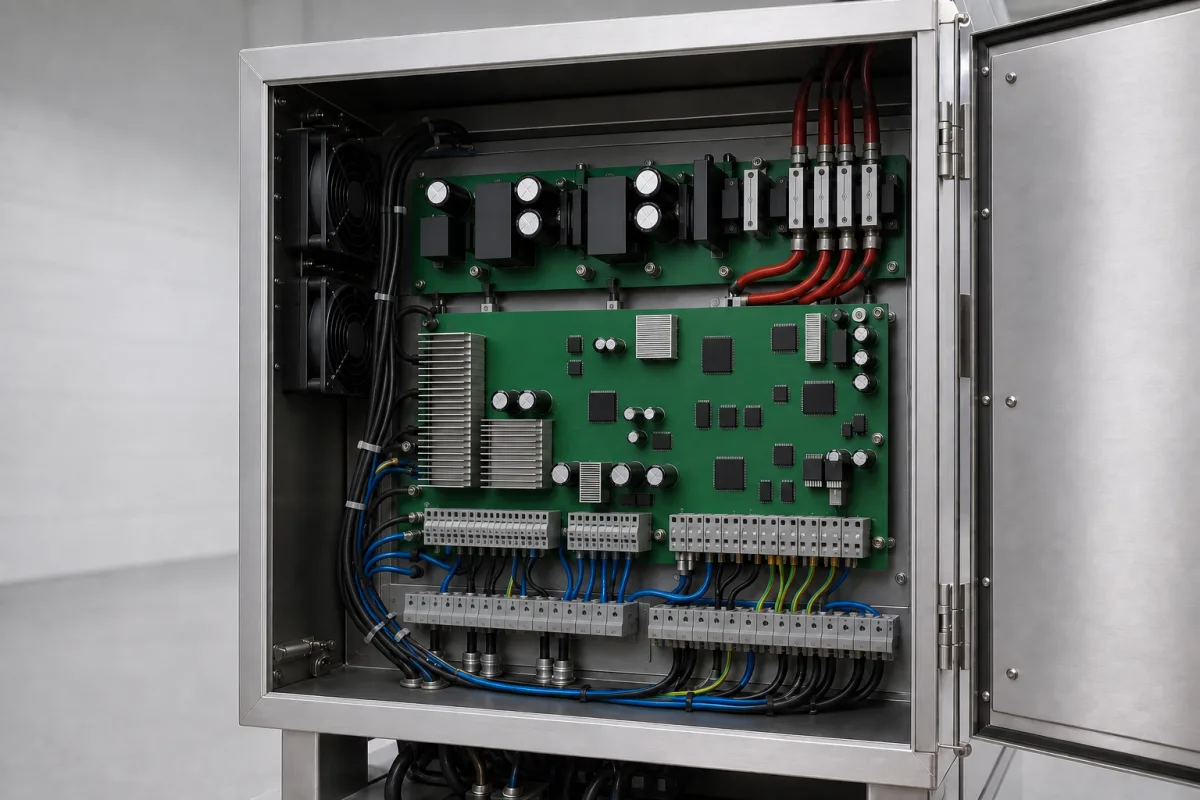
A canonical Control and Regulation Circuitry is characterized by the integration of Microcontroller/DSP Unit and Signal Conditioning Circuit. In industrial production environments, manufacturers listed on CNFX commonly emphasize Printed Circuit Board (PCB) construction to support stable, high-cycle operation across diverse manufacturing scenarios.

Electronic circuitry responsible for managing and adjusting the operational parameters of a high-voltage test unit.
Product Specifications

Technical details and manufacturing context for Control and Regulation Circuitry

Definition
The control and regulation circuitry is a critical electronic subsystem within a high-voltage test unit that monitors, controls, and fine-tunes the unit's output voltage, current, and other test parameters. It ensures stable, precise, and safe operation during electrical testing procedures by processing feedback signals and executing control algorithms.
Working Principle
The circuitry operates by receiving input commands (e.g., target voltage, test duration) and sensor feedback (e.g., actual output voltage, current). It compares these signals, processes the error via control algorithms (often PID-based), and generates output signals to adjust power semiconductor devices (like IGBTs or thyristors) in the unit's power supply, thereby regulating the final high-voltage output to match the desired test profile.
Common Materials
Printed Circuit Board (PCB), Semiconductors (ICs, transistors), Passive components (resistors, capacitors, inductors), Connectors
Technical Parameters
  • Maximum controllable output voltage of the test unit. (kV) Customizable
Components / BOM
  • Microcontroller/DSP Unit
    Executes the control algorithms, processes sensor data, and generates control signals for the power stage.
    Material: Semiconductor (silicon)
  • Signal Conditioning Circuit
    Amplifies, filters, and isolates sensor signals (e.g., from voltage dividers, current transformers) for accurate measurement by the controller.
    Material: PCB with operational amplifiers, isolation components
  • Driver Stage
    Amplifies the low-power control signals from the microcontroller to levels sufficient to drive the high-power switching devices (IGBTs, thyristors) in the main power supply.
    Material: PCB with gate driver ICs, optocouplers
  • Communication Interface
    Provides connectivity (e.g., Ethernet, serial, digital I/O) for receiving commands from and sending status data to a master controller or user interface.
    Material: PCB with communication ICs, connectors
Engineering Reasoning
0-1000 VDC control voltage, 4-20 mA signal current, -40°C to +85°C ambient temperature
Control voltage exceeding 1200 VDC causes dielectric breakdown, signal current below 3.5 mA triggers loss-of-signal fault, ambient temperature above 90°C initiates thermal shutdown
Design Rationale: Dielectric breakdown at 1200 VDC due to insulation material's dielectric strength limit (12 kV/mm for polyimide), thermal runaway above 90°C from semiconductor junction temperature exceeding 150°C
Risk Mitigation (FMEA)
Trigger Transient voltage spike exceeding 1500 VDC with 1 μs duration
Mode: MOSFET gate oxide breakdown in PWM controller
Strategy: TVS diode clamping at 1300 VDC with 5 ns response time
Trigger Electrolytic capacitor electrolyte evaporation at 85°C ambient temperature
Mode: Power supply ripple voltage exceeding 5% of nominal 24 VDC
Strategy: Solid polymer capacitors with 5000-hour lifespan at 105°C

Industry Taxonomies & Aliases

Commonly used trade names and technical identifiers for Control and Regulation Circuitry.

Applied To / Applications

This component is essential for the following industrial systems and equipment:

Industrial Ecosystem & Supply Chain DNA

Complementary Systems
Downstream Applications
Specialized Tooling

Application Fit & Sizing Matrix

Operational Limits
pressure: 0 to 1 bar (ambient pressure only)
other spec: Voltage Range: 0-100kV, Humidity: 0-95% non-condensing, Vibration: 5g max
temperature: -20°C to +85°C
Media Compatibility
✓ Dry air/nitrogen environments ✓ Clean room conditions ✓ Indoor industrial enclosures
Unsuitable: High particulate/dust environments (risk of arcing/contamination)
Sizing Data Required
  • Maximum test voltage required (kV)
  • Control signal type/interface (e.g., analog 4-20mA, digital Modbus)
  • Required response time/bandwidth (Hz)

Reliability & Engineering Risk Analysis

Failure Mode & Root Cause
Contact welding or sticking
Cause: Excessive inrush current, poor contact alignment, or contamination leading to arcing and fusion of relay/contactor contacts
Insulation breakdown
Cause: Moisture ingress, thermal cycling, or voltage transients causing degradation of wire insulation or PCB traces
Maintenance Indicators
  • Audible buzzing or chattering from relays/contactors indicating loose connections or coil issues
  • Visible discoloration, charring, or melting on terminal blocks, connectors, or PCB components
Engineering Tips
  • Implement regular thermographic inspections to identify overheating components before catastrophic failure
  • Use conformal coating on PCBs and install surge protection devices to prevent moisture and voltage spike damage

Compliance & Manufacturing Standards

Reference Standards
ISO 13849-1: Safety of machinery - Safety-related parts of control systems ANSI/UL 508A: Standard for Industrial Control Panels DIN EN 60204-1: Safety of machinery - Electrical equipment of machines
Manufacturing Precision
  • Printed Circuit Board (PCB) trace width: +/-10%
  • Component placement accuracy: +/-0.1mm
Quality Inspection
  • High Potential (Hi-Pot) Test: Dielectric strength verification
  • Functional Safety Test: Performance Level (PL) validation per ISO 13849

Factories Producing Control and Regulation Circuitry

Verified manufacturers with capability to produce this product in China

✓ 95% Supplier Capability Match Found

P Project Engineer from Brazil Jan 09, 2026
★★★★★
"The Control and Regulation Circuitry we sourced perfectly fits our Electrical Equipment Manufacturing production line requirements."
Technical Specifications Verified
S Sourcing Manager from Canada Jan 06, 2026
★★★★★
"Found 21+ suppliers for Control and Regulation Circuitry on CNFX, but this spec remains the most cost-effective."
Technical Specifications Verified
P Procurement Specialist from United States Jan 03, 2026
★★★★★
"The technical documentation for this Control and Regulation Circuitry is very thorough, especially regarding technical reliability."
Technical Specifications Verified
Verification Protocol

“Feedback is collected from verified sourcing managers during RFQ (Request for Quote) and factory evaluation processes on CNFX. These reports represent historical performance data and technical audit summaries from our B2B manufacturing network.”

17 sourcing managers are analyzing this specification now. Last inquiry for Control and Regulation Circuitry from USA (1h ago).

Supply Chain Compatible Machinery & Devices

Transformer Winding Machine

Industrial machine for winding copper wire onto transformer cores

Explore Specs →
Circuit Breaker Trip Unit

Protective control module for electrical circuit breakers

Explore Specs →
Circuit Breaker Arc Chute

Electrical component that extinguishes arcs in circuit breakers

Explore Specs →
Medium Voltage Switchgear Assembly Line

Automated production system for assembling medium voltage electrical switchgear.

Explore Specs →

Frequently Asked Questions

What is the primary function of this control and regulation circuitry?

This circuitry manages and adjusts operational parameters of high-voltage test units, ensuring precise control over voltage, current, and timing during electrical equipment testing procedures.

What components are included in the BOM for this control circuitry?

The bill of materials includes a microcontroller/DSP unit for processing, signal conditioning circuits for input/output management, driver stages for power control, and communication interfaces for system integration.

How does this circuitry ensure reliable operation in high-voltage environments?

It utilizes industrial-grade semiconductors, proper PCB layout for electrical isolation, passive components rated for high-voltage applications, and robust connectors designed to withstand electrical stress and environmental factors.

Can I contact factories directly on CNFX?

CNFX is an open directory, not a transaction platform. Each factory profile provides direct contact information and production details to help you initiate direct inquiries with Chinese suppliers.

Get Quote for Control and Regulation Circuitry

Request technical pricing, lead times, or customized specifications for Control and Regulation Circuitry directly from verified manufacturing units.

Your business information is encrypted and only shared with verified Control and Regulation Circuitry suppliers.

Thank you! Your message has been sent. We'll respond within 1–3 business days.

Need to Manufacture Control and Regulation Circuitry?

Connect with verified factories specializing in this product category

Add Your Factory Contact Us
Previous Product
Control and Monitoring Station
Next Product
Control Board