Editorial Technical Reference

Control Board

This page explains how Control Board is classified within Electrical Equipment Manufacturing. Technical values and manufacturer relationships are research references; confirm the current specification and supplier evidence for each order.

Technical Definition & Core Assembly

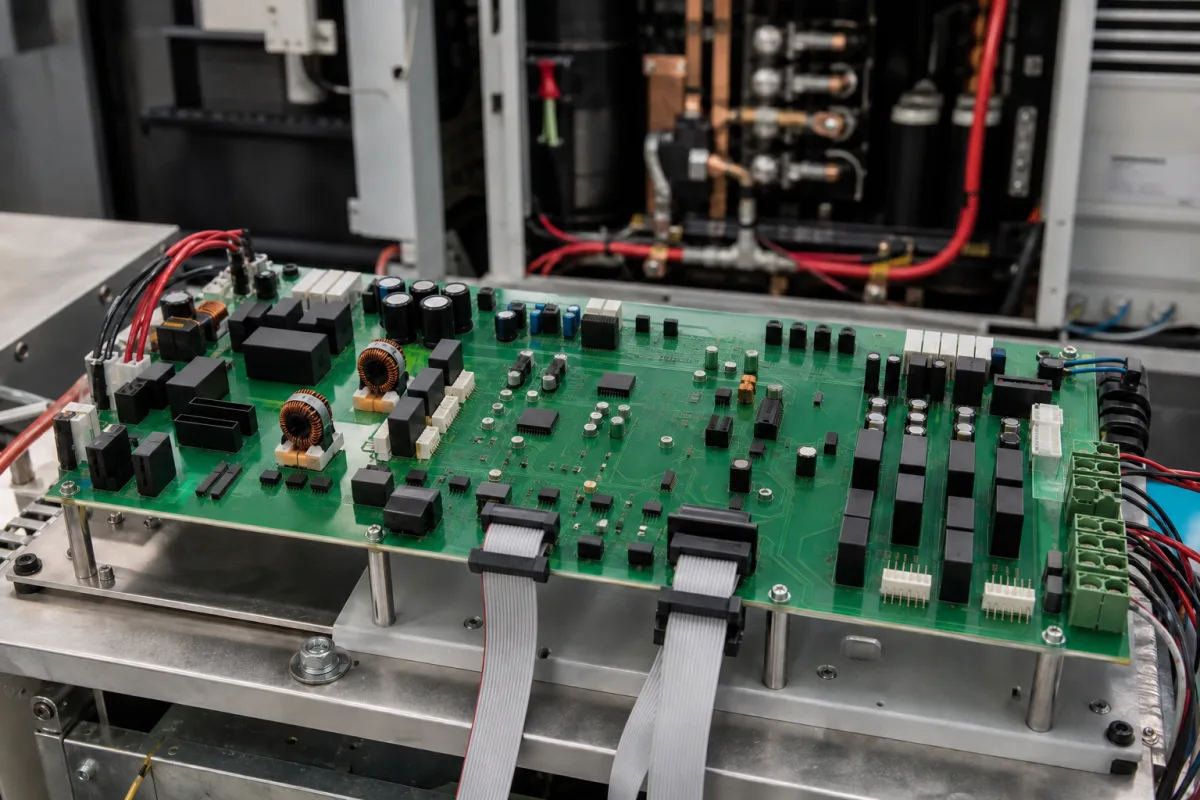
A printed circuit board assembly that regulates and monitors the operation of a plasma power supply.

Representative product image. Confirm appearance and specifications with the manufacturer.

Product Specifications

Technical details and manufacturing context for Control Board

Definition
The control board is a critical electronic component within a plasma power supply system. It serves as the central processing unit that manages power delivery, monitors system parameters, executes control algorithms, and interfaces with external devices to ensure stable and efficient plasma generation. The board is typically fabricated on an FR-4 substrate with copper traces and populated with integrated circuits, resistors, capacitors, and connectors. It operates with a DC input voltage of 24 V ±10% and controls output power in the range of 0.5 to 2.0 kW, depending on the plasma power supply rating. The switching frequency is set between 20 and 50 kHz, which helps reduce transformer size. Control accuracy is maintained within ±0.5% to ensure stable plasma output. The board is designed for industrial environments, with an operating temperature range of -40 to 85 °C and storage temperature range of -40 to 105 °C, per IEC 60068-2-1/2. It withstands non-condensing humidity from 5% to 95% RH (IEC 60068-2-78) and offers ingress protection from IP54 to IP65 (IEC 60529). The board dimensions are 150×100×1.6 mm (IPC-2221), with a weight of 0.5 to 1.0 kg including heatsink and enclosure. Copper thickness ranges from 35 to 70 µm (IPC-6012), and surface finish options include HASL to ENIG (IPC-6012). These specifications serve as reference ranges; actual values must be confirmed with the manufacturer for specific models. The control board's role is to precisely regulate voltage, current, and frequency supplied to the plasma load, ensuring reliable operation. It continuously monitors for faults and adjusts parameters to maintain optimal performance. For procurement, verify model-specific parameters and compliance with relevant standards directly with the legal manufacturer or supplier.
Working Principle
The control board receives input signals, such as user commands and sensor feedback, through its input circuits. Its microprocessor or microcontroller executes programmed firmware to process these inputs. It then generates output control signals, including PWM for switching components and analog signals for regulation, to drive the power supply's main circuits like inverters or amplifiers. This precisely controls the voltage, current, and frequency supplied to the plasma load. The board continuously monitors system parameters for faults and adjusts control parameters to maintain stable and efficient plasma generation.
Common Materials
FR-4 PCB substrate, Copper traces, Electronic components (ICs, resistors, capacitors, connectors)
Technical Parameters
ParameterTypical rangeNotes & selection driver
Input Voltage24 ±10% V DCRequired for control logic and I/O
Output Power0.5–2.0 kWMatches plasma power supply rating
Switching Frequency20–50 kHzHigher reduces transformer size
Control Accuracy±0.5 %Ensures stable plasma output
Operating Temperature-40–85 °CExtended range for industrial useIEC 60068-2-1/2
Storage Temperature-40–105 °CSurvives harsh shipping conditionsIEC 60068-2-1/2
Humidity5–95 % RHNon-condensingIEC 60068-2-78
Ingress ProtectionIP54–IP65Dust and water resistanceIEC 60529
Board Dimensions150×100×1.6 mmStandard form factorIPC-2221
Weight0.5–1.0 kgIncluding heatsink and enclosure
Copper Thickness35–70 µmHigh current capacityIPC-6012
Surface FinishHASL–ENIGENIG for fine pitch componentsIPC-6012

Ranges are indicative industry figures for RFQ preparation, not a supplier commitment. Confirm every value and standard with the legal manufacturer before ordering.

Components / BOM
  • Circuit Board
    The board itself: the substrate and copper traces that carry power and signals between the parts on it.
  • Microcontroller Unit (MCU)
    Executes the control firmware, processes data, and generates control signals.
    Material: Semiconductor (Silicon)
  • Power Regulation Circuit
    Converts the input voltage to stable lower voltages required by the board's ICs.
    Material: Electronic components (ICs, inductors, capacitors)
  • Input/Output (I/O) Connectors Part
    Provides physical interfaces for power input, signal input from sensors, and control output to power stages.
    Material: Plastic housing with metal contacts
  • Signal Conditioning Circuitry
    Filters, amplifies, or isolates analog/digital signals from sensors or user interfaces.
    Material: Electronic components (op-amps, resistors, capacitors, optocouplers)

Applied To / Applications

This component is essential for the following industrial systems and equipment:

Industrial Ecosystem & Supply Chain Structure

Complementary Systems
Downstream Applications
Specialized Tooling

Application Fit & Sizing Matrix

Operational Limits
pressure: Atmospheric (sealed enclosure recommended)
other spec: Humidity: 10-90% non-condensing, Vibration: 5g max, EMI shielding required
temperature: -40°C to +85°C (operating), -40°C to +105°C (storage)
Media Compatibility
✓ Clean dry air environments ✓ Industrial control cabinets ✓ Laboratory plasma systems
Unsuitable: High particulate or corrosive gas atmospheres (e.g., chlorine, fluorine plasma byproducts)
Sizing Data Required
  • Power supply output rating (kW/kV)
  • Control interface requirements (analog/digital I/O count)
  • Mounting space constraints and cooling method

Reliability & Engineering Risk Analysis

Failure Mode & Root Cause
Component overheating
Cause: Inadequate ventilation, dust accumulation on heat sinks, or excessive ambient temperature leading to thermal stress on ICs and capacitors.
Corrosion or contamination
Cause: Exposure to moisture, chemical vapors, or conductive dust causing short circuits, oxidation of contacts, or degradation of PCB traces.
Maintenance Indicators
  • Unusual audible buzzing or clicking from relays or transformers
  • Visible discoloration, bulging, or leaking capacitors on the board
Engineering Tips
  • Implement regular compressed air cleaning with ESD-safe tools to prevent dust buildup and ensure proper airflow for cooling.
  • Install environmental controls (e.g., dehumidifiers, enclosures with proper IP rating) to protect against moisture and corrosive contaminants.

Indicative industry ranges for design and RFQ preparation. Confirm the exact figures and applicable standard with the manufacturer before specifying.

Compliance & Manufacturing Standards

Applicable Standards
IEC 61010-1:2010 - Safety requirements for electrical equipment for measurement, control, and laboratory use UL 508A - Standard for Industrial Control Panels

Quoted from the published standard.

Manufacturing Precision
  • Component placement accuracy: +/-0.1mm
  • PCB flatness: 0.15mm per 100mm
Quality Inspection
  • In-Circuit Test (ICT) for electrical continuity and component verification
  • Environmental Stress Screening (ESS) including thermal cycling and vibration testing

Manufacturers of Control Board

3 companies list this product among what they make. Company figures are quoted from each company's own website; every card states where the relationship came from.

Sino-Galvo Technology Co., Ltd.
Jiangsu, CN
Listed on the company's own website · profile compiled by CNFX from public sources
Tortai Technologies Co., Ltd.
Dongguan, Guangdong, CN
Listed on the company's own website · profile compiled by CNFX from public sources
ULIKE CIRCUIT
Guangdong, CN
Also makes: Control Circuit Board, Rf Pcb, Metal Core PCB and 8 more
Listed on the company's own website · profile compiled by CNFX from public sources

Manufacturer listings support early research and capability understanding. They are not certification, ranking, or transaction guarantees.

Technical documentation
Request current drawings, revision history, and a signed specification sheet.
Manufacturing capability
Verify equipment lists, process limits, capacity, and representative production evidence.
Inspection readiness
Confirm test methods, calibrated equipment, sampling plans, and traceable reports.
Supplier transparency
Check the legal entity, factory address, ownership, certifications, and direct contacts.

CNFX does not score or rank suppliers. Buyers must verify all claims and documents with the legal manufacturer before ordering.

Supply Chain Compatible Machinery & Devices

Circuit Breaker Arc Chute

The Circuit Breaker Arc Chute is a critical safety component in electrical circuit breakers, designed to rapidly extinguish electric arcs that form during circuit interruption.

Explore Specs →
Medium Voltage Switchgear Assembly Line

Automated production system for assembling medium voltage electrical switchgear.

Explore Specs →
Motor Terminal Block

A motor terminal block is a standardized electrical component that provides secure, insulated connection points for motor winding leads.

Explore Specs →
PLC Control System

A digital industrial computer control system that monitors inputs, makes decisions based on a custom program, and controls outputs to automate industrial processes.

Explore Specs →

Frequently Asked Questions

What is the function of the control board in a plasma power supply?

The control board acts as the central processing unit, managing power delivery, monitoring system parameters, executing control algorithms, and interfacing with external devices to ensure stable plasma generation.

What are the typical input voltage and output power ranges?

The input voltage is 24 V DC ±10%. The output power range is 0.5 to 2.0 kW, matching the plasma power supply rating. These are reference values; confirm with the manufacturer for specific models.

What environmental conditions can the control board withstand?

It operates from -40 to 85 °C and can be stored from -40 to 105 °C (IEC 60068-2-1/2). It handles non-condensing humidity from 5% to 95% RH (IEC 60068-2-78) and offers IP54 to IP65 ingress protection (IEC 60529).

What standards are referenced for the board's construction?

The board dimensions follow IPC-2221, copper thickness and surface finish follow IPC-6012, and environmental tests reference IEC standards. These are procurement references; verify compliance with the manufacturer.

Data Basis

Editorial classification, named public sources where available, and source-reviewed manufacturer records.

Preliminary Technical Classification
This page supports structured research, RFQ preparation, and supplier evaluation. It does not replace buyer-led supplier qualification, standards review, or technical approval.
Buyer enquiry

Request manufacturing insight for Control Board

Ask for use case, specification boundaries, supplier type, and RFQ preparation information for this product.

Where it goes
Straight to the CNFX editorial desk, and to the manufacturer if this product is linked to a claimed profile. Nothing is broadcast to a supplier list.
Your details stay here
We do not sell or rent enquiry data, and we do not add you to a mailing list. Used only to answer this request.
No commission, no middleman
CNFX is a directory. We take no cut of any order and never negotiate on a supplier's behalf.
What we don't claim
A listing is not an endorsement. Qualify every supplier and verify every figure yourself before ordering.

Your business information is used only to process this request.

Thank you! Your message has been sent. We'll respond within 1–3 business days.
Sorry, we couldn't send your message. Please try again, or email us at contact@cnfx.com.

Need to Manufacture Control Board?

Compare manufacturer profiles with relevant product and process capability.

Previous Product
Wire Tensioning System
Last Product
Get QuotesChat