Industry-Verified Manufacturing Data (2026)

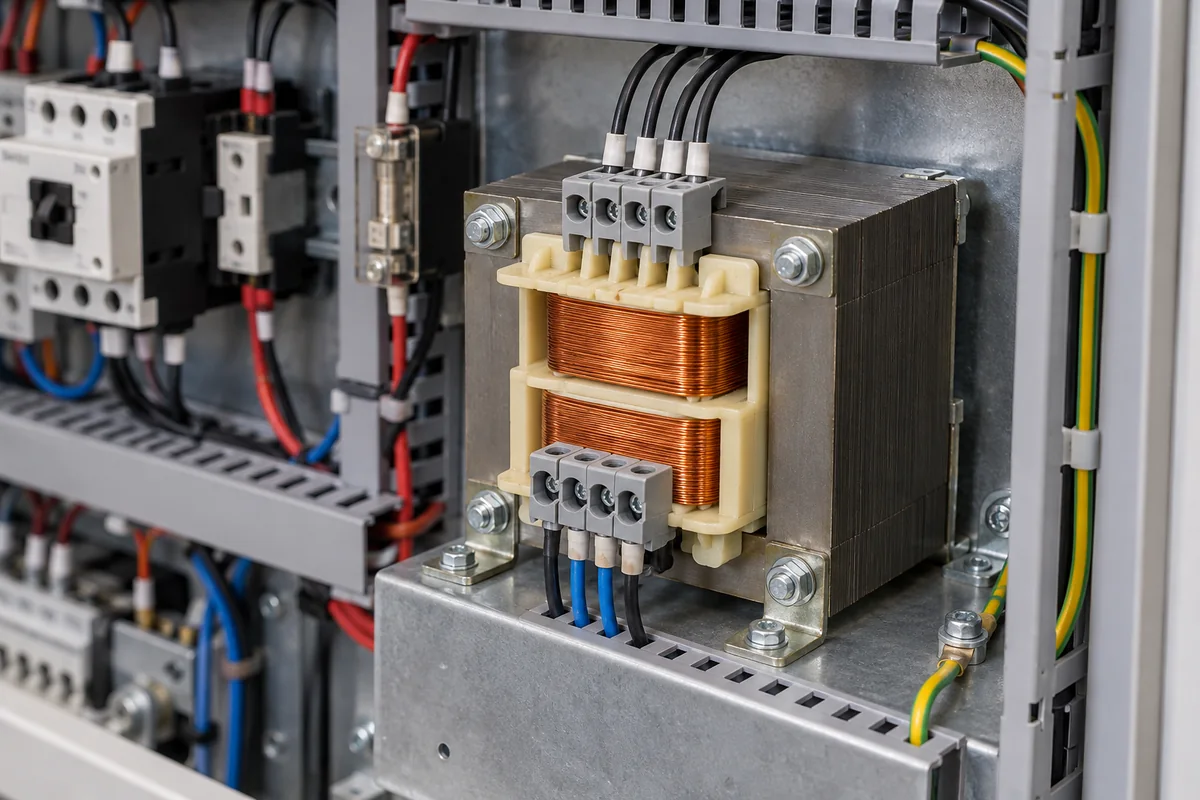
Control Power Transformer

Based on aggregated insights from multiple verified factory profiles within the CNFX directory, the standard Control Power Transformer used in the Electrical Equipment Manufacturing sector typically supports operational capacities ranging from standard industrial configurations to heavy-duty production requirements.

Technical Definition & Core Assembly

A canonical Control Power Transformer is characterized by the integration of Core and Primary Winding. In industrial production environments, manufacturers listed on CNFX commonly emphasize Silicon Steel Laminations (Core) construction to support stable, high-cycle operation across diverse manufacturing scenarios.

A transformer that provides low-voltage power for control circuits within a Motor Control Center.
Product Specifications

Technical details and manufacturing context for Control Power Transformer

Definition
A specialized transformer within a Motor Control Center that steps down the main incoming voltage (typically 480V or 600V) to a lower, safer control voltage (commonly 120V or 24V) to power the logic, relays, contactor coils, PLCs, indicator lights, and other control devices, isolating them from the higher power circuits.
Working Principle
Operates on the principle of electromagnetic induction. The primary winding, connected to the main power supply, creates a varying magnetic field in the transformer core. This induces a proportional voltage in the secondary winding, which is connected to the control circuit, providing the required lower operating voltage.
Common Materials
Silicon Steel Laminations (Core), Copper Windings, Insulating Materials, Steel Enclosure
Technical Parameters
  • Rated power capacity (e.g., 500 VA, 1 kVA) (VA/kVA) Standard Spec
Components / BOM
  • Core
    Provides a low-reluctance path for the magnetic flux, typically made of laminated silicon steel to reduce eddy current losses.
    Material: Silicon Steel
  • Primary Winding
    Connected to the main power supply; carries the input current and creates the magnetic field.
    Material: Copper
  • Secondary Winding
    Output winding that provides the stepped-down voltage to the control circuit.
    Material: Copper
  • Insulation
    Electrically isolates the windings from each other and from the core/ground.
    Material: Insulating Paper/Varnish/Resin
  • Terminal Block
    Provides secure connection points for incoming and outgoing power wires.
    Material: Thermoplastic/Steel
Engineering Reasoning
120-480 VAC primary to 24-120 VAC secondary, 50-60 Hz, 0.5-10 kVA
Core saturation at 1.2 T magnetic flux density, insulation breakdown at 3 kV/mm dielectric strength, winding temperature exceeding 155°C (Class F insulation)
Design Rationale: Core saturation due to harmonic distortion exceeding 5% THD, insulation degradation from partial discharge at >500 pC discharge magnitude, thermal runaway from I²R losses exceeding 15 W/kg
Risk Mitigation (FMEA)
Trigger Voltage transient exceeding 1.2 pu for >1 cycle
Mode: Inter-turn insulation breakdown causing short circuit
Strategy: Install 40 kA surge arrester with 1.5 kV clamping voltage on primary side
Trigger Continuous load at 115% rated capacity for >30 minutes
Mode: Thermal degradation of Class F insulation reducing dielectric strength by 50%
Strategy: Implement 105% load current monitoring with automatic trip at 110% for >15 minutes

Industry Taxonomies & Aliases

Commonly used trade names and technical identifiers for Control Power Transformer.

Applied To / Applications

This component is essential for the following industrial systems and equipment:

Industrial Ecosystem & Supply Chain DNA

Complementary Systems
Downstream Applications
Specialized Tooling

Application Fit & Sizing Matrix

Operational Limits
pressure: N/A (electrical device, not fluid handling)
other spec: Voltage: Primary 480V/600V typical, Secondary 120V/240V typical; Frequency: 50/60 Hz; Insulation Class: Class H (180°C) standard
temperature: -20°C to +40°C ambient operating range, 155°C maximum winding temperature rise
Media Compatibility
✓ Indoor industrial environments ✓ Motor Control Center enclosures ✓ Clean, dry electrical rooms
Unsuitable: Hazardous locations with explosive atmospheres (unless specifically rated for Class I, Division 2)
Sizing Data Required
  • Primary voltage (V)
  • Secondary voltage required (V)
  • Control circuit load (VA/kVA)

Reliability & Engineering Risk Analysis

Failure Mode & Root Cause
Insulation breakdown
Cause: Thermal aging from prolonged overload, moisture ingress, or contamination degrading dielectric strength
Winding failure
Cause: Mechanical stress from short-circuit events, thermal cycling, or loose connections leading to turn-to-turn faults
Maintenance Indicators
  • Audible humming or buzzing that increases in volume or changes pitch
  • Visible signs of overheating such as discoloration, bulging, or oil leaks (in oil-filled transformers)
Engineering Tips
  • Implement regular infrared thermography scans to detect hot spots and monitor thermal performance under load
  • Maintain clean, dry environments with proper ventilation and perform periodic dielectric fluid testing/analysis

Compliance & Manufacturing Standards

Reference Standards
IEC 60076-1: Power transformers - General ANSI/IEEE C57.12.00: Standard for General Requirements for Liquid-Immersed Distribution, Power, and Regulating Transformers EN 50588-1: Medium power transformers 50 Hz, with highest voltage for equipment not exceeding 36 kV - Part 1: General requirements
Manufacturing Precision
  • Turns ratio: +/- 0.5% of rated voltage
  • Insulation resistance: Minimum 1000 MΩ at 20°C
Quality Inspection
  • Impulse withstand voltage test (lightning impulse test)
  • Temperature rise test (load loss and heat run test)

Factories Producing Control Power Transformer

Verified manufacturers with capability to produce this product in China

✓ 97% Supplier Capability Match Found

T Technical Director from Canada Feb 07, 2026
★★★★★
"Great transparency on the Control Power Transformer components. Essential for our Electrical Equipment Manufacturing supply chain."
Technical Specifications Verified
P Project Engineer from United States Feb 04, 2026
★★★★☆
"The Control Power Transformer we sourced perfectly fits our Electrical Equipment Manufacturing production line requirements. (Delivery took slightly longer than expected, but technical support was excellent.)"
Technical Specifications Verified
S Sourcing Manager from United Arab Emirates Feb 01, 2026
★★★★★
"Found 52+ suppliers for Control Power Transformer on CNFX, but this spec remains the most cost-effective."
Technical Specifications Verified
Verification Protocol

“Feedback is collected from verified sourcing managers during RFQ (Request for Quote) and factory evaluation processes on CNFX. These reports represent historical performance data and technical audit summaries from our B2B manufacturing network.”

15 sourcing managers are analyzing this specification now. Last inquiry for Control Power Transformer from Germany (59m ago).

Supply Chain Compatible Machinery & Devices

Circuit Breaker Trip Unit

Protective control module for electrical circuit breakers

Explore Specs →
Circuit Breaker Arc Chute

Electrical component that extinguishes arcs in circuit breakers

Explore Specs →
Medium Voltage Switchgear Assembly Line

Automated production system for assembling medium voltage electrical switchgear.

Explore Specs →
Motor Terminal Block

Electrical connection interface for motor windings

Explore Specs →

Frequently Asked Questions

What is the primary function of a control power transformer in a Motor Control Center?

A control power transformer steps down the main power supply voltage to a lower, safer voltage (typically 120V or 24V) to power the control circuits, relays, and indicators within a Motor Control Center, isolating control systems from higher voltage power circuits.

What materials are used in the construction of this control power transformer?

This transformer features a core made of silicon steel laminations for efficient magnetic flux, copper windings for optimal conductivity, high-grade insulating materials for safety and durability, and a robust steel enclosure for protection in industrial environments.

How do I select the right control power transformer for my Motor Control Center application?

Consider the input voltage (primary), required output voltage (secondary), power rating (VA/kVA), enclosure type for environmental protection, and compliance with industry standards like UL or IEC. Consult manufacturer specifications for your specific MCC configuration.

Can I contact factories directly on CNFX?

CNFX is an open directory, not a transaction platform. Each factory profile provides direct contact information and production details to help you initiate direct inquiries with Chinese suppliers.

Get Quote for Control Power Transformer

Request technical pricing, lead times, or customized specifications for Control Power Transformer directly from verified manufacturing units.

Your business information is encrypted and only shared with verified Control Power Transformer suppliers.

Thank you! Your message has been sent. We'll respond within 1–3 business days.

Need to Manufacture Control Power Transformer?

Connect with verified factories specializing in this product category

Add Your Factory Contact Us
Previous Product
Control PCB
Next Product
Control Power Transformer (Optional)