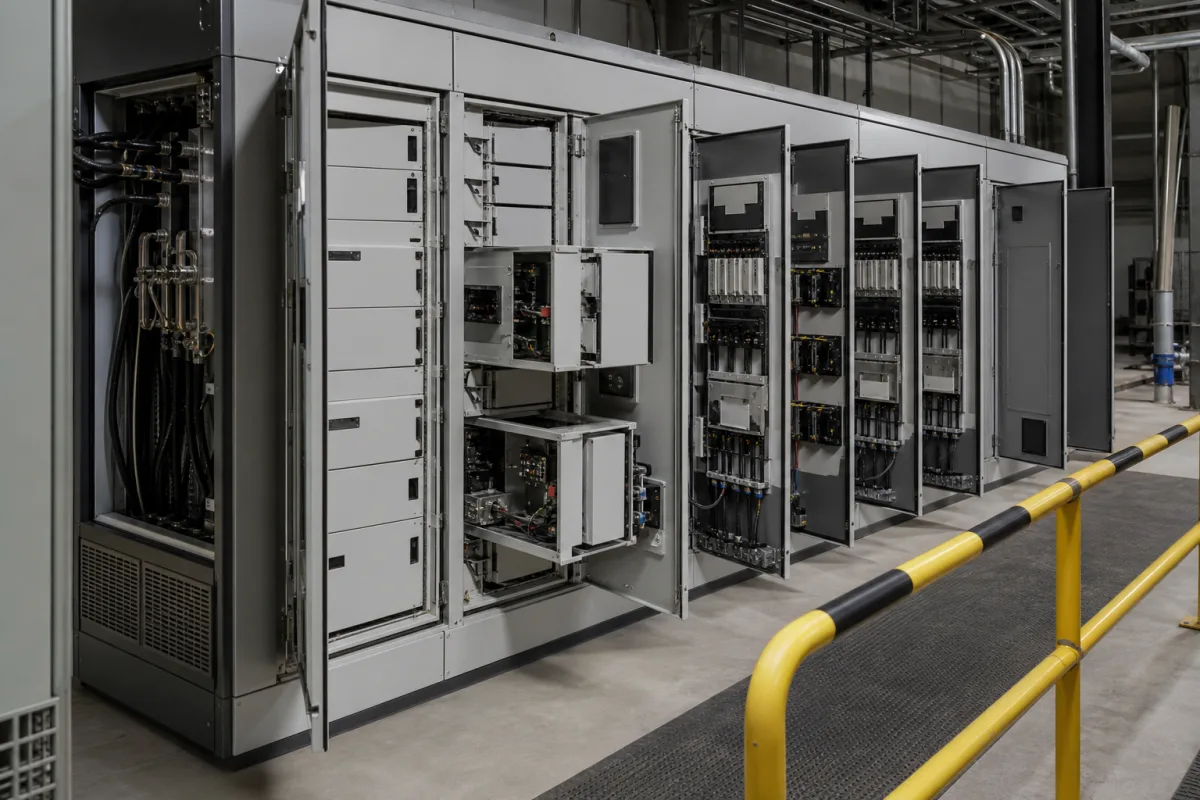
Low-voltage motor control centers (MCCs) that group combination starters, drives and feeders in shared vertical sections · Standards (UL 845, NEMA ICS 18), voltage, horizontal and vertical bus ratings and bracing, short-circuit rating, enclosure type, section size, unit spaces and drawout units, wiring class and type, bus material
A motor control center (MCC) is a line-up of steel vertical sections sharing a horizontal power bus, each fed by a vertical bus into plug-in units that hold combination starters, variable frequency drives and feeder breakers for a plant's motors. Choosing one means fixing the electrical ratings, the enclosure and the unit construction. Ask three things first: what voltage, bus current and short-circuit current the MCC must carry and withstand, what enclosure and space the room allows, and how units will be withdrawn, wired and maintained.
Low-voltage motor control centers to UL 845/NEMA ICS 18 and similar standards, including combination starter, drive and feeder units and prefabricated MCC rooms. Medium-voltage controllers, individual motor starters (see motor starter), variable frequency drives sold alone (see variable frequency drive) and power distribution panels (see power distribution panels) are outside this page.
CNFX editorial research · Sources checked October 11, 2026 · 4 sources
Set the standards, voltage, bus and short-circuit ratings
Rockwell Automation's CENTERLINE 2100 procurement specification requires MCCs to meet NEMA ICS 18 and UL 845, noting that UL 845 is harmonised with CSA C22.2 No. 254-05 and the Mexican ANCE standard. Its arc-resistant option applies where the available short-circuit current is 65,000 A or less, MCC voltage is 600 V or less for device-limited designs (480 V or less for duration-limited), and the horizontal power bus is 3000 A or less; a main incoming air circuit breaker option is withdrawable, 100% rated, up to 3200 A with an SCCR up to 100 kA at 600 V. The horizontal bus is tin-plated copper, braced and isolated from the vertical bus with glass-polyester supports. [1]
The University of Houston master specification for 600 V MCCs calls for silver-plated copper bus sized to carry rated full-load current with a maximum 50 °C temperature rise above 40 °C ambient, bracing to the integrated equipment rating, the main horizontal bus near the top of the line-up, insulated horizontal and vertical bus barriers with closing plates over unused openings, and bottom bus covers. [2]
Editorial note: specify short-circuit current rating at the MCC's line terminals from the actual fault study, and require bus bracing and every unit's interrupting rating to meet it.
Give the supplier the system voltage, phases and frequency, available short-circuit current, main and horizontal bus amperes, vertical bus amperes, bus material and plating, enclosure type, section dimensions and room layout, list of units (starter size, drive, feeder) with ratings, wiring class and type, communication network, arc-resistant requirement, incoming cable or busway entry and the applicable standard.
02
Fix the enclosure, section size, unit spaces, drawout units and wiring
The CENTERLINE 2100 specification calls for vertical sections 90 in high, 15 or 20 in deep and 20 in wide (71 in reduced-height sections if specified), removable steel lifting angles, a tin-plated or unplated copper ground bus, and units whose doors depend on enclosure type: vented doors for NEMA/UL Type 1, filtered vents for Type 1 with gasketed doors and non-vented doors for Type 12. An optional withdrawable power stab lets the primary voltage be disconnected with the unit door closed. [1]
The University of Houston specification calls for dead-front, self-supporting NEMA 1 construction indoors and NEMA 3R outdoors, unit space of six 12 in modules or multiples of 6 in, NEMA size 1 and 2 combination starters fitting one space, units that can be withdrawn to a padlockable test position, a full-height isolated vertical wireway in each section, NEMA Class I Type B wiring with numbered terminal blocks, trip-free overload relays and run/stop pilot lights. [2]
Editorial calculation: a 90 in by 20 in section is about 2,286 mm high and 508 mm wide (× 25.4), and six 12 in modules give 72 in of unit space. [1][2]
A second maker's published design shows the same building blocks. Siemens describes its tiastar standard MCCs as modular, self-contained units meeting UL and NEMA standards, with heavy-gauge steel framing and side panels and sections separated by 14-gauge steel barriers. Plug-in units connect through rear-mounted, self-aligning copper stabs that grasp the bus, with brackets guiding the unit into place; units take pilot devices from 22 mm to 30 mm, direct starters or drives such as SINAMICS G120, and Siemens states that its high-density units save up to 50% of unit space. Its arc-resistant tiastar version is tested to IEEE C37.20.7 Type 2A. [3]
Editorial note: when comparing arc-resistant MCCs, ask for the test standard and accessibility type (for example IEEE C37.20.7 Type 2A), the test current and duration, and the conditions — door closed, vent path, room height — under which the rating holds. [3][1]
03
Settle bus temperature rise, wireways, arc type and factory tests
NASA's guide specification UFGS 26 24 19.00 40 (May 2019) flags a conflict: NEMA ICS 1 allows a 65 °C temperature rise on buses irrespective of the equipment, while UL 845 allows 65 °C only under certain conditions (plated buses, devices UL-labelled for it) and otherwise 50 °C. It bases bus ratings on a 65 °C maximum rise per UL 845, with bus short-circuit ratings of 42,000, 65,000 or 100,000 A rms symmetrical, horizontal bus of 600 to 1,200 A and vertical bus of 300 or 600 A. [4]
Wireways are at least 300 mm at one end and 150 mm at the other, and 100 mm wide vertically. Arc-resistant types follow IEEE C37.20.7: Type 1 protects the front, Type 2 the front, sides and rear, suffix B adds low-voltage control compartments and suffix C isolates adjacent compartments; NASA's note says Type 2B could raise cost by about 20 percent. Factory tests include dielectric tests on the assembled MCC per NEMA ICS 1 and contactor checks at 90 percent of rated voltage. [4]
Editorial note: the University of Houston specification above caps bus rise at 50 °C over a 40 °C ambient, so state the rise and the standard in the enquiry. [2][4]
04
Vertical sections, horizontal and vertical bus, barriers, plug-in units, wireways and ground bus
The plug-in unit row is where the sources differ in detail: Rockwell offers withdrawable power stabs operated with the door closed, the University of Houston asks for a padlockable test position, and Siemens connects units through rear-mounted, self-aligning copper stabs. [1][2][3]
Voltage, bus amperes, short-circuit rating, enclosure type, bus plating and section size for an MCC order
State the temperature-rise basis with the bus amperes: the University of Houston caps rise at 50 °C over a 40 °C ambient, while NASA's guide bases ratings on a 65 °C rise per UL 845. Humidity, control voltage, frequency and weight have no published value here. [2][4]
Explore company information and manufacturing capabilities, then discuss the scope of your project with a relevant supplier.
Share this page
Compiled and source-reviewed by the CNFX editorial team.
Each manufacturer above links to the page on that company's own website where the product is listed, with the date we checked it. How we source and review
· Page last updated 13 October 2026
Buyer questions
Which standards cover low-voltage motor control centers?
Procurement specifications cite NEMA ICS 18 and UL 845, which is harmonised with CSA C22.2 No. 254-05 and ANCE. [1]
How big is an MCC vertical section?
One specification calls for sections 90 in high, 20 in wide and 15 or 20 in deep, about 2.3 m by 0.5 m. [1]
Can MCC units be withdrawn safely?
Specifications call for units that withdraw to a padlockable test position, and one option withdraws the power stabs with the door closed. [2][1]
What test standard applies to arc-resistant MCCs?
Siemens states that its arc-resistant tiastar MCCs are tested to IEEE C37.20.7 Type 2A; ask any supplier for the standard, type and test conditions. [3]
What bus temperature rise should an MCC specification state?
NASA's UFGS 26 24 19.00 40 notes that NEMA ICS 1 allows a 65 °C rise, while UL 845 allows 65 °C only under certain conditions and otherwise 50 °C; state which applies. [4]
Sources and what still needs a direct check
Sources checked 2026-10-11. Sources are Rockwell Automation's procurement specification for its CENTERLINE 2100 MCC line, Siemens' tiastar product page, the University of Houston's master construction specification and NASA's UFGS 26 24 19.00 40 guide specification, cited as examples of what an MCC specification covers, not endorsements.