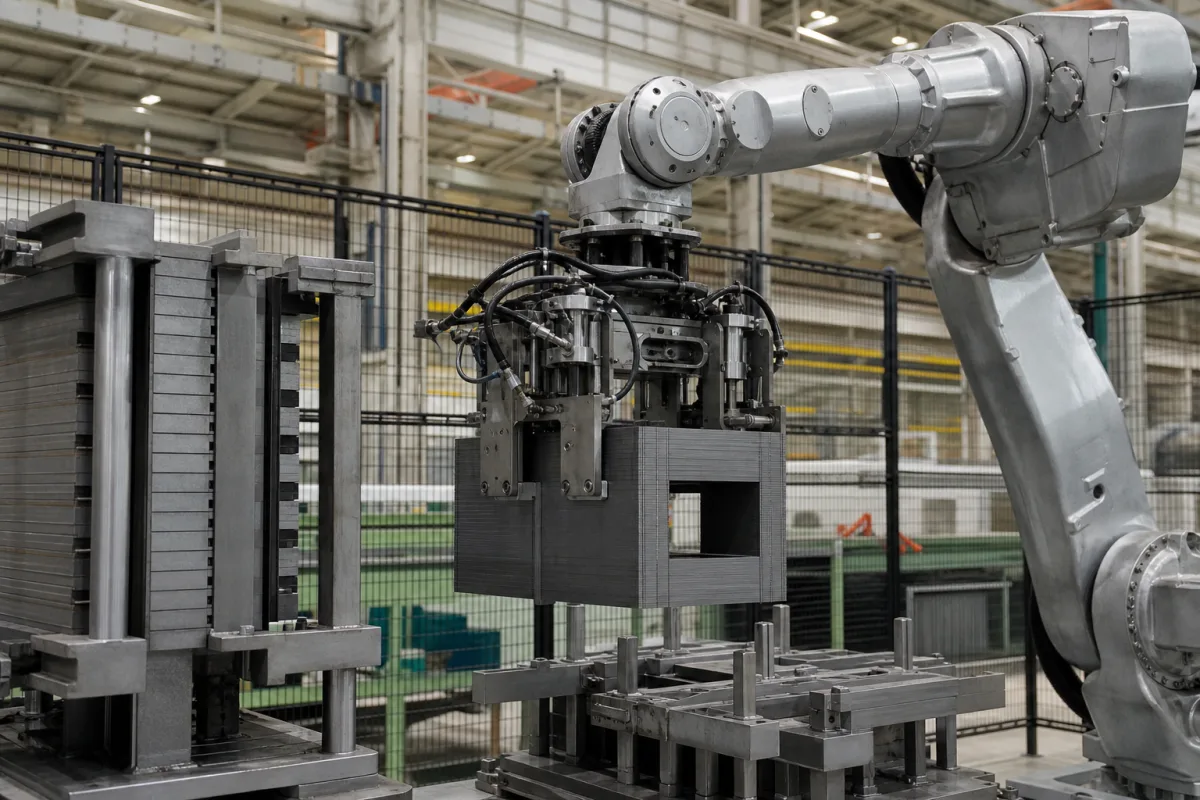
Transformer core clamping and handling robot: holding a stacked core of loose laminations under pressure while it is lifted, tilted and carried to the next station
Clamping and moving a stacked transformer core without losing a sheet · pack pressure set against the 345 kPa (ASTM A719) and 1 MPa (IEC 60404-13) lamination-factor test points, a 164 kg leg from one 150 mm stack, and fixtures that tilt about 15° so a core can travel without a clamp
Once a transformer core has been stacked, it is a block of hundreds of coated silicon-steel sheets 0.2 to 0.4 mm thick that are not yet bolted, banded or bonded together. The machine that picks it up has to hold that block hard enough that no sheet walks out when it is lifted, turned upright or set down for the next operation, and the steel makers' own lamination-factor data say what pressure a tight pack corresponds to.
Robots, end-of-arm clamps, tilting fixtures and gantries that hold and transfer stacked transformer and reactor cores of grain-oriented electrical steel after or during stacking, judged by pack pressure, core mass and how the core is kept together while it moves. Machines whose job is to stack the laminations, with their stacking concepts, step-lap patterns and sheets-per-minute output, are covered on the Transformer core lamination stacking machine page; the stacked core itself is covered on the Electrical steel lamination core for transformers page; general-purpose six-axis, SCARA, delta and collaborative assembly robots and how to size and guard them are covered on the Assembly robot page; welded motor rotor and stator stacks are covered on the Electric motor rotor lamination stacking and welding machine page.
CNFX editorial research · Sources checked October 12, 2026 · 6 sources
How hard to squeeze a stacked core: lamination factor is tested at 345 kPa under ASTM A719 and at 1 MPa under IEC 60404-13
Lamination (stacking) factor is the ratio of the solid steel volume, from weight and density, to the volume of the compressed pack. [2] The grade minimums below were measured on pressed test stacks; the clamp on the robot decides how close a real core in transit comes to them.
Cleveland-Cliffs measures lamination factor on a stack of Epstein strips at 345 kPa (50 psi) under ASTM A719, and states that values determined under IEC 60404-13 come out about 0.5 percentage points higher because that method presses at 1 MPa (145 psi). Its representative curve of lamination factor against pressure spans 0.07 to 7.0 MPa. [2] Both makers give an assumed density of 7.65 kg/dm³. [1][2]
Editorial calculation: a clamp jaw bearing on a 150 × 300 mm face (0.045 m²) applies 0.045 × 345,000 ≈ 15.5 kN to reach the ASTM A719 test pressure and 0.045 × 1,000,000 = 45 kN to reach the IEC 60404-13 pressure. A core leg of 150 × 150 mm cross-section and 1,000 mm length at 95.0 % lamination factor holds 22.5 dm³ × 0.95 × 7.65 kg/dm³ ≈ 164 kg of steel, and a 150 mm stack of 0.27 mm sheet at that factor is 150 × 0.95 / 0.27 ≈ 528 sheets. [2][1]
Cleveland-Cliffs lists “easy assembly due to smoothness of coating (low coefficient of friction)” among the properties of its CARLITE 3 insulation. [2] Editorial note: for a jaw that holds the pack only by its two outer sheets, the same smoothness lets inner sheets slide once the pack is tilted, so clamp pressure has to be kept on through the whole move.
Nominal thickness
Minimum lamination factor, Nippon Steel ORIENTCORE (JIS C 2550)
Minimum lamination factor, Cleveland-Cliffs TRAN-COR H
State the core mass, the clamping face dimensions and the pressure the pack must keep while it is carried and tilted, and whether the clamp stays on the core for the next operation.
02
Getting the stacked core upright and to the next station: a bolted clamping assembly, a stacking table leaning about 15°, or a frame tilted to vertical
Two patent disclosures describe how a stacked core was moved without a robot clamp, and what that clamp replaces.
In the Ansaldo system the laminations are grain-oriented silicon steel between 0.2 and 0.4 mm thick, lifted one by one by four gantry cranes with suction-cup frames from four platforms and staggered so the joint lines never fall in the same plane. [4] The supporting frame has to be strong enough to be tilted with the whole core on it. [4]
The Waukesha disclosure gives the cost argument for a fixture or robot that keeps the pack held throughout: fitting a clamping assembly for transport and then removing it at the next station is time-consuming. [3]
Disclosure
How the stacked core is held
How it is moved
Waukesha Electric Systems, US 7,458,476 (background)
On a horizontal fixture, a core clamping assembly must be fitted before the stacked reactor core can be removed safely, and the patent describes taking it off again at the next position as added time and cost [3]
Lifted out of the fixture with the clamping assembly on [3]
Waukesha Electric Systems, US 7,458,476 (invention)
A steel stacking table whose pivot arms rest at about 15° to the base plate, so the laminates lean slightly from vertical and gravity holds them against the support members during stacking [3]
The table swings upright, is detached from its base and travels as the transport fixture; a strap or tie-down is optional for a sudden jolt [3]
Ansaldo Componenti, US 4,893,401
Laminations stacked flat on a supporting frame shaped like the core, with uprights for the three legs and cross-members for the yokes; upper yoke left off [4]
The frame runs on rails to a separate station and is tilted into a vertical position before the core is completed [4]
Say whether the core leaves the cell flat, tilted or upright, whether a temporary clamp or strap goes with it, and what the receiving station expects.
03
Fingers with vacuum cups that open as each formed lamination grows by up to 290 mm
Where the same robot also places the laminations, the hand has to cope with sheets that get bigger as the core builds. In one application for a core-former cell, each of two fingers carries a pair of vacuum cups suited to oily metal surfaces, pneumatic cylinders rotate the fingers to wrap the formed lamination round the stack, and the finger spacing is reset for every lamination to absorb up to 290 mm of growth over one core. A laser line and an off-centre camera locate the creases before the final cut frees the strip, and load cells end the build when the preset count and weight are reached. [5] The manual cell it replaces ended with the operator weighing the core and binding it with mild steel strapping. [5]
Steinemann’s gripper for flat plates combines suction-head arms and a bellows on one vacuum line, and bends up the plate ends as it lifts to overcome the relatively strong adhesion between plates in a stack. [6]
Give the smallest and largest lamination, the coating and oil condition, and whether the robot only moves finished cores or also places sheets.
04
What to send when specifying a core clamping and handling robot
Paste it into your enquiry below or into an email to a maker, then replace every bracket.
Steel: [grade; thickness 0.20–0.35 mm; coating]
Core: [three-leg, single-frame, EI or reactor; leg cross-section; total mass]
Clamping: [jaw face size; pressure to hold in transit; clamp kept on or released at the next station]
Movement: [lift, tilt to vertical, transfer distance; receiving station]
Placement: [finished cores only, or also individual laminations; largest and smallest sheet]
Robot: [articulated arm or gantry; reach and payload with the clamp fitted]
Explore company information and manufacturing capabilities, then discuss the scope of your project with a relevant supplier.
Share this page
Compiled and source-reviewed by the CNFX editorial team.
Each manufacturer above links to the page on that company's own website where the product is listed, with the date we checked it. How we source and review
· Page last updated 13 October 2026
Buyer questions
What pressure should a clamp hold on a stacked transformer core?
The steel makers test lamination factor at 345 kPa (ASTM A719) or 1 MPa (IEC 60404-13); Cleveland-Cliffs says the IEC value is about 0.5 percentage points higher. On a 150 × 300 mm face those pressures need about 15.5 kN and 45 kN (editorial calculation). [2]
How heavy is a stacked core leg?
Editorial calculation: a 150 × 150 mm leg 1,000 mm long at 95.0 % lamination factor and 7.65 kg/dm³ holds about 164 kg of steel. [1][2]
Can a stacked core be moved without a clamping assembly?
Waukesha's patent stacks reactor-core laminates on a table leaning about 15° so gravity holds them, then swings it upright and moves it as the transport fixture, with an optional strap. [3]
How does a robot handle laminations that grow as the core builds?
In one core-former application, vacuum-cup fingers reset their spacing for each lamination, absorbing up to 290 mm of growth over one core. [5]
Sources and what still needs a direct check
Sources checked 2026-10-12. Pack pressure and lamination factors come from Nippon Steel and Cleveland-Cliffs grain-oriented steel data; core transfer and tilting from patents by Waukesha Electric Systems and Ansaldo Componenti; lamination gripping from a robot core-former application and an Ulrich Steinemann AG patent.