Industry-Verified Manufacturing Data (2026)

Vision/Positioning System

Based on aggregated insights from multiple verified factory profiles within the CNFX directory, the standard Vision/Positioning System used in the Machinery and Equipment Manufacturing sector typically supports operational capacities ranging from standard industrial configurations to heavy-duty production requirements.

Technical Definition & Core Assembly

A canonical Vision/Positioning System is characterized by the integration of Industrial Camera and Vision Processing Unit. In industrial production environments, manufacturers listed on CNFX commonly emphasize Aluminum Alloy (housing) construction to support stable, high-cycle operation across diverse manufacturing scenarios.

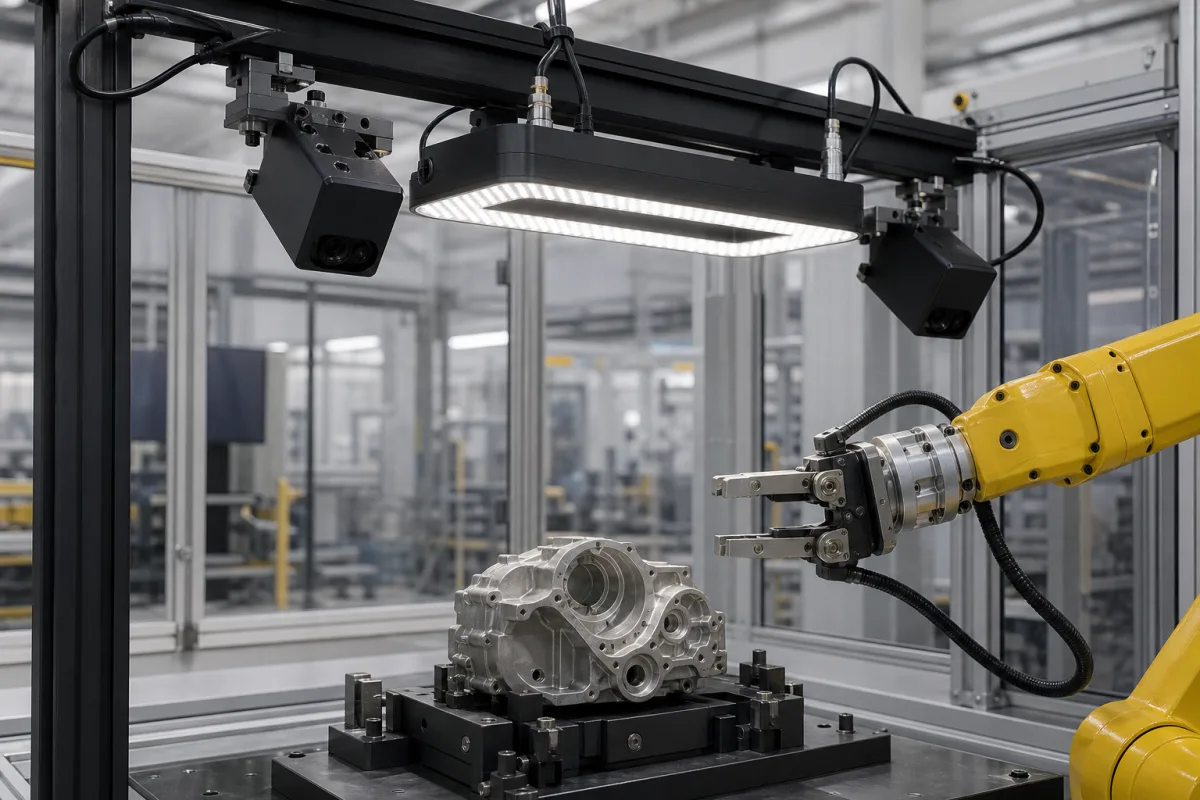
A vision-based system that identifies, locates, and guides the robot's clamping and handling operations.
Product Specifications

Technical details and manufacturing context for Vision/Positioning System

Definition
The Vision/Positioning System is a critical component of the Core Clamping and Handling Robot. It integrates cameras, sensors, and processing software to visually identify target objects, determine their precise position and orientation in 3D space, and provide real-time coordinate data to the robot's control system. This enables accurate, adaptive, and automated picking, placing, and manipulation tasks.
Working Principle
The system captures images of the workspace using industrial cameras. Image processing algorithms analyze these images to detect target objects based on features like shape, color, or markers. Using techniques such as stereo vision or laser triangulation, it calculates the object's precise 3D coordinates (X, Y, Z) and rotation. This positioning data is then transmitted to the robot's controller to guide the end-effector's movement for precise clamping and handling.
Common Materials
Aluminum Alloy (housing), Optical Glass (lenses), Silicon (sensor chip), PCB (circuit board)
Technical Parameters
  • Positioning Accuracy - The maximum permissible error between the measured position and the true position of the target object. (mm) Per Request
Components / BOM
  • Industrial Camera
    Captures high-resolution images of the target objects and workspace.
    Material: Aluminum housing, optical glass lenses, silicon sensor
  • Vision Processing Unit
    Runs image processing algorithms to identify objects and calculate their position.
    Material: PCB, silicon chips (CPU/GPU)
  • Lighting Module
    Provides consistent, controlled illumination to ensure clear image capture under varying conditions.
    Material: LED array, aluminum housing, polycarbonate diffuser
  • Lens
    Focuses light onto the camera sensor to form a clear image.
    Material: Optical glass, brass barrel
Engineering Reasoning
0.5-3.0 m focal distance, ±0.1 mm positioning accuracy, 0.1-100 lux illumination range
Image sensor temperature exceeding 85°C, lens distortion exceeding 0.5% pincushion/barrel, signal-to-noise ratio falling below 20 dB
Design Rationale: Thermal noise in CMOS sensors following Johnson-Nyquist relation (σ² = kT/C), lens material thermal expansion coefficient mismatch (ΔL = αL₀ΔT), photon shot noise following Poisson statistics (σ = √N)
Risk Mitigation (FMEA)
Trigger Ambient light intensity exceeding 100,000 lux causing sensor saturation
Mode: Pixel blooming and charge spillover across adjacent photodiodes
Strategy: Neutral density optical filters with OD 3.0 attenuation, automatic exposure control with 1 ms response time
Trigger Mechanical vibration at 120 Hz resonance frequency exceeding 2 g RMS
Mode: Lens focal plane displacement beyond depth of field (DOF = 2u²Nλ/f²)
Strategy: Viscous damping mounts with 0.7 critical damping ratio, structural stiffening to shift natural frequency to 250 Hz

Industry Taxonomies & Aliases

Commonly used trade names and technical identifiers for Vision/Positioning System.

Applied To / Applications

This component is essential for the following industrial systems and equipment:

Industrial Ecosystem & Supply Chain DNA

Complementary Systems
Downstream Applications
Specialized Tooling

Application Fit & Sizing Matrix

Operational Limits
pressure: Atmospheric pressure only (non-pressurized system)
other spec: Maximum object velocity: 2 m/s, Minimum feature size: 0.5 mm, Lighting conditions: 500-2000 lux recommended
temperature: 0°C to 50°C operating range
Media Compatibility
✓ Metal components (steel, aluminum) ✓ Plastic injection molded parts ✓ Electronic circuit boards
Unsuitable: High-vibration environments (e.g., near heavy machinery without isolation)
Sizing Data Required
  • Maximum object dimensions (L x W x H)
  • Required positioning accuracy (mm)
  • Cycle time requirements (parts per minute)

Reliability & Engineering Risk Analysis

Failure Mode & Root Cause
Lens Contamination
Cause: Accumulation of dust, oil mist, or debris on optical surfaces, often due to inadequate sealing or environmental exposure in industrial settings.
Sensor Calibration Drift
Cause: Gradual misalignment or loss of accuracy from thermal cycling, mechanical vibration, or component aging affecting positioning precision.
Maintenance Indicators
  • Inconsistent or erratic positioning readings during operation
  • Visible fogging, smudges, or particulate buildup on camera lenses or optical windows
Engineering Tips
  • Implement regular preventive cleaning schedules using approved optical-grade materials and ensure environmental controls (e.g., air filtration, positive pressure enclosures) to minimize contamination.
  • Establish a routine calibration verification program using traceable standards, and monitor system performance trends to schedule recalibration before critical drift occurs.

Compliance & Manufacturing Standards

Reference Standards
ISO 10360-2:2009 - Acceptance and reverification tests for coordinate measuring machines (CMMs) ANSI/ASME B89.1.12 - Methods for Performance Evaluation of Coordinate Measuring Systems DIN 32877:2019 - Optical 3D measuring systems - Acceptance and reverification tests
Manufacturing Precision
  • Positioning Accuracy: +/-0.005 mm
  • Repeatability: +/-0.002 mm
Quality Inspection
  • MTF (Modulation Transfer Function) Test for optical resolution
  • Environmental Vibration/Shock Testing for operational stability

Factories Producing Vision/Positioning System

Verified manufacturers with capability to produce this product in China

✓ 96% Supplier Capability Match Found

P Procurement Specialist from Australia Feb 24, 2026
★★★★★
"Standard OEM quality for Machinery and Equipment Manufacturing applications. The Vision/Positioning System arrived with full certification."
Technical Specifications Verified
T Technical Director from Singapore Feb 21, 2026
★★★★★
"Great transparency on the Vision/Positioning System components. Essential for our Machinery and Equipment Manufacturing supply chain."
Technical Specifications Verified
P Project Engineer from Germany Feb 18, 2026
★★★★★
"The Vision/Positioning System we sourced perfectly fits our Machinery and Equipment Manufacturing production line requirements."
Technical Specifications Verified
Verification Protocol

“Feedback is collected from verified sourcing managers during RFQ (Request for Quote) and factory evaluation processes on CNFX. These reports represent historical performance data and technical audit summaries from our B2B manufacturing network.”

16 sourcing managers are analyzing this specification now. Last inquiry for Vision/Positioning System from Brazil (53m ago).

Supply Chain Compatible Machinery & Devices

Automated Assembly Line System

Integrated production system for sequential component assembly operations

Explore Specs →
Automated Powder Coating System

Integrated industrial system for applying dry powder coatings to metal substrates.

Explore Specs →
Centrifugal Pump Impeller

Rotating component that transfers energy to fluid in centrifugal pumps.

Explore Specs →
High-Precision CNC Laser Cutting Machine

Computer-controlled industrial machine using focused laser beams to cut sheet metal with micron-level accuracy.

Explore Specs →

Frequently Asked Questions

What materials are used in the Vision/Positioning System construction?

The system features an Aluminum Alloy housing for durability, Optical Glass lenses for clarity, Silicon sensor chips for precision imaging, and PCB circuit boards for reliable electronics.

What components are included in the system's Bill of Materials (BOM)?

The complete BOM includes an Industrial Camera for image capture, specialized Lens for focus, Lighting Module for optimal illumination, and Vision Processing Unit for real-time analysis and guidance.

How does this system improve robotic operations in manufacturing?

It enhances precision by visually identifying parts, accurately locating positions, and guiding robotic clamping/handling operations, reducing errors and increasing production efficiency in machinery manufacturing.

Can I contact factories directly on CNFX?

CNFX is an open directory, not a transaction platform. Each factory profile provides direct contact information and production details to help you initiate direct inquiries with Chinese suppliers.

Get Quote for Vision/Positioning System

Request technical pricing, lead times, or customized specifications for Vision/Positioning System directly from verified manufacturing units.

Your business information is encrypted and only shared with verified Vision/Positioning System suppliers.

Thank you! Your message has been sent. We'll respond within 1–3 business days.

Need to Manufacture Vision/Positioning System?

Connect with verified factories specializing in this product category

Add Your Factory Contact Us
Previous Product
Vision/Positioning Sensors
Next Product
Volume Adjustment Mechanism