Web guiding · Guide type and span lengths, edge sensor choice, unwind and rewind guiding, why webs wander
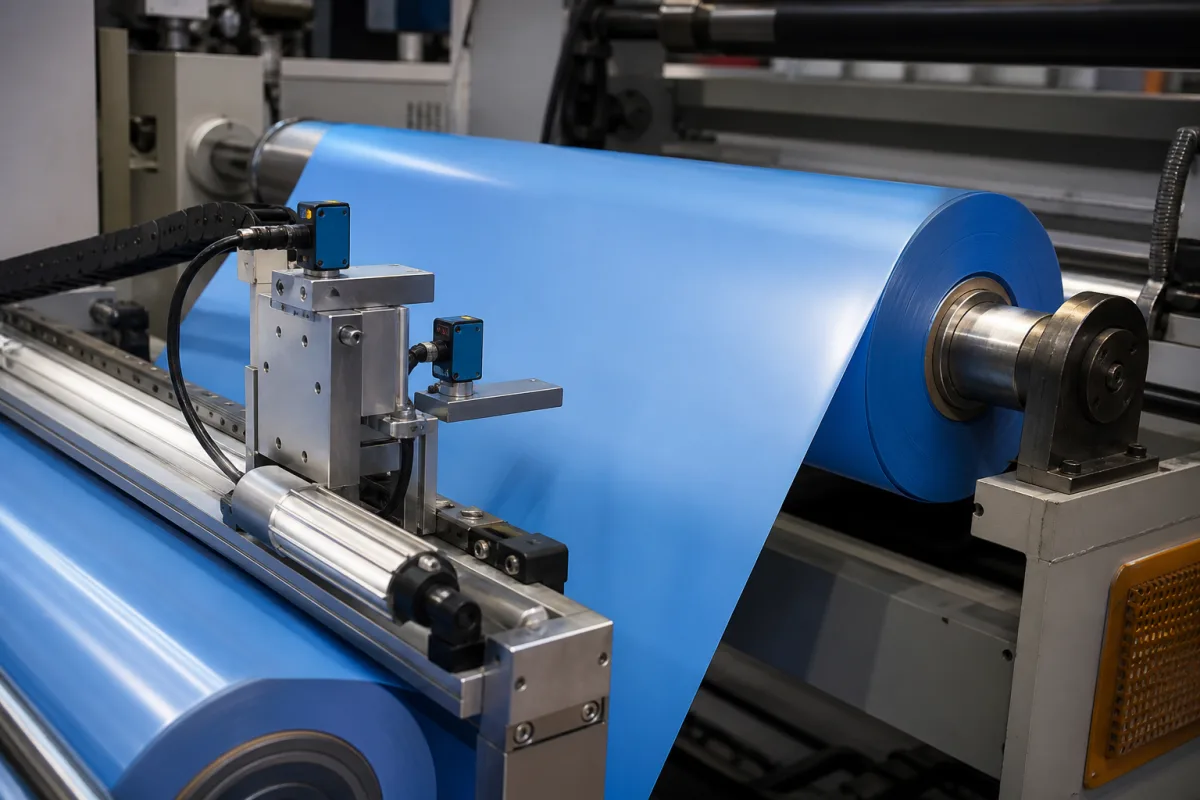
A web edge guide system keeps a moving web of film, foil, paper, nonwoven or coated electrode at the right lateral position: a sensor reads the edge (or a printed line or the web centre), a controller compares it with the set point, and an actuator pivots a roller frame, steers a roller or shifts an unwind or rewind stand. Ask three things first: which guide type suits the space and material, what entry and exit spans the guide needs, and which sensor can see your web edge reliably.
Closed-loop web guiding systems for roll-to-roll lines: displacement (offset pivot) guides, steering guides, unwind and rewind guides, edge, line and centre sensors, controllers and actuators. Tension control, winders and slitters, and vision inspection systems are outside this page.
CNFX editorial research · Sources checked October 12, 2026 · 4 sources
Fife's guiding brochure from Maxcess describes offset pivot (displacement-type) guides — "usually furnished with two rollers", with the entire guide pivoting — as giving correction with minimal entry and exit spans when space is limited. It sizes the minimum entering and exiting span as D1 or D2 = 0.00357 × W × ø × √(W × E × t / T), where W is web width (mm), ø the guide angle in degrees with ø = sin⁻¹(C/L), C the correction (mm), L the guide span (mm), E the modulus of elasticity (N/mm²), t the thickness (mm) and T the tension (N). [1]
Fife's steering guides instead use a long entering span to give immediate lateral correction of transient errors while compensating steady-state errors, with roll faces up to 9 m and more. [1] Erhardt+Leimer's ELGUIDER pivoting frame turns the web four times by 90° around an imaginary pivot point in the infeed plane, with a correction angle of up to ±5°; it needs enough web tension for friction between web and roller, and its infeed, exit and transfer paths should be 60–100% of the web width, longer for higher tension, modulus or correction. [2]
Editorial calculation with Fife's formula, for illustration only: a 600 mm wide film, 0.05 mm thick, run at 200 N, corrected by 10 mm on a 300 mm guide span gives ø = sin⁻¹(10/300) ≈ 1.91°; assuming a modulus of 4,000 N/mm² (an assumed value, not from a source), √(600 × 4,000 × 0.05 / 200) ≈ 24.5 and D(min) ≈ 0.00357 × 600 × 1.91 × 24.5 ≈ 100 mm. [1]
Give the supplier the material, width range, thickness, modulus if known, web tension, line speed, required correction and accuracy, where the guide sits (unwind, intermediate, rewind), available entry and exit spans and roller positions, edge, line or centre guiding, environment (dust, solvent, temperature), supply voltage and the line control interface.
02
Pick a sensor that can see the edge
Fife lists ultrasonic sensors for single-edge or centre guiding with a closed face for immunity to dust and contaminants, and infrared light sensors "widely used on opaque materials" and on materials with opacity as low as 10%, with proportional band ranges from 5 to 420 mm; it also offers line sensors, camera sensors and special sensors such as capacitive and inductive types for metallic materials. [1]
Erhardt+Leimer's ELGUIDER options include ultrasonic edge sensors with ±3 mm or ±10 mm fields of view, a compact infrared transmitted-light sensor with ±2.5 mm range and 0.01 mm resolution, an infrared retroreflective sensor with ±10 mm and 0.02 mm, and wide-band infrared or blue-light sensors with 160, 320 or 480 mm ranges for centre or edge detection. It advises placing the sensor behind the positioning roller, as close to it as possible. [2]
Editorial note: transparent, very thin or perforated webs and coated electrode foils behave differently under light and ultrasound; ask the supplier to test the sensor on a sample of your actual material.
03
Understand why webs wander and where to guide
Researchers at Oklahoma State University explain that a web with camber, a length difference across its width, steers toward its long side; "in many spans in a process machine there may be no known boundary conditions and no steady state deformation", and the web may keep travelling toward the long side from span to span until a web guide returns it. They write that camber "most often" results from "viscoelastic deformation due web thickness non-uniformity in the CMD and residual winding stresses while the web is stored in a wound roll". [3]
Fife's unwind and rewind guides shift the roll stand laterally: unwind stands compensate web misalignment, and rewind stands follow the edge of the approaching web, which helps prevent telescoping and gives evenly wound rolls. [1] Editorial note: a guide corrects position at one point; place guides where position matters, for example before a coating or slitting station, and guide again after long free paths.
04
Compare what suppliers offer
Suppliers linked to this page list web guide control systems; each card links to the page reviewed.
The supplier reviewed also lists powder brakes and clutches, tension control and air shafts; ask for the guide type, sensor range and accuracy, actuator stroke and force, and the maximum tension the frame accepts.
05
Set width, tension and repeat-accuracy limits for a frame guide
BST, part of the Elexis group, publishes technical details for its FRAMEGuide web guiding system: web widths of 350–1,750 mm, a maximum web tension of 1,000 N, repeat accuracy of ±0.05 mm, or ±0.01 mm for the FRAMEGuide Pro, a 24 V DC power supply, and manual or motorised sensor positioning with automatic edge seeking. [4]
The Pro version uses a brushless actuator and backlash-free components, which BST names for battery cell coating and precision printing, and the system is offered with impurity-free technology to reduce contamination risks from copper, zinc and nickel. Listed interfaces are digital I/O, CAN, Profibus DP, Profinet, Powerlink, EtherCAT, Ethernet UDP and Ethernet IP. [4]
Editorial note: the frame's ±0.01 mm repeat accuracy and the 0.01 mm resolution of Erhardt+Leimer's compact infrared sensor [2] are different figures; ask for the system accuracy on your web. Check that your maximum web tension stays below the frame rating, 1,000 N for this frame [4], and that your web width falls inside its range.
06
Trace the guiding system components
This is a functional reference built from the sources cited; it is not one maker's design.
Fill the specification fields with values for your line
An edge guide quotation needs values for your web and line. The table explains each field, gives published values where a reviewed source states them, and says what to obtain from the supplier.
Explore company information and manufacturing capabilities, then discuss the scope of your project with a relevant supplier.
Share this page
Compiled and source-reviewed by the CNFX editorial team.
Published product pages show what a company offers, not tested performance. Confirm the legal seller, factory and scope for your order. How we source and review
· Page last updated 13 October 2026
Buyer questions
How long should the spans around a web guide be?
Erhardt+Leimer sizes ELGUIDER paths at 60–100% of web width; Fife gives a formula for the minimum entering and exiting span of offset pivot guides. [2][1]
Which sensor suits transparent film?
Fife lists ultrasonic sensors for edge guiding and infrared sensors for materials with opacity as low as 10%; test on your actual web. [1]
Why does a web drift sideways?
Camber makes a web steer toward its long side, and it can keep drifting from span to span until a guide corrects it. [3]
What web tension and width can a pivoting-frame web guide take?
BST lists 1,000 N maximum web tension and 350–1,750 mm web width for its FRAMEGuide; ask each supplier for the rating of the frame offered. [4]
Sources and what still needs a direct check
Sources checked 2026-10-12. Maxcess (Fife) and Erhardt+Leimer are web guiding makers describing their own products and sizing rules; the Oklahoma State University paper studies cambered web behaviour.