Industry-Verified Manufacturing Data (2026)

High-Voltage Bushings

Based on aggregated insights from multiple verified factory profiles within the CNFX directory, the standard High-Voltage Bushings used in the Electrical Equipment Manufacturing sector typically supports operational capacities ranging from standard industrial configurations to heavy-duty production requirements.

Technical Definition & Core Assembly

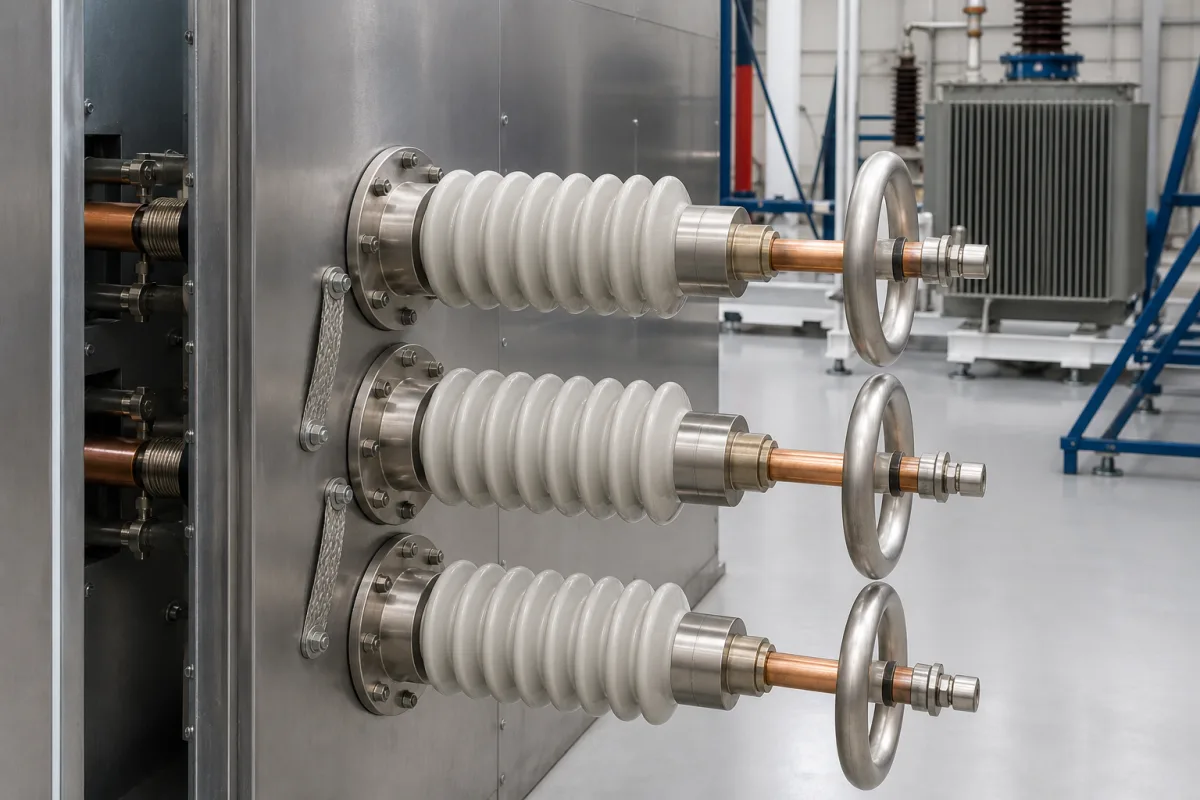
A canonical High-Voltage Bushings is characterized by the integration of Central Conductor and Insulation Body. In industrial production environments, manufacturers listed on CNFX commonly emphasize Porcelain construction to support stable, high-cycle operation across diverse manufacturing scenarios.

Insulating components that allow high-voltage conductors to pass safely through grounded barriers in test chambers
Product Specifications

Technical details and manufacturing context for High-Voltage Bushings

Definition
High-voltage bushings are critical insulating components in high-voltage test chambers that enable electrical conductors to pass through grounded chamber walls or barriers while maintaining electrical isolation and preventing flashover or leakage currents. They provide a sealed, insulated pathway for test voltages to enter the test area without compromising safety or test integrity.
Working Principle
High-voltage bushings work by using multiple layers of insulating materials (typically porcelain, epoxy resin, or composite materials) arranged in concentric or graded configurations to control electric field distribution. They incorporate capacitive grading to equalize voltage stress along the length, preventing localized breakdown. The design ensures that the high-voltage conductor is completely isolated from the grounded chamber structure while maintaining hermetic sealing for environmental control.
Common Materials
Porcelain, Epoxy resin, Silicone rubber, Composite polymer materials
Technical Parameters
  • Rated voltage and withstand voltage levels (kV) Standard Spec
Components / BOM
  • Central Conductor
    Carries high-voltage current through the bushing
    Material: Copper or aluminum alloy
  • Insulation Body
    Provides primary electrical insulation between conductor and ground
    Material: Porcelain, epoxy resin, or composite polymer
  • Flange Assembly
    Secures bushing to chamber wall and provides grounding connection
    Material: Stainless steel or aluminum
  • Grading Rings/Capacitors
    Equalizes electric field distribution along insulation surface
    Material: Metallic foil or conductive polymer
  • Sealing System
    Maintains hermetic seal between chamber interior and exterior
    Material: Silicone rubber gaskets or O-rings
Engineering Reasoning
1-800 kV AC, 1-1200 kV DC
Partial discharge inception voltage (PDIV) exceeding 2 pC at 1.2 times rated voltage, or surface tracking exceeding 25 kV/cm
Design Rationale: Dielectric breakdown via Townsend avalanche mechanism when electric field strength exceeds 30 kV/mm in SF6 gas or 15 kV/mm in oil-impregnated paper, compounded by thermal aging reducing insulation resistance below 10^12 Ω·m
Risk Mitigation (FMEA)
Trigger Moisture ingress exceeding 500 ppm in oil or 150 ppm in SF6 gas
Mode: Surface tracking and carbonization along creepage path
Strategy: Hermetic sealing with double O-ring gaskets and continuous gas pressure monitoring at 0.5 bar above atmospheric
Trigger Thermal cycling between -40°C and 150°C exceeding 1000 cycles
Mode: Delamination of composite insulation layers creating partial discharge channels
Strategy: Graded permittivity design with epoxy-SiO2 nanocomposite (ε_r=3.2-4.5) and embedded fiber Bragg grating temperature sensors

Industry Taxonomies & Aliases

Commonly used trade names and technical identifiers for High-Voltage Bushings.

Applied To / Applications

This component is essential for the following industrial systems and equipment:

Industrial Ecosystem & Supply Chain DNA

Complementary Systems
Downstream Applications
Specialized Tooling

Application Fit & Sizing Matrix

Operational Limits
pressure: Up to 10 bar absolute (vacuum to positive pressure)
other spec: Voltage rating: 1 kV to 800 kV AC, 50/60 Hz frequency, creepage distance per IEC 60137
temperature: -40°C to +150°C continuous, up to +180°C short-term
Media Compatibility
✓ SF6 gas insulated systems ✓ Mineral oil transformers ✓ Dry air/nitrogen test chambers
Unsuitable: Conductive/corrosive slurries or abrasive particulate environments
Sizing Data Required
  • Rated system voltage (kV)
  • Conductor diameter/cross-section (mm)
  • Barrier thickness/material (mm)

Reliability & Engineering Risk Analysis

Failure Mode & Root Cause
Partial Discharge (PD) and Tracking
Cause: Contamination accumulation (dust, moisture, salt) on the bushing surface leading to localized electrical stress, insulation degradation, and eventual flashover or puncture.
Oil Leakage and Gasket Failure
Cause: Thermal cycling causing expansion/contraction, mechanical stress from vibrations, or improper installation leading to seal degradation, loss of insulating oil, and reduced dielectric strength.
Maintenance Indicators
  • Audible corona discharge (crackling/hissing sounds) or visible surface tracking/arcing on the bushing porcelain.
  • Visible oil leaks or significant oil level drop in the bushing's oil gauge, often accompanied by discoloration or carbon deposits.
Engineering Tips
  • Implement regular infrared thermography scans to detect hot spots from partial discharge or poor connections before catastrophic failure.
  • Establish a rigorous cleaning and coating program for bushing surfaces using non-conductive, hydrophobic materials to prevent contamination buildup and moisture ingress.

Compliance & Manufacturing Standards

Reference Standards
IEC 60137:2017 (International Electrotechnical Commission) ANSI/IEEE C57.19.00-2004 (American National Standards Institute/Institute of Electrical and Electronics Engineers) DIN 42523-1:2014 (German Institute for Standardization)
Manufacturing Precision
  • Bore Diameter: +/-0.05mm
  • Surface Flatness: 0.2mm per 100mm
Quality Inspection
  • Partial Discharge Test (PD Test)
  • Power Frequency Withstand Voltage Test

Factories Producing High-Voltage Bushings

Verified manufacturers with capability to produce this product in China

✓ 97% Supplier Capability Match Found

T Technical Director from Canada Jan 14, 2026
★★★★★
"Impressive build quality. Especially the technical reliability is very stable during long-term operation."
Technical Specifications Verified
P Project Engineer from United States Jan 11, 2026
★★★★☆
"As a professional in the Electrical Equipment Manufacturing sector, I confirm this High-Voltage Bushings meets all ISO standards. (Delivery took slightly longer than expected, but technical support was excellent.)"
Technical Specifications Verified
S Sourcing Manager from United Arab Emirates Jan 08, 2026
★★★★★
"Standard OEM quality for Electrical Equipment Manufacturing applications. The High-Voltage Bushings arrived with full certification."
Technical Specifications Verified
Verification Protocol

“Feedback is collected from verified sourcing managers during RFQ (Request for Quote) and factory evaluation processes on CNFX. These reports represent historical performance data and technical audit summaries from our B2B manufacturing network.”

9 sourcing managers are analyzing this specification now. Last inquiry for High-Voltage Bushings from Vietnam (1h ago).

Supply Chain Compatible Machinery & Devices

Circuit Breaker Trip Unit

Protective control module for electrical circuit breakers

Explore Specs →
Circuit Breaker Arc Chute

Electrical component that extinguishes arcs in circuit breakers

Explore Specs →
Medium Voltage Switchgear Assembly Line

Automated production system for assembling medium voltage electrical switchgear.

Explore Specs →
Motor Terminal Block

Electrical connection interface for motor windings

Explore Specs →

Frequently Asked Questions

What materials are used in high-voltage bushings for electrical equipment?

High-voltage bushings are manufactured from materials like porcelain, epoxy resin, silicone rubber, and composite polymers, chosen for their insulating properties and durability in high-voltage applications.

What are the main components of a high-voltage bushing?

Key components include the central conductor, flange assembly, grading rings or capacitors, insulation body, and sealing system, ensuring safe and reliable operation in test chambers.

How do high-voltage bushings enhance safety in electrical test chambers?

They insulate high-voltage conductors as they pass through grounded barriers, preventing electrical discharge and ensuring operator safety and equipment integrity in test environments.

Can I contact factories directly on CNFX?

CNFX is an open directory, not a transaction platform. Each factory profile provides direct contact information and production details to help you initiate direct inquiries with Chinese suppliers.

Get Quote for High-Voltage Bushings

Request technical pricing, lead times, or customized specifications for High-Voltage Bushings directly from verified manufacturing units.

Your business information is encrypted and only shared with verified High-Voltage Bushings suppliers.

Thank you! Your message has been sent. We'll respond within 1–3 business days.

Need to Manufacture High-Voltage Bushings?

Connect with verified factories specializing in this product category

Add Your Factory Contact Us
Previous Product
High-Temperature Silicone Rubber Compound
Next Product
High-Voltage Insulated Cable Termination