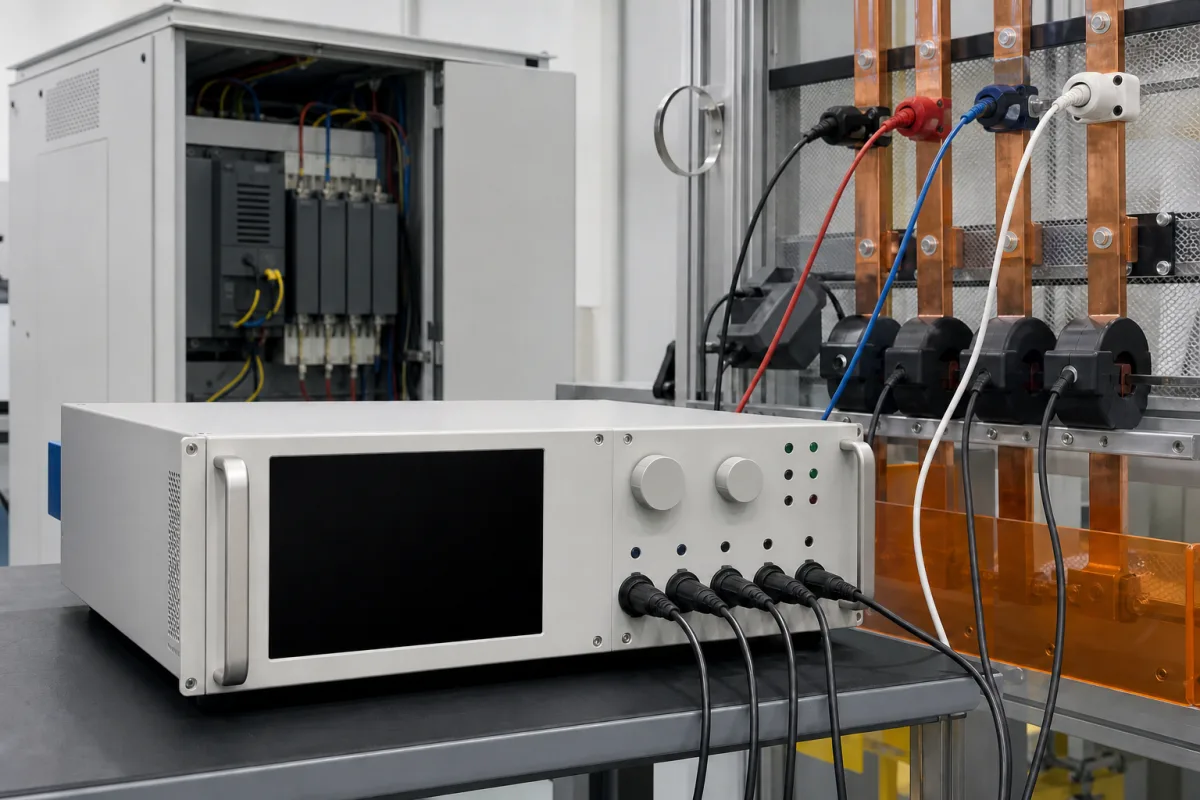
Electrical measurement · Accuracy, bandwidth, harmonics, IEC 61000-4-30 class and time sync
A power analyzer measures voltage, current, power and harmonics on electrical equipment or supplies. Ask three things first: whether you are testing equipment efficiency or recording supply quality, what accuracy and bandwidth the signals need, and whether results must be comparable under IEC 61000-4-30 Class A.
Benchtop and portable precision power analyzers and power quality analyzers, including panel-mounted power quality monitors. Basic energy meters, clamp meters and calibration sources are outside this page.
CNFX editorial research · Sources checked October 12, 2026 · 4 sources
Decide between power and power quality measurement
Fluke explains that IEC 61000-4-30 Class A defines measurement methods, time aggregation, accuracy and evaluation for each power quality parameter so that results from different analyzers are reliable, repeatable and comparable; functional and uncertainty tests are in IEC 62586-2, and the standard is in its third edition (2015). [1]
Class A requirements it lists include voltage uncertainty of 0.1% of declared input voltage over 10–150% of that voltage, contiguous non-overlapping 10/12-cycle measurements at 50/60 Hz, dips and swells measured on a full cycle updated every half cycle, aggregation over 10/12 cycles, 150/180 cycles, 10 minutes synchronised to UTC and 2 hours for flicker, and external time synchronisation by GPS or NTP to ±20 ms at 50 Hz and ±16.7 ms at 60 Hz. [1]
Editorial calculation: at 50 Hz one cycle lasts 1 ÷ 50 = 20 ms, so the ±20 ms requirement keeps time stamps within one cycle; the ±1 s per 24 h fallback allowed without external sync is about 1 ÷ 86,400 ≈ 12 ppm. [1]
Give the supplier the purpose (equipment test or supply survey), voltage and current ranges, frequency range, number of channels, accuracy and class required, harmonics order, logging duration, time synchronisation, communication and sensors.
02
Check accuracy, bandwidth and sampling
Fluke contrasts accuracy specified only at full scale with Class A, which requires 0.1% across 10–150% of the declared voltage. [1] Editorial calculation: for a 230 V declared input, Class A's 0.1% of declared voltage is ±0.23 V across the whole 23–345 V (10–150%) range, which at 23 V is 1% of reading; an instrument that states accuracy only at full scale gives no figure for that low end. [1]
AIP's AIP87330 three-phase power analyzer, as an equipment-test example, lists ±0.1% basic accuracy, DC and 0.5 Hz–100 kHz bandwidth, 100 kS/s sampling, 1,000 Vrms (1,500 Vpk), current inputs from 1 A to 50 A, a 16-bit converter, 100 ms update, harmonics to the 50th, and efficiency and energy functions. [2]
Editorial calculation: a 100 kS/s sampling rate captures signal content up to half that rate, 50 kHz, by the sampling theorem; ask how a 100 kHz bandwidth is achieved and what accuracy applies above 50 kHz. [2]
03
Read a precision power analyzer's accuracy, bandwidth and channel count
Yokogawa's WT5000 precision power analyzer page gives the figures a high-end benchtop power analyzer is specified by. It states a basic power accuracy of ±0.03%, guaranteed from 1% to 130% of the selected voltage and current ranges at 50/60 Hz, with a low-power-factor influence of 0.02% of apparent power. Its inputs sample at 10 MS/s with 18-bit resolution and a 1 MHz power bandwidth using fibre-optic isolation, through seven user-swappable input elements that can analyse 7 phases in one chassis, plus up to four motor speed and torque inputs. Data update down to 10 ms (50 ms when streaming), raw waveform streaming of up to 22 items at up to 2 MS/s, and software for harmonic and flicker measurement to IEC 61000-3-2, 61000-3-3 and 61000-3-11 are listed. [4]
The accuracy here is a power-measurement figure across a range, while the Class A requirement described above is a power-quality figure for voltage; choose the instrument by which of the two the work needs. [1][2][3]
Editorial calculation: ±0.03% of a 10 kW reading is ±3 W; measuring a 98% efficient inverter at 10 kW in and 9.8 kW out, the 200 W loss carries an uncertainty of up to about ±6 W (3%) if the two readings' errors add.
Ask for the power accuracy at your frequency, power factor and percentage of range, the bandwidth and number of input elements, and whether harmonic and flicker software to the IEC standards you need is included.
04
Bench power analyzers, Class A and Class S recorders, panel monitors
AIP lists single-phase, three-phase and multichannel power analyzers for motor and power-supply testing; SUIN lists SA2110 (Class S), SA2200 (Class A) and SA2300 power quality analyzers; Sfere lists panel power quality analyzers including a Class A model; HV Hipot, Wrindu, GFUVE, Yada, Toprie, Mewoi and Rongtech list portable or bench power quality analyzers; Fengtu lists a portable field power analyzer. [2][3]
05
Inputs, converter, time base and logging inside an analyzer
The time base row is what separates a Class A recorder from a bench analyzer: it holds time stamps to GPS or NTP. [1]
Ranges, accuracy, harmonic order and environment to state when asking for a price
Read each accuracy row against the span it applies to: the Class A voltage figure covers 10–150% of declared voltage, the WT5000 power figure 1–130% of range. [1][4]
Example: ±0.03% at 50/60 Hz, 1–130% of range; 10 MS/s, 18 bit, 1 MHz (Yokogawa WT5000). [4]
Accuracy at your frequency and PF.
07
Send the purpose, signals and compliance needs together
Paste it into your enquiry below or into an email to a maker, then replace every bracket.
Purpose: [equipment efficiency test or supply quality survey]
Signals: [voltage and current ranges; frequency range; channels]
Accuracy: [across range; power and power factor]
Power quality: [IEC 61000-4-30 class; parameters; logging time]
Timing: [GPS or NTP sync]
Sensors: [shunts, clamps, CTs]
Documents: [calibration certificate; class test report]
Explore company information and manufacturing capabilities, then discuss the scope of your project with a relevant supplier.
Share this page
Compiled and source-reviewed by the CNFX editorial team.
Each manufacturer above links to the page on that company's own website where the product is listed, with the date we checked it. How we source and review
· Page last updated 13 October 2026
Buyer questions
What does IEC 61000-4-30 Class A mean?
It fixes measurement methods, intervals, accuracy and time synchronisation for power quality parameters so results from different Class A analyzers can be compared. [1]
Why check accuracy across the range, not just full scale?
Class A requires 0.1% of declared voltage from 10% to 150% of it; a figure quoted only at full scale does not show the accuracy at low readings, so ask for the uncertainty across the whole 10–150% range. [1]
Can a 100 kS/s analyzer measure 100 kHz?
Sampling captures up to half the sample rate, 50 kHz; ask the supplier how a higher stated bandwidth is achieved. [2]
How accurate is a precision power analyzer?
Yokogawa states ±0.03% basic power accuracy for its WT5000 at 50/60 Hz from 1% to 130% of range, with 10 MS/s 18-bit sampling and 1 MHz power bandwidth. [4]
Sources and what still needs a direct check
Sources checked 2026-10-12. Fluke is a test instrument maker explaining IEC 61000-4-30 Class A. AIP and SUIN are suppliers listed on this page; their values are catalogue figures.