Editorial Technical Reference

PLC Control Unit

This page explains how PLC Control Unit is classified within Electrical Equipment Manufacturing. Technical values and manufacturer relationships are research references; confirm the current specification and supplier evidence for each order.

Technical Definition & Core Assembly

A modular electronic device that houses the central processing unit, memory, and input/output interfaces for a Programmable Logic Controller system.
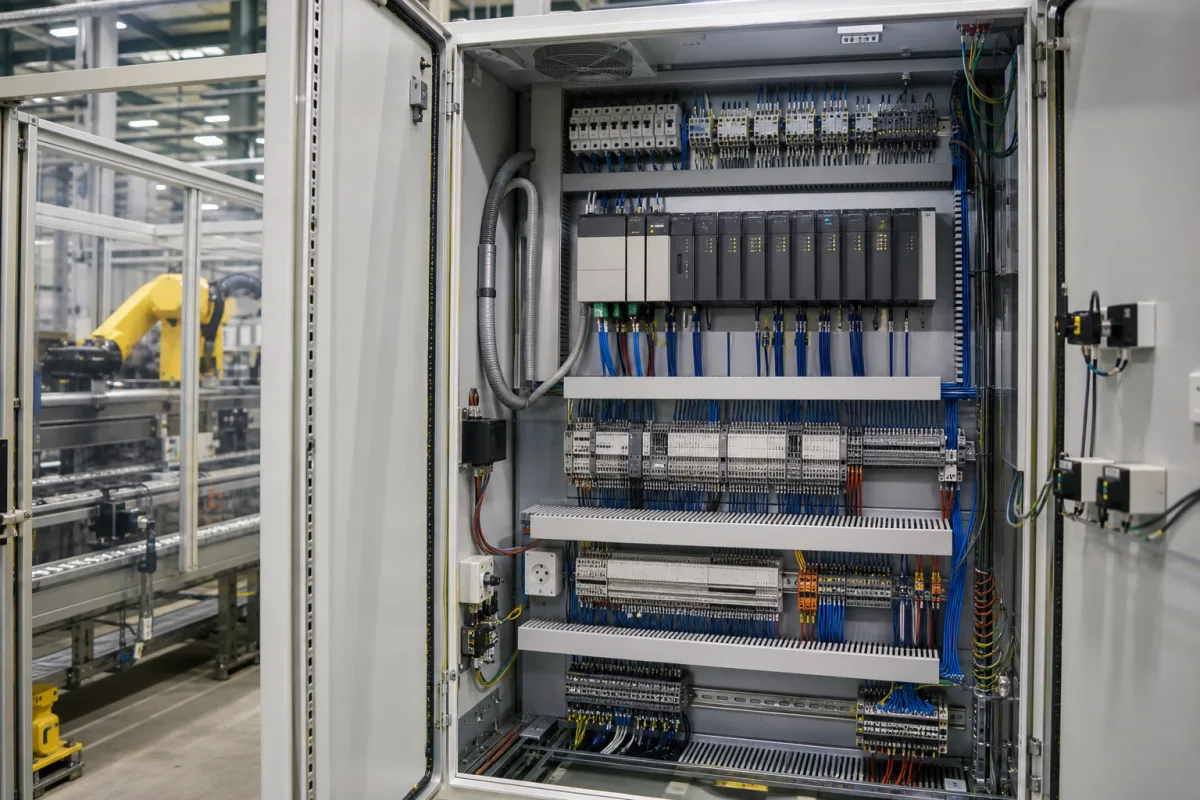
Representative product image. Confirm appearance and specifications with the manufacturer.

Product Specifications

Technical details and manufacturing context for PLC Control Unit

Definition
The PLC Control Unit is a modular electronic device that serves as the core computational and control module within an industrial automation system. It houses the central processing unit (CPU), memory, and input/output (I/O) interfaces, executing programmed logic instructions to monitor sensor inputs, process data according to control algorithms, and command actuator outputs to automate machinery and processes. As the primary decision-making brain of a Programmable Logic Controller (PLC) system, it coordinates the exchange of signals between field devices and the control program.

This unit is designed for integration into electrical equipment manufacturing environments, where it provides reliable and repeatable control. It is typically mounted in a control cabinet or as a standalone unit, depending on the protection rating required. The unit's modular nature allows for flexible configuration with various I/O modules to match the specific needs of the application.

Key technical parameters include a supply voltage of 24 V DC ±10% (per IEC 61131-2), power consumption ranging from 5 to 15 W, and onboard digital inputs and outputs ranging from 8 to 32 and 6 to 24 channels, respectively. Optional analog inputs and outputs are available from 0 to 8 and 0 to 4 channels. Program memory ranges from 64 to 512 KB, and data memory from 32 to 256 KB. The cycle time for 1K instructions is typically 0.1 to 10 ms, and the operating temperature range is -40 to 85 °C, with humidity from 5 to 95% RH (non-condensing). Protection ratings vary from IP20 for cabinet mounting to IP65 for standalone use. Dimensions and weight vary with I/O configuration, typically 70–120 x 90–150 x 60–100 mm and 0.3–1.5 kg.

All values are reference ranges and must be verified with the legal manufacturer or supplier for the specific model and application. Standards listed are for procurement and verification reference only and do not imply certification or compliance.
Working Principle
The PLC Control Unit operates by continuously scanning a cyclic sequence. First, it reads the status of all connected input devices, such as sensors and switches. Then, it executes the user-programmed logic stored in its memory, processing the input data according to the control algorithm. Finally, it updates the status of all connected output devices, such as relays, motor starters, and valves. This scan cycle repeats at high speed, enabling real-time control of industrial processes. The cycle time, typically 0.1 to 10 ms for 1K instructions, determines the responsiveness of the system. The unit's CPU manages this process, ensuring that inputs are sampled, logic is executed, and outputs are set in a deterministic manner.
Common Materials
Fiberglass PCB, Silicon Microprocessors, Aluminum Alloy Housing
Technical Parameters
ParameterTypical rangeNotes & selection driver
Supply Voltage24 ±10% V DCOutside this range, the unit may fail to operate or be damaged.IEC 61131-2
Power Consumption5–15 WDepends on number of I/O modules connected.
Digital Inputs8–32 channelsNumber of onboard digital inputs.IEC 61131-2
Digital Outputs6–24 channelsNumber of onboard digital outputs.IEC 61131-2
Analog Inputs0–8 channelsOptional analog input channels.IEC 61131-2
Analog Outputs0–4 channelsOptional analog output channels.IEC 61131-2
Program Memory64–512 KBSize of user program memory.
Data Memory32–256 KBSize of data memory for variables and registers.
Cycle Time0.1–10 msTypical scan time for 1K instructions.IEC 61131-3
Operating Temperature-40–85 °CExtended temperature range for industrial environments.IEC 61131-2
Humidity5–95 % RHNon-condensing.IEC 61131-2
Protection RatingIP20–IP65IP20 for cabinet mounting, IP65 for standalone.IEC 60529
Dimensions (W x H x D)70–120 x 90–150 x 60–100 mmVaries with I/O configuration.
Weight0.3–1.5 kgDepends on number of I/O modules.

Ranges are indicative industry figures for RFQ preparation, not a supplier commitment. Confirm every value and standard with the legal manufacturer before ordering.

Components / BOM
  • Central Processing Unit (CPU)
    Executes the control program instructions and manages data processing.
    Material: Silicon microprocessor chip
  • Memory Module
    Stores the operating system, user program, and data variables.
    Material: Semiconductor memory chips (RAM, ROM, Flash)
  • I/O Interface
    Provides electrical connection points for input sensors and output actuators.
    Material: Gold-plated connector pins, insulating plastic
  • Communication Port Optional Part
    Enables data exchange with programming devices, HMIs, or other controllers (e.g., Ethernet, serial).
    Material: RJ45 connector or terminal blocks

Industry Taxonomies & Aliases

Commonly used trade names and technical identifiers for PLC Control Unit.

Applied To / Applications

This component is essential for the following industrial systems and equipment:

Industrial Ecosystem & Supply Chain Structure

Complementary Systems
Downstream Applications
Specialized Tooling

Application Fit & Sizing Matrix

Operational Limits
pressure: N/A (enclosure rated for atmospheric conditions only)
other spec: Humidity: 10-95% non-condensing, Vibration: 5-500 Hz at 1G max, EMI/RFI: IEC 61000-6-2 compliant
temperature: 0°C to 60°C (operating), -20°C to 70°C (storage)
Media Compatibility
✓ Industrial control cabinets (NEMA 12/4X) ✓ Clean manufacturing environments ✓ HVAC control rooms
Unsuitable: Washdown areas with direct high-pressure water jets or corrosive chemical exposure
Sizing Data Required
  • I/O point count and types (digital/analog/specialty)
  • Required memory capacity for program and data storage
  • Communication protocol requirements (Ethernet/IP, Profinet, Modbus, etc.)

Reliability & Engineering Risk Analysis

Failure Mode & Root Cause
Memory corruption or loss
Cause: Power supply fluctuations, electrical noise, or improper shutdown procedures leading to data corruption in non-volatile memory.
I/O module failure
Cause: Environmental factors such as excessive heat, humidity, or dust accumulation, or electrical overload from connected devices.
Maintenance Indicators
  • Unusual audible buzzing or clicking from the PLC unit or power supply
  • Intermittent or erratic operation of connected machinery without changes to the control program
Engineering Tips
  • Implement a robust power conditioning system with uninterruptible power supply (UPS) and surge protection to ensure stable voltage and prevent electrical noise.
  • Establish a regular preventive maintenance schedule that includes cleaning air filters, checking ventilation, and verifying backup battery health for memory retention.

Indicative industry ranges for design and RFQ preparation. Confirm the exact figures and applicable standard with the manufacturer before specifying.

Compliance & Manufacturing Standards

Applicable Standards
ISO 13849-1: Safety of machinery - Safety-related parts of control systems ANSI/ISA-88.00.01: Batch Control DIN EN 61131-2: Programmable controllers - Equipment requirements and tests

Quoted from the published standard.

Manufacturing Precision
  • Mounting hole alignment: +/-0.1mm
  • PCB component placement: +/-0.05mm
Quality Inspection
  • Environmental stress screening (temperature/humidity cycling)
  • Functional safety verification test (IEC 61508 compliance)

Manufacturers of PLC Control Unit

Manufacturer profiles associated with PLC Control Unit.

Sourcing PLC Control Unit from China?
Tell us your specification and target quantity — we will match it against manufacturer records and come back with the factories that fit.
Request manufacturers We manufacture this

Manufacturer listings support early research and capability understanding. They are not certification, ranking, or transaction guarantees.

Technical documentation
Request current drawings, revision history, and a signed specification sheet.
Manufacturing capability
Verify equipment lists, process limits, capacity, and representative production evidence.
Inspection readiness
Confirm test methods, calibrated equipment, sampling plans, and traceable reports.
Supplier transparency
Check the legal entity, factory address, ownership, certifications, and direct contacts.

CNFX does not score or rank suppliers. Buyers must verify all claims and documents with the legal manufacturer before ordering.

Supply Chain Commonly Integrated Components

Component Insertion Robot

Automated robotic system for precise insertion of electrical components into medium voltage switchgear assemblies

Explore Specs →
Wire Tensioning System

A precision subsystem that applies and maintains consistent tension to the wire during the winding process of a three-phase induction motor.

Explore Specs →
Flange Assembly

A structural component that provides mechanical connection and sealing interface in high-voltage insulating bushings.

Explore Specs →
Slurry Supply System

A system that precisely meters and delivers electrode slurry to the coating head in lithium-ion battery electrode production.

Explore Specs →

Frequently Asked Questions

What is the typical supply voltage for a PLC Control Unit?

The typical supply voltage is 24 V DC ±10%, as per IEC 61131-2. However, always verify the exact requirements for your specific model with the manufacturer.

How many digital inputs and outputs can a PLC Control Unit have?

Onboard digital inputs range from 8 to 32 channels, and digital outputs from 6 to 24 channels, depending on the model. Optional analog inputs and outputs are also available (0–8 and 0–4 channels). Confirm the configuration with the supplier.

What is the operating temperature range for a PLC Control Unit?

The operating temperature range is -40 to 85 °C, as per IEC 61131-2. This extended range is suitable for industrial environments. Always check the specific model's datasheet.

What protection ratings are available for PLC Control Units?

Protection ratings vary from IP20 for cabinet mounting to IP65 for standalone use, per IEC 60529. The appropriate rating depends on the installation environment. Verify with the manufacturer.

Data Basis

Editorial classification, named public sources where available, and source-reviewed manufacturer records.

Preliminary Technical Classification
This page supports structured research, RFQ preparation, and supplier evaluation. It does not replace buyer-led supplier qualification, standards review, or technical approval.
Buyer enquiry

Request manufacturing insight for PLC Control Unit

Ask for use case, specification boundaries, supplier type, and RFQ preparation information for this product.

Where it goes
Straight to the CNFX editorial desk, and to the manufacturer if this product is linked to a claimed profile. Nothing is broadcast to a supplier list.
Your details stay here
We do not sell or rent enquiry data, and we do not add you to a mailing list. Used only to answer this request.
No commission, no middleman
CNFX is a directory. We take no cut of any order and never negotiate on a supplier's behalf.
What we don't claim
A listing is not an endorsement. Qualify every supplier and verify every figure yourself before ordering.

Your business information is used only to process this request.

Thank you! Your message has been sent. We'll respond within 1–3 business days.
Sorry, we couldn't send your message. Please try again, or email us at contact@cnfx.com.

Need to Manufacture PLC Control Unit?

Compare manufacturer profiles with relevant product and process capability.

Previous Product
PLC Control System
Next Product
Power Analyzer
Get QuotesChat