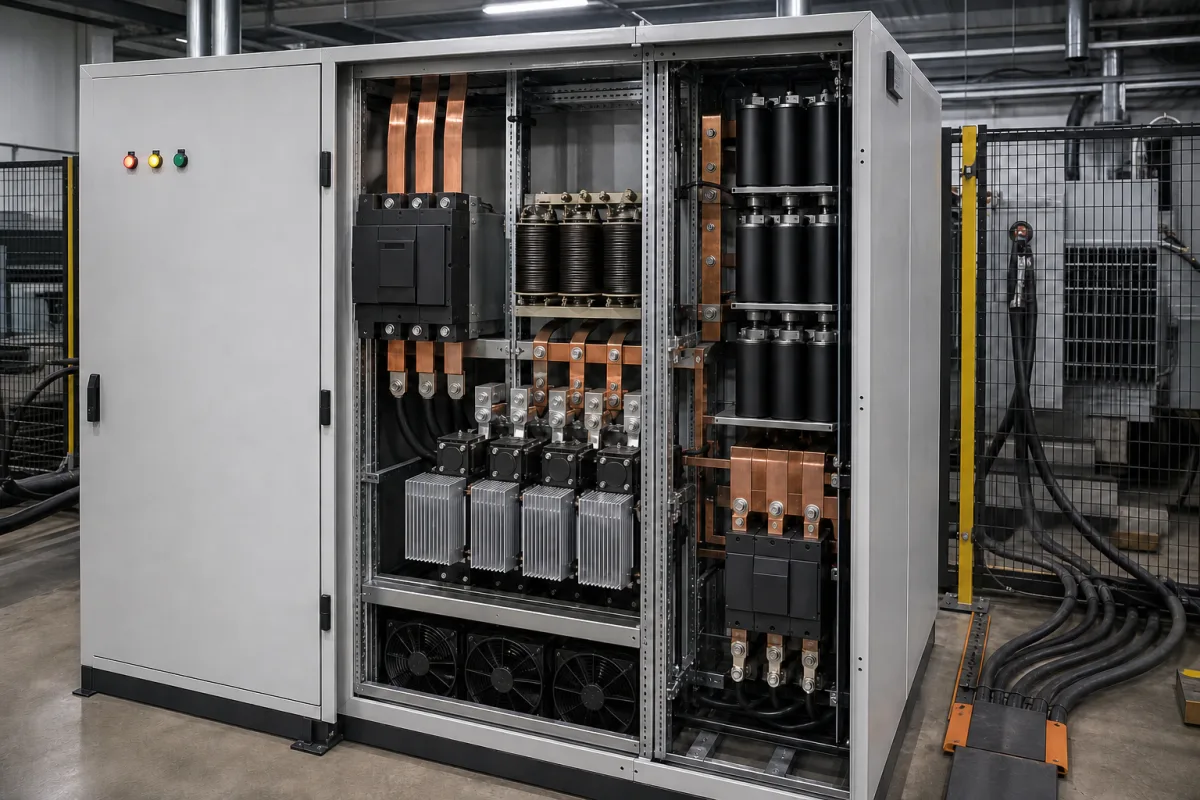
Power converter for a wind turbine (the low-voltage cabinet that connects the generator to the grid)
The converter cabinet between a wind turbine generator and the grid · full power or doubly-fed, 525–690 V grid side, IGBT modules with DC capacitors, air or liquid cooling, IP54 cabinets, fault ride-through tests, and humidity inside the cabinet as a driver of failures
In a variable-speed wind turbine, the converter cabinet connects the generator to the grid. ABB's product note separates full power converters, listed for permanent magnet and asynchronous generators, from converters for doubly-fed induction generators (DFIG), which have a rotor connection. The buyer specifies the generator type and rating, grid voltage, grid codes, cooling and where the cabinet will stand, in the nacelle or at the tower base.
Low-voltage converter cabinets for wind turbine generators, full power and doubly-fed. Packaged DC-DC converter modules are covered on the DC-DC converter page; battery storage converters on the Energy storage converter (PCS) page; PV inverters on the Solar inverter (grid-tied PV inverter) page; 50/60/400 Hz static converters on the Frequency converter (static 50/60/400 Hz power converter) page; motor drives on the Variable frequency drive page; inverter power-stage assemblies on the Power electronics board (inverter power-stage assembly: power modules, gate-driver board, DC link and busbars on a liquid-cooled cold plate) page.
CNFX editorial research · Sources checked October 13, 2026 · 2 sources
Full power or doubly-fed, and what one product range lists
ABB's ACS800 low voltage wind turbine converter product note (2013) covers both drivetrain concepts and says that "In case of grid faults, full converters decouple the generator from the grid and provide dynamic and flexible response to fault conditions." Both types are listed for 525 to 690 V AC three-phase grids, ±10%, with air or liquid cooling and nacelle or tower installation. [1]
The highlights list "IGBT power modules with integrated DC capacitors and control electronics", a grid side contactor or breaker, "All components installed inside an IP54 cabinet", and an optional parallel sub-converter configuration for redundancy. The full power models are listed for permanent magnet and asynchronous generators. Total harmonic current distortion (n = 2 to 40) is given as max 4% beside max 3% "with DFIG generator current"; generator side du/dt is 1.0 to 1.4 kV/µs. [1]
The note gives differing power ranges for the same full power models. Its technical data table lists 0.6 to 3.3 MW and 1.5 to 6 MW, while the model headings read "ACS800-77LC, 0.8 to 3.3 MW" and "ACS800-87LC, 1.75 to 6 MW"; the rating tables sit next to those headings without their own labels. Confirm the rating range for the exact model with the supplier. [1]
Before shipment, ABB says the converters go through fault ride-through and power quality tests in its multi-megawatt grid code laboratory. The note lists fault ride-through against grid codes from Germany, Spain, Denmark, National Grid Electricity Transmission, FERC and CEPRI (China). [1]
Generator rating
Generator / grid current
Modules
Cabinet width
Coolant flow
Cabinet weight
800 kW
898 A / 720 A
2 + 2
2,300 mm
100 l/min
2,000 kg
1,800 kW
1,697 A / 1,843 A
3 + 4
3,300 mm
170 l/min
3,000 kg
1,750 kW
1,697 A / 1,843 A
3 + 4
1,600 mm
185 l/min
3,000 kg
3,200 kW
3,324 A / 3,192 A
6 + 7
2,600 mm
260 l/min
4,500 kg
Rows are from ABB's two full power converter tables (800–3,300 kW and 1,750–3,200 kW). State the generator type and rating, grid voltage, grid codes, cooling medium and installation place, and ask for cabinet dimensions and weight for that rating.
02
Humidity inside the converter cabinet
Karoline Pelka and Katharina Fischer of Fraunhofer IWES write that "the converter system of, on average, every second wind turbine suffers damage which requires repairing" each year, and that field data analyses showed power and temperature cycling fatigue does not play a relevant role in wind turbines; seasonal failure patterns instead point to humidity. [2]
Their measurements covered 31 turbines from seven manufacturers on three continents, onshore and offshore, with converters in the nacelle or tower base, air- and water-cooled. The absolute humidity in the turbine or the power cabinet "barely differs from that of the environment around the turbine, not even in air-conditioned offshore wind turbines". [2]
Cabinet air was on average 5–30 K warmer than turbine ambient air, so cabinet relative humidity stayed below ambient, "typically by at least 20% on average over the course of the year". The authors still find that "it is precisely the relative humidity in the cabinet which is key to failure generation", and that comparably low levels have an impact on reliability. [2]
Give the supplier the site climate (onshore or offshore, ambient temperature and humidity range) and the installation place, and ask how cabinet relative humidity is kept down when the turbine stands still or runs at low load.
03
Wind turbine converter details
Paste it into your enquiry below or into an email to a maker, then replace every bracket.
Explore company information and manufacturing capabilities, then discuss the scope of your project with a relevant supplier.
Share this page
Compiled and source-reviewed by the CNFX editorial team.
Each manufacturer above links to the page on that company's own website where the product is listed, with the date we checked it. How we source and review
· Page last updated 13 October 2026
Buyer questions
What does a full power converter do during a grid fault?
ABB says full converters decouple the generator from the grid and give a dynamic response to the fault. [1]
What grid voltage do low-voltage wind converters connect to?
ABB's ACS800 range lists 525 to 690 V AC three-phase, ±10%. [1]
How often do wind turbine converters need repair?
Fraunhofer IWES researchers write that each year, on average, every second turbine's converter system needs repairing. [2]
Why is humidity relevant if the cabinet is warm?
Fraunhofer IWES found cabinet relative humidity is the key to failure generation, even at comparably low levels. [2]
Sources and what still needs a direct check
Sources checked 2026-10-13. ABB publishes the ACS800 low voltage wind turbine converter product note; Fraunhofer IWES publishes a summary of its converter humidity field study (Fischer et al., Energies 2021).