Industry-Verified Manufacturing Data (2026)

Transformer / Inductor

Based on aggregated insights from multiple verified factory profiles within the CNFX directory, the standard Transformer / Inductor used in the Electrical Equipment Manufacturing sector typically supports operational capacities ranging from standard industrial configurations to heavy-duty production requirements.

Technical Definition & Core Assembly

A canonical Transformer / Inductor is characterized by the integration of Magnetic core and Winding. In industrial production environments, manufacturers listed on CNFX commonly emphasize Ferrite core construction to support stable, high-cycle operation across diverse manufacturing scenarios.

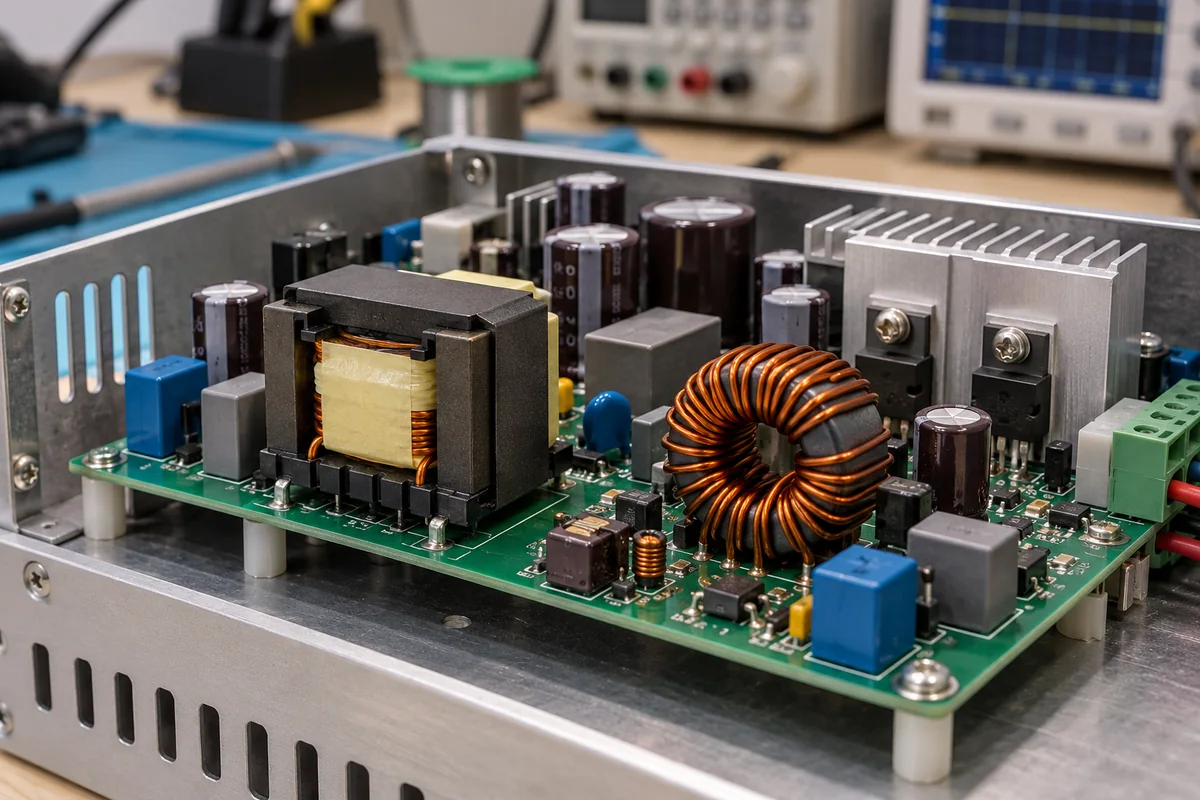
Electromagnetic components in power converters that transfer energy, change voltage levels, or store energy in magnetic fields.
Product Specifications

Technical details and manufacturing context for Transformer / Inductor

Definition
Transformer/Inductor components are essential electromagnetic elements within power converter systems. Transformers transfer electrical energy between circuits through electromagnetic induction while changing voltage and current levels. Inductors store energy in magnetic fields and regulate current flow, providing filtering, energy storage, and current limiting functions in converter circuits.
Working Principle
Transformers operate on electromagnetic induction between primary and secondary windings around a magnetic core, enabling voltage transformation and isolation. Inductors function by storing energy in magnetic fields when current flows through coiled conductors, resisting changes in current and providing impedance to AC signals.
Common Materials
Ferrite core, Silicon steel core, Copper winding, Insulation materials, Bobbin
Technical Parameters
  • Core dimensions including length, width, and height for magnetic path optimization (mm) Standard Spec
Components / BOM
  • Magnetic core
    Provides magnetic path and concentrates magnetic flux
    Material: Ferrite or silicon steel
  • Winding
    Conducts electrical current and creates magnetic field
    Material: Copper or aluminum
  • Bobbin
    Supports and insulates windings
    Material: Plastic or ceramic
  • Insulation
    Prevents electrical shorts between windings and core
    Material: Polyester film or varnish
Engineering Reasoning
0.1-1000 kVA for power transformers, 1 μH-10 H for inductors
Core saturation flux density exceeding 1.6-2.0 T for silicon steel, insulation breakdown at >25 kV/mm for transformer oil, thermal runaway at >180°C for Class H insulation
Design Rationale: Core saturation due to excessive magnetic flux density (Bmax = μ0μrH), dielectric breakdown from electric field strength exceeding insulation material's dielectric strength, thermal degradation from Arrhenius equation (reaction rate doubles per 10°C rise above rated temperature)
Risk Mitigation (FMEA)
Trigger Core saturation from DC bias current exceeding 10% of rated AC current
Mode: Inductor overheating to >200°C due to increased core losses (Pcore ∝ Bmax^2 f^1.3)
Strategy: Gapped core design with air gap length calculated using lg = (μ0N^2Ae)/L to prevent saturation, DC blocking capacitors in series
Trigger Partial discharge inception at >3 pC discharge magnitude in transformer insulation
Mode: Progressive insulation breakdown leading to winding-to-winding short circuit
Strategy: Vacuum pressure impregnation with epoxy resin having >30 kV/mm dielectric strength, corona shielding using semiconductor coatings at winding edges

Industry Taxonomies & Aliases

Commonly used trade names and technical identifiers for Transformer / Inductor.

Applied To / Applications

This component is essential for the following industrial systems and equipment:

Industrial Ecosystem & Supply Chain DNA

Complementary Systems
Downstream Applications
Specialized Tooling

Application Fit & Sizing Matrix

Operational Limits
pressure: Atmospheric to 1.5 bar (typical for sealed units), vacuum compatible for oil-filled types
other spec: Frequency range: 50Hz to 1MHz, insulation resistance: >100MΩ at 500VDC, dielectric strength: 2-4kV RMS
temperature: -40°C to +150°C (ambient), up to +200°C (hot spot) depending on insulation class
Media Compatibility
✓ Dry air/nitrogen (encapsulated) ✓ Mineral/silicone oil (immersed) ✓ Epoxy/potting compounds (sealed)
Unsuitable: Conductive/ionized fluids or corrosive atmospheres without proper hermetic sealing
Sizing Data Required
  • Required power rating (VA/kVA)
  • Input/output voltage and current specifications
  • Operating frequency and duty cycle

Reliability & Engineering Risk Analysis

Failure Mode & Root Cause
Insulation breakdown
Cause: Thermal aging from overheating, moisture ingress, or electrical stress exceeding dielectric strength
Winding deformation or short circuit
Cause: Mechanical stress from through-fault currents, loose connections, or vibration leading to insulation displacement
Maintenance Indicators
  • Audible humming or buzzing that increases in intensity or changes pitch
  • Visible oil leaks, discoloration, or bulging in the transformer tank
Engineering Tips
  • Implement regular dissolved gas analysis (DGA) on insulating oil to detect early thermal and electrical faults
  • Maintain proper cooling system operation and cleanliness to prevent overheating, and ensure tight electrical connections to reduce hot spots

Compliance & Manufacturing Standards

Reference Standards
ISO 9001:2015 - Quality management systems IEC 61558-1 - Safety of power transformers, power supplies, reactors and similar products UL 506 - Standard for Specialty Transformers
Manufacturing Precision
  • Inductance tolerance: +/-10% (typical for power inductors)
  • Winding resistance tolerance: +/-5% (for copper windings)
Quality Inspection
  • Hi-pot (dielectric withstand) test - verifies insulation integrity
  • Inductance measurement test - confirms electrical performance specifications

Factories Producing Transformer / Inductor

Verified manufacturers with capability to produce this product in China

✓ 92% Supplier Capability Match Found

S Sourcing Manager from United States Feb 25, 2026
★★★★★
"The technical documentation for this Transformer / Inductor is very thorough, especially regarding technical reliability."
Technical Specifications Verified
P Procurement Specialist from United Arab Emirates Feb 22, 2026
★★★★☆
"Reliable performance in harsh Electrical Equipment Manufacturing environments. No issues with the Transformer / Inductor so far. (Delivery took slightly longer than expected, but technical support was excellent.)"
Technical Specifications Verified
T Technical Director from Australia Feb 19, 2026
★★★★★
"Testing the Transformer / Inductor now; the technical reliability results are within 1% of the laboratory datasheet."
Technical Specifications Verified
Verification Protocol

“Feedback is collected from verified sourcing managers during RFQ (Request for Quote) and factory evaluation processes on CNFX. These reports represent historical performance data and technical audit summaries from our B2B manufacturing network.”

13 sourcing managers are analyzing this specification now. Last inquiry for Transformer / Inductor from India (1h ago).

Supply Chain Compatible Machinery & Devices

Circuit Breaker Trip Unit

Protective control module for electrical circuit breakers

Explore Specs →
Circuit Breaker Arc Chute

Electrical component that extinguishes arcs in circuit breakers

Explore Specs →
Medium Voltage Switchgear Assembly Line

Automated production system for assembling medium voltage electrical switchgear.

Explore Specs →
Motor Terminal Block

Electrical connection interface for motor windings

Explore Specs →

Frequently Asked Questions

What are the main differences between ferrite core and silicon steel core transformers?

Ferrite cores excel in high-frequency applications with low core losses, while silicon steel cores are ideal for low-frequency power transformers due to higher saturation flux density and better efficiency at 50/60Hz.

How do I select the right insulation materials for transformer windings?

Consider operating temperature class, dielectric strength, thermal conductivity, and environmental factors. Common materials include polyester film, Nomex, and epoxy coatings, with selection based on voltage requirements and thermal management needs.

What factors affect the efficiency of inductors in power converters?

Core material properties (permeability, losses), winding resistance (copper quality and configuration), operating frequency, and thermal design all significantly impact inductor efficiency in switching power supplies and converters.

Can I contact factories directly on CNFX?

CNFX is an open directory, not a transaction platform. Each factory profile provides direct contact information and production details to help you initiate direct inquiries with Chinese suppliers.

Get Quote for Transformer / Inductor

Request technical pricing, lead times, or customized specifications for Transformer / Inductor directly from verified manufacturing units.

Your business information is encrypted and only shared with verified Transformer / Inductor suppliers.

Thank you! Your message has been sent. We'll respond within 1–3 business days.

Need to Manufacture Transformer / Inductor?

Connect with verified factories specializing in this product category

Add Your Factory Contact Us
Previous Product
Transformer
Next Product
Transformer Core Lamination Stacking Machine