Industry-Verified Manufacturing Data (2026)

Power Switching Stage

Based on aggregated insights from multiple verified factory profiles within the CNFX directory, the standard Power Switching Stage used in the Electrical Equipment Manufacturing sector typically supports operational capacities ranging from standard industrial configurations to heavy-duty production requirements.

Technical Definition & Core Assembly

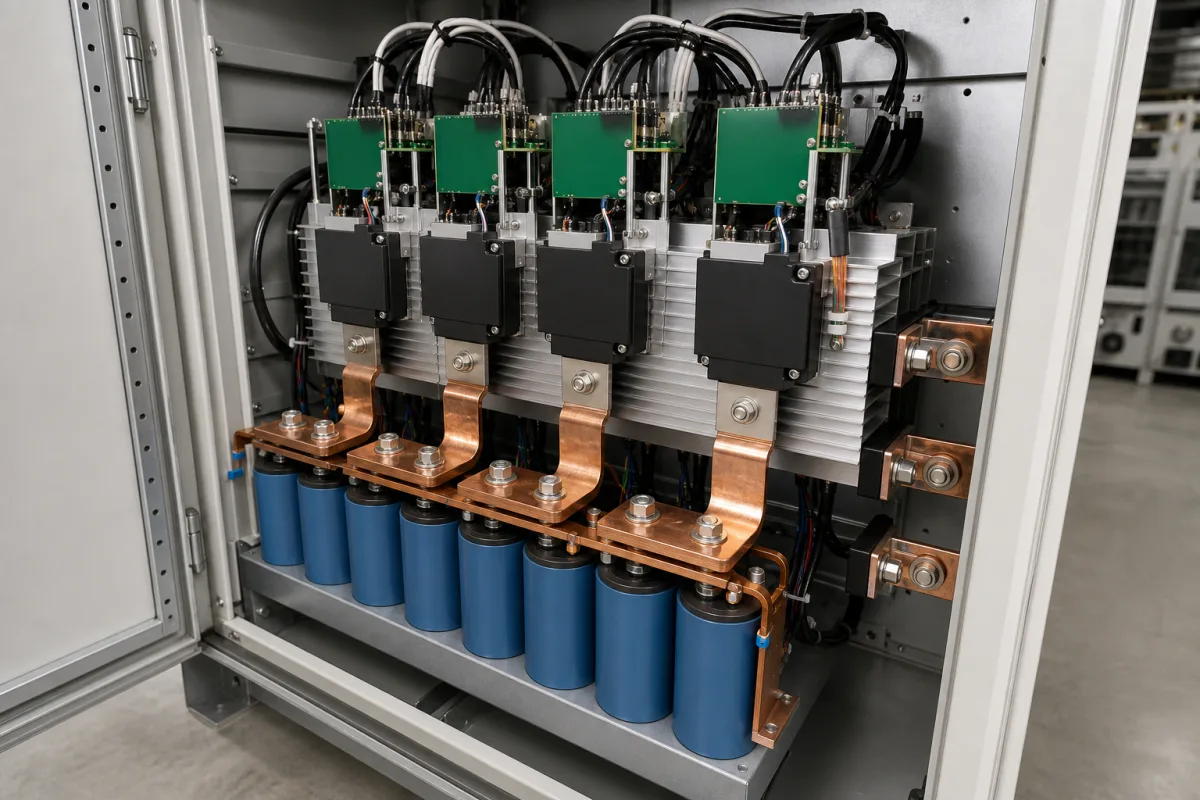
A canonical Power Switching Stage is characterized by the integration of Power Semiconductor Switch(es) and Gate Driver Circuit. In industrial production environments, manufacturers listed on CNFX commonly emphasize Silicon (for semiconductor dies) construction to support stable, high-cycle operation across diverse manufacturing scenarios.

A circuit stage within a Voltage Control Unit responsible for switching power flow to regulate output voltage.
Product Specifications

Technical details and manufacturing context for Power Switching Stage

Definition
The Power Switching Stage is a critical component of a Voltage Control Unit that performs the actual switching of electrical power. It typically consists of semiconductor switches (such as MOSFETs or IGBTs) and associated driver circuits. Its primary function is to rapidly turn the power flow on and off according to control signals from the unit's logic, enabling precise regulation of the output voltage through techniques like pulse-width modulation (PWM).
Working Principle
The stage receives a low-power control signal (e.g., a PWM waveform) from the Voltage Control Unit's controller. This signal drives a gate driver circuit, which amplifies it to rapidly switch high-power semiconductor devices (like MOSFETs/IGBTs) between their on (conducting) and off (non-conducting) states. This switching action chops the input DC power, creating a pulsed output. The average value of this pulsed waveform, filtered by downstream components (like inductors and capacitors), determines the final regulated DC output voltage.
Common Materials
Silicon (for semiconductor dies), Copper (for conductors and traces), FR-4 or similar (for PCB substrate), Thermal interface material (e.g., thermal paste), Aluminum (for heatsink)
Technical Parameters
  • Key electrical specifications include maximum switching current (A), maximum blocking voltage (V), and switching frequency (Hz). (A, V, Hz) Standard Spec
Components / BOM
  • Power Semiconductor Switch(es)
    The primary device(s) (e.g., MOSFET, IGBT) that physically interrupt or allow current flow.
    Material: Silicon, Gallium Nitride (GaN), Silicon Carbide (SiC)
  • Gate Driver Circuit
    Amplifies the low-power control signal to provide the high-current, fast voltage transitions needed to switch the power semiconductors reliably.
    Material: Integrated Circuit (Silicon), discrete transistors, resistors, capacitors
  • Snubber Circuit
    Suppresses voltage spikes and ringing caused by parasitic inductance during switching transitions to protect the semiconductors.
    Material: Resistors, capacitors, diodes
  • Heatsink
    Dissipates heat generated by switching and conduction losses in the semiconductor devices to maintain safe operating temperatures.
    Material: Aluminum, Copper
Engineering Reasoning
0-1000 V, 0-100 A, -40°C to 125°C ambient
Junction temperature exceeding 175°C for silicon MOSFETs, voltage overshoot beyond 1200 V for 1000 V-rated components, current density surpassing 100 A/cm²
Design Rationale: Thermal runaway due to power dissipation exceeding thermal resistance limits (RθJA > 2°C/W), avalanche breakdown from voltage transients exceeding semiconductor breakdown voltage, electromigration at current densities above 100 A/cm²
Risk Mitigation (FMEA)
Trigger Gate oxide breakdown from voltage spikes exceeding 20 V/ns slew rate
Mode: Short-circuit failure with drain-source resistance dropping below 0.1 Ω
Strategy: Integrated gate driver with active Miller clamp limiting dV/dt to 10 V/ns
Trigger Thermal cycling stress from 1000+ power cycles between -40°C and 125°C
Mode: Bond wire fatigue leading to open-circuit failure with resistance > 10 Ω
Strategy: Direct copper bonding (DCB) substrate with coefficient of thermal expansion matching silicon (4.2 ppm/°C)

Industry Taxonomies & Aliases

Commonly used trade names and technical identifiers for Power Switching Stage.

Applied To / Applications

This component is essential for the following industrial systems and equipment:

Industrial Ecosystem & Supply Chain DNA

Complementary Systems
Downstream Applications
Specialized Tooling

Application Fit & Sizing Matrix

Operational Limits
current: Up to 100A continuous
voltage: Up to 600V DC
temperature: -40°C to +125°C
thermal resistance: 1.5°C/W junction-to-case
switching frequency: Up to 500kHz
Media Compatibility
✓ DC power distribution systems ✓ Motor drive circuits ✓ Uninterruptible power supplies
Unsuitable: High-vibration industrial environments without proper mounting
Sizing Data Required
  • Maximum load current (A)
  • Input voltage range (V)
  • Required switching frequency (Hz)

Reliability & Engineering Risk Analysis

Failure Mode & Root Cause
Contact Welding
Cause: High inrush currents or frequent switching under load leading to arcing and localized melting of contact surfaces, causing them to fuse together.
Insulation Breakdown
Cause: Thermal cycling, moisture ingress, or contamination (dust, oil) degrading dielectric properties, leading to short circuits or ground faults.
Maintenance Indicators
  • Audible arcing or buzzing during operation, indicating poor contact or insulation issues.
  • Visible discoloration, scorch marks, or overheating on the switching device enclosure or terminals.
Engineering Tips
  • Implement predictive maintenance using thermal imaging to detect abnormal heat patterns in contacts and insulation before failure.
  • Ensure proper environmental control (e.g., dust sealing, humidity management) and use contactors/relays rated for the specific application's inrush and switching frequency.

Compliance & Manufacturing Standards

Reference Standards
ISO 9001:2015 - Quality Management Systems IEC 60947-1 - Low-voltage switchgear and controlgear UL 508 - Industrial Control Equipment
Manufacturing Precision
  • Contact Resistance: +/- 5% of rated value
  • Insulation Clearance: +/- 0.5mm
Quality Inspection
  • High-Potential (Hi-Pot) Dielectric Strength Test
  • Contact Resistance Measurement Test

Factories Producing Power Switching Stage

Verified manufacturers with capability to produce this product in China

✓ 97% Supplier Capability Match Found

P Project Engineer from Canada Jan 30, 2026
★★★★★
"Great transparency on the Power Switching Stage components. Essential for our Electrical Equipment Manufacturing supply chain."
Technical Specifications Verified
S Sourcing Manager from United States Jan 27, 2026
★★★★★
"The Power Switching Stage we sourced perfectly fits our Electrical Equipment Manufacturing production line requirements."
Technical Specifications Verified
P Procurement Specialist from United Arab Emirates Jan 24, 2026
★★★★★
"Found 31+ suppliers for Power Switching Stage on CNFX, but this spec remains the most cost-effective."
Technical Specifications Verified
Verification Protocol

“Feedback is collected from verified sourcing managers during RFQ (Request for Quote) and factory evaluation processes on CNFX. These reports represent historical performance data and technical audit summaries from our B2B manufacturing network.”

7 sourcing managers are analyzing this specification now. Last inquiry for Power Switching Stage from Germany (1h ago).

Supply Chain Compatible Machinery & Devices

Circuit Breaker Trip Unit

Protective control module for electrical circuit breakers

Explore Specs →
Circuit Breaker Arc Chute

Electrical component that extinguishes arcs in circuit breakers

Explore Specs →
Medium Voltage Switchgear Assembly Line

Automated production system for assembling medium voltage electrical switchgear.

Explore Specs →
Motor Terminal Block

Electrical connection interface for motor windings

Explore Specs →

Frequently Asked Questions

What is the primary function of a power switching stage in electrical equipment?

The power switching stage regulates output voltage by controlling power flow within a voltage control unit, using semiconductor switches to manage electrical current precisely.

What materials ensure reliability in power switching stages?

Silicon semiconductor dies, copper conductors, FR-4 PCB substrates, thermal interface materials, and aluminum heatsinks work together to provide electrical efficiency, structural integrity, and thermal management.

How does the BOM contribute to power switching stage performance?

The bill of materials includes gate driver circuits for switch control, heatsinks for cooling, power semiconductor switches for current regulation, and snubber circuits to suppress voltage spikes, ensuring stable operation.

Can I contact factories directly on CNFX?

CNFX is an open directory, not a transaction platform. Each factory profile provides direct contact information and production details to help you initiate direct inquiries with Chinese suppliers.

Get Quote for Power Switching Stage

Request technical pricing, lead times, or customized specifications for Power Switching Stage directly from verified manufacturing units.

Your business information is encrypted and only shared with verified Power Switching Stage suppliers.

Thank you! Your message has been sent. We'll respond within 1–3 business days.

Need to Manufacture Power Switching Stage?

Connect with verified factories specializing in this product category

Add Your Factory Contact Us
Previous Product
Power Switching Circuit
Next Product
Power Transformer