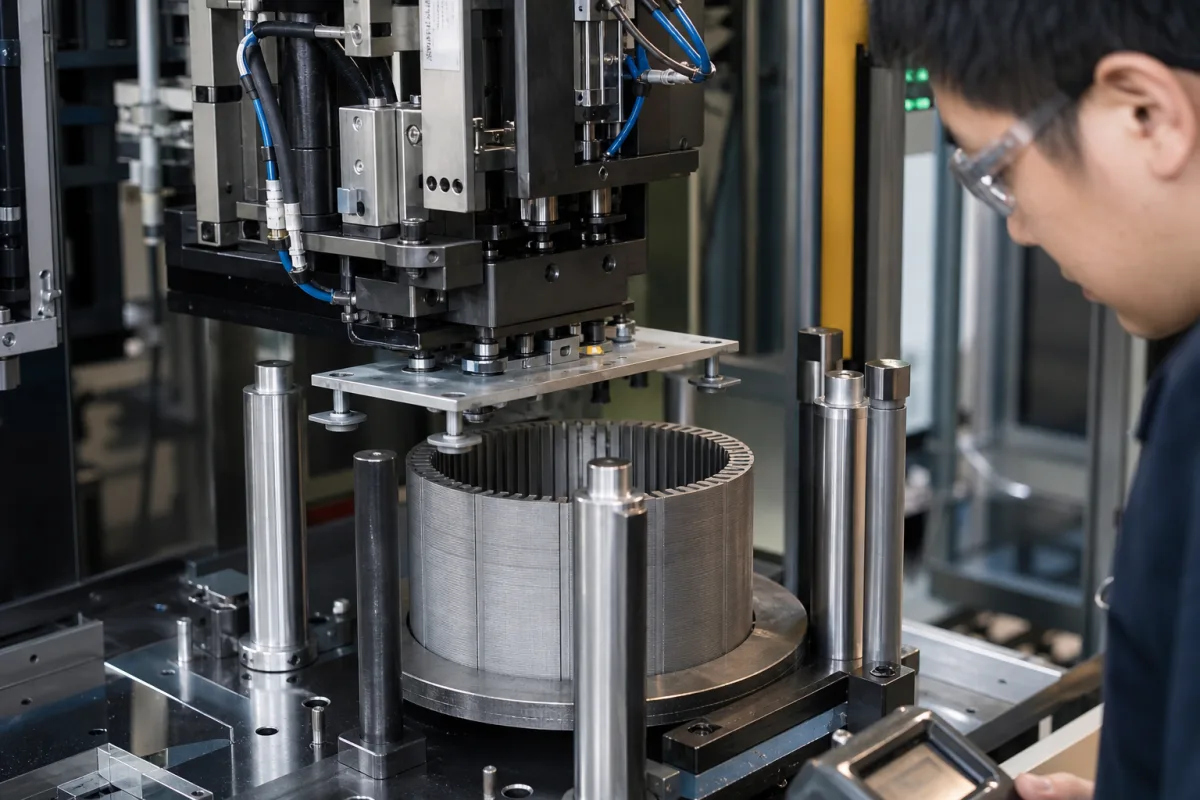
Precision stacking head for stator laminations: placing sheets over guide rods and building the stack to height
The pick-and-place end of a lamination stacking cell · 21 conical guide rods held to 0.05 mm position on a 15 t table, 18 to 23 laminations for one stack height, top-up laminations turned 180° to put burrs inward, and arms that stack inside a generator frame
Loose laminations that are not interlocked or bonded in the die have to be placed one by one, or in small packets, onto a fixture that keeps their slots in line. The stacking head is the part that picks them and puts them there; the fixture's locating rods, the measurement that decides when the stack is complete and, for large machines, the way sheets are brought into the frame all determine how precise the finished core is. This page takes those three in turn from patent and machine documents.
Pick-and-place stacking heads, pick-off heads and stacking tables that build stator and rotor cores from loose electrical-steel laminations over locating rods or mandrels, including stack-height control and stacking inside large generator frames. Machines that stack and then weld laminations into rotor or stator cores are covered on the Electric motor rotor lamination stacking and welding machine page. Transformer core stacking is covered on the Transformer core lamination stacking machine page and finished stator stacks on the Electric motor stator lamination stack page; in-die interlocking or bonding in stamping presses is outside this page.
CNFX editorial research · Sources checked October 13, 2026 · 4 sources
Twenty-one conical guide rods at ≤0.05 mm position on a 15-tonne table: where the robot puts each lamination
Shanghai Fanuc Robotics' patent application CN102306981A describes a stator lamination stacking workbench for power station generators that works with a robot stacking the laminations; it replaces fixed manual tables whose rods could not be raised automatically and whose positioning accuracy needed manual re-alignment of the laminations. [1]
Editorial note: the stacking head places each sheet over all 21 rods at once, so its placement accuracy has to be matched to the rod-to-slot clearance; the conical rod tips give the lamination a lead-in, and the servo lift adjusts rod height during stacking, the shortcoming the patent identifies in fixed tables.
Editorial calculation: a flatness of 0.1 mm over 3,000 mm is a slope of about 0.03 mm per metre, and the installed levelness is 0.08 mm per metre; per metre of table, both are smaller than the 0.05 mm rod position tolerance.
Element
Published requirement
Guide rods
21 in the embodiment; the number follows the stator lamination, for example 21, 19 or 22 [1]
Rod tips and finish
Conical ends; ground after heat treatment, surface roughness ≤ Ra 0.4, straightness ≤ 0.02 mm [1]
Rod position and squareness
Position ≤ 0.05 mm; perpendicularity to the table ≤ 0.02 mm [1]
Rod sleeves
Ground after heat treatment; inner wall coated with PTFE [1]
Rod height drive
Servo motor, precision reducer, servo coupling, precision steering gear and ball screw, guided by linear rails, raising an annular plate that carries the rods [1]
Table
Machined in one piece; flatness ≤ 0.1/3000 mm; installed levelness ≤ 0.08/1000 mm; load capacity ≥ 15 t [1]
Give the lamination drawing (outer and bore diameter, slot count and locating features), the clearance allowed between rod and slot, the core mass and stack length, and how many rods the fixture should use.
02
Stack to height, not to count: why the same core can take 18 or 23 laminations
Lamination thickness varies within the steel tolerance, so a fixed count does not give a fixed height. Oberg Industries' patent US5826323A works through an example. [2]
Oberg's own answer is inside the die: it measures strip thickness at each stroke and raises a 0.003 in dimple on selected laminations to correct the height by less than one lamination thickness. [2] A stacking head working with loose laminations has to solve the same problem outside the press.
Siemens' US4250614 does it by measurement: a first quantity smaller than the final stack is picked and its size measured at an intermediate station, then a second quantity depending on the result is added from a magazine of at least three carriers on a rotating column, so one carrier can be reloaded while the other two supply. The prior art it cites weighed the stack instead. The laminations added are turned 180° by the pickup device, so that the stamping burrs point inward at both ends of the stack and do not damage windings fitted later. [3]
In the companion pick-off head of US4311424, a pick-off finger engages a cutout in the laminations on a horizontal carrier, a guide bar aligned with the take-up mandrel keeps them in register, and the number picked is changed by changing the value set on the measuring device. [3]
Oberg example
Inches
Editorial conversion (mm)
Nominal lamination thickness
0.0185 ± 0.002
0.470 ± 0.051
Thinnest and thickest lamination
0.0165 and 0.0205 (printed as 0.2050 in the patent text)
0.419 and 0.521
Target stack height window
0.366 to 0.388
9.30 to 9.86
Laminations needed
23 at minimum thickness, 18 at maximum
—
Spread
Up to 5 laminations within the nominal stack height [2]
—
State the stack height and tolerance, the lamination thickness tolerance, whether the stack is built to height or to count, and whether burr direction at the stack ends matters.
03
Stacking inside a generator frame: a crane arm, wedge-guided sheets and a sliding lifter for alignment
For large turbo and hydro generators the core is stacked inside the stator frame. GE's US10658909B2 describes a stacker for horizontal stacking, including repair work where single sheets or packets are replaced instead of the whole core. [4]
GE notes that the devices then in use were installed inside the core, with rails in the stator frame carrying sheet dollies, and that setting them up took substantial time and cost. Its stacker instead uses a movable support outside the frame and an arm whose holding device, a gripper in one embodiment and a suction pad in another, clamps the sheets and guides them horizontally into the frame. [4]
Pairs of plates with wedges placed in the core slots keep the core stable and guide the incoming sheets, and a lifter with a circular sliding device and a plane sliding device lets the operator turn and shift the sheets to line them up with the stack, correcting misalignment once the sheets are inside the core. [4]
Editorial note: on these machines the stacking head is a crane arm and the locating rods are replaced by the core's own slots and wedges; ask how alignment is checked after each packet, since the patent leaves the alignment to the operator through the sliding devices.
State whether stacking is new build or repair, horizontal or vertical, the sheet or packet mass, and the access available inside the frame.
04
What to send for a precision stacking head
Paste it into your enquiry below or into an email to a maker, then replace every bracket.
Laminations: [drawing; thickness and tolerance; burr side]
Stack: [height and tolerance; to height or to count; mass]
Fixture: [guide rods or mandrel; rod count; clearance]
Head: [gripper or suction; single sheets or packets; placement accuracy]
Measurement: [height or weight check; top-up method]
Machine: [motor or generator; new build or repair; horizontal or vertical]
Explore company information and manufacturing capabilities, then discuss the scope of your project with a relevant supplier.
Share this page
Compiled and source-reviewed by the CNFX editorial team.
Each manufacturer above links to the page on that company's own website where the product is listed, with the date we checked it. How we source and review
· Page last updated 13 October 2026
Buyer questions
How accurate are the guide rods on a robot stator stacking table?
Shanghai Fanuc Robotics' CN102306981A specifies rod position ≤0.05 mm, perpendicularity to the table ≤0.02 mm, straightness ≤0.02 mm and surface roughness ≤Ra 0.4, with 21 rods in its embodiment. [1]
Why build a lamination stack to height rather than count?
Oberg's US5826323A shows that with 0.0185 ± 0.002 in laminations the same stack height can need anywhere from 18 to 23 laminations. [2]
Why are some laminations turned 180° when a stack is completed?
In Siemens' US4250614 the top-up laminations are turned 180° so that stamping burrs point inward at both ends of the stack and do not damage the windings. [3]
How are generator stator cores stacked inside the frame?
GE's US10658909B2 uses a crane arm with a gripper or suction pad, wedge plates in the core slots and a sliding lifter to align sheets horizontally inside the frame. [4]
Sources and what still needs a direct check
Sources checked 2026-10-13. Guide rod and table requirements come from Shanghai Fanuc Robotics' application CN102306981A; the lamination-count example from Oberg Industries' US5826323A; measured top-up, burr orientation and pick-off head from Siemens' US4250614 and US4311424; in-frame generator stacking from GE's US10658909B2.