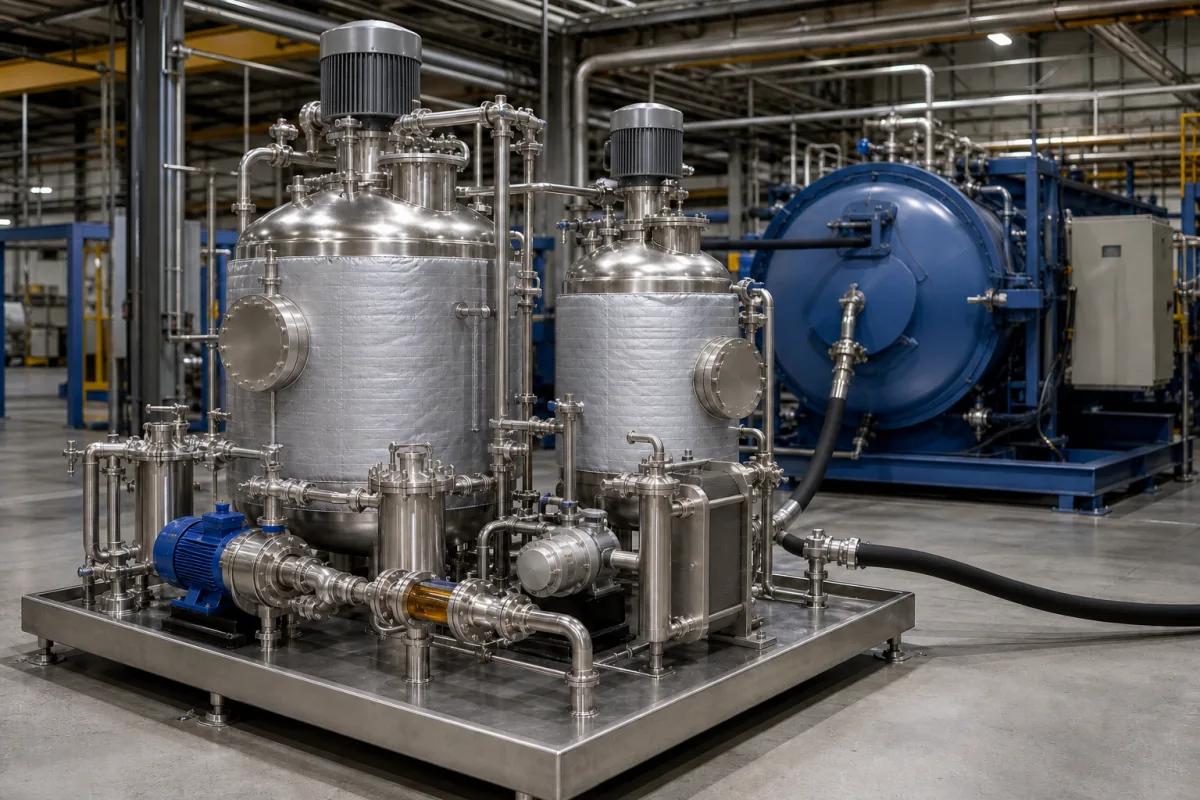
Resin storage and conditioning skid for winding impregnation: chilled, stirred tanks that hold the resin at 20–25 °C and keep its viscosity and gel time in limits
The resin side of an impregnation plant, before and between cycles · holding a one-component resin cool enough, turned over fast enough and stirred on a schedule so that it is still usable when it is drawn into the vessel
A one-component impregnating resin is sold with its hardener or catalyst already in it, so it is slowly curing from the day it is made. In a drum that clock is set by the shelf life on the label. Once the resin is in the plant's storage tank, the clock is set by the tank: how warm the resin is kept, how much of it is used and replaced each month, whether pigment is allowed to settle, and how often someone checks its viscosity and gel time. The storage and conditioning skid is the equipment that controls those four things: jacketed or coil-cooled tanks with a chiller, an agitator, a transfer pump and filters, and a sampling point.
Storage and conditioning equipment for one-component impregnating resins used on motor, generator and transformer windings: jacketed and chilled storage tanks, agitators, transfer and circulation pumps, filters and sampling points, sized from the resin maker's tank temperature, turnover and stirring requirements. The impregnation vessel with its vacuum and pressure cycle is covered on the Vacuum pressure impregnation (VPI) chamber page; gear metering pumps and dispense valves on the Metering pump/valve set for resin page; preheat and cure ovens on the VPI-line curing oven page; pressure boosters on the Pressure intensifier page and press hydraulics on the Hydraulic pressure control system for presses page. The resins themselves and two-component meter-mix machines are outside this page.
CNFX editorial research · Sources checked October 13, 2026 · 4 sources
Tank temperature and turnover written into three resin data sheets: 20 °C or below, below 25 °C, and at least 10 % replaced each month
The chiller duty and the tank size both follow from these two numbers. A tank that is too large for the plant's resin use cannot reach the turnover the resin maker asks for, whatever the chiller does.
ELANTAS links the bodying (thickening) of precatalysed resins such as E 468-2FC to extended storage and use, and writes that tanks without chillers or with minimal turnover may require the occasional addition of fresh resin. [1] It also asks for treated units to cool to room temperature before immersion, to limit bodying of the resin; that matters for the storage tank because resin returned from the vessel after the cycle carries the heat it picked up from the parts. [1]
Editorial calculation: a tank holding 1,000 kg of Voltatex 4020 needs at least 100 kg a month used and replaced to meet the 10 % rule, which is five 20 kg cans (100 ÷ 20). [3] A plant that uses 30 kg a month should therefore hold no more than about 300 kg in the tank, not size the tank for the largest part it might ever treat.
Resin (data sheet)
Chemistry
Tank requirement
Drum storage
As supplied
ELANTAS Ripley E 468-2FC
Single-component, heat-cured, 100 % solids epoxy; no catalyst to add
Replenishment of 10 % or more per month and cooling to keep the resin at 20 °C / 68 °F or below [1]
Below 25 °C, six months from shipment in sealed containers; usable life extended by refrigerated storage at 5 °C [1]
Viscosity 300–1,000 cP at 25 °C; Sunshine gel time 10–20 min at 135 °C [1]
ELANTAS Epoxylite TSA 220
One-component epoxy VPI resin, thermal class 220 °C
Viscosity and gel time in tanks to be monitored regularly and kept within the recommended limits; tank sample testing offered on request [2]
At least 12 months below 25 °C in tightly closed containers [2]
1,250 mPa·s at 50 °C; gel time 6 min at 165 °C; cure 12 h at 165 °C [2]
Give the resin product and its data-sheet tank temperature and turnover, the monthly resin consumption, the hottest ambient in the resin room, and the temperature of resin returned from the impregnation vessel.
02
Motor-driven stirring for pigmented resin, circulation and a sampling point for viscosity and gel-time checks
Two of the three data sheets ask for things the skid must physically provide: a stirrer in the tank, and resin samples drawn from it on a schedule.
The Voltatex 4020 data sheet says the pigmented resin has to be stirred in its delivery packaging before it is filled into the tank to avoid pigment sedimentation, that a continuous or repetitive stirring schedule must be set up during processing, and that a motor-powered stirring unit in the storage tank is “highly recommended”. [3] It names a separate thinner, Voltatex T031, for adjusting process viscosity and a cleaner, Voltatex T050, for regular cleaning of the equipment, because the cured resin is almost insoluble. [3]
ELANTAS's TSA 220 sheet makes the monitoring explicit: viscosity and gel time of the resin in the tank are to be checked regularly and held within the recommended limits. [2] For E 468-2FC the reference values are 300–1,000 cP at 25 °C and a 10–20 minute Sunshine gel time at 135 °C, so a tank sample can be compared directly with the as-supplied range. [1]
The picture above shows the arrangement: two insulated stainless tanks with top-mounted agitator motors on one skid, a blue transfer pump, filter housings and a plate heat exchanger in the pipework, and a hose running to the impregnation vessel behind.
Skid element
Requirement it serves
Source
Chiller with jacket or coil
Hold the resin at 20 °C or below (E 468-2FC) or below 25 °C (Voltatex 4020)
Specify agitator type and duty (continuous or timed), the sampling valve position and size, the viscosity and gel-time test the plant will run, and the cleaning access the tank needs.
03
Accelerator in the mica tape, slow epoxy-anhydride in the tank: why global-VPI resin for high-voltage coils keeps in storage
High-voltage stator bars are impregnated with a different arrangement, and it changes what the storage tank has to do.
A review of mica/epoxy insulation from Montanuniversität Leoben and partners describes a system still in use in which zinc naphthenate is immobilised in the mica tape as the accelerator for the VPI process, while the epoxy/anhydride resin reaches it from the tank. [4] It states that cycloaliphatic anhydrides such as MHHPA react at higher temperatures and show good storage stability, that DGEBA with MHHPA reacts so slowly that an accelerator is required, and that the choice of metal-salt accelerator can move hardening temperatures between 90 and 170 °C and change storage stability. [4]
For the storage skid this means the resin in the tank is not the full curing system; it only starts to cure fast where it meets the accelerator in the tape. The same review notes that the epoxy/anhydride/zinc naphthenate system shows only a low increase of viscosity at room temperature, with the reaction speeding up as temperature rises, so cooling and turnover still decide how long the tank charge lasts. [4]
State whether the resin is fully catalysed (one-component) or relies on an accelerator in the tape, since that decides how strict the tank temperature and turnover must be.
04
Resin storage skid data to send
Paste it into your enquiry below or into an email to a maker, then replace every bracket.
Resin product and data sheet: [ ]
Tank temperature limit: [°C]
Monthly resin use: [kg]
Tank working volume: [L or kg]
Return resin temperature from vessel: [°C]
Stirring: [continuous / timed; pigmented resin yes/no]
Sampling: [viscosity and gel-time test, frequency]
Transfer and filtration: [pump type; filter rating]
Cleaning: [solvent; access]
Explore company information and manufacturing capabilities, then discuss the scope of your project with a relevant supplier.
Share this page
Compiled and source-reviewed by the CNFX editorial team.
Each manufacturer above links to the page on that company's own website where the product is listed, with the date we checked it. How we source and review
· Page last updated 13 October 2026
Buyer questions
What temperature should a VPI resin storage tank be kept at?
ELANTAS asks for cooling to 20 °C or below for its E 468-2FC epoxy; the Voltatex 4020 data sheet asks for below 25 °C. [1][3]
How much resin turnover does a storage tank need?
Both ELANTAS and the Voltatex 4020 data sheet ask for at least 10 % of the tank used and replaced with fresh resin each month. [1][3]
Does the storage tank need an agitator?
For pigmented Voltatex 4020 the data sheet calls for a continuous or repetitive stirring schedule and recommends a motor-powered stirrer in the tank. [3]
What should be checked on resin in the tank?
ELANTAS asks for regular checks of viscosity and gel time against the recommended limits, and offers tank sample testing. [2][1]
Sources and what still needs a direct check
Sources checked 2026-10-13. Four documents: two ELANTAS resin data sheets (Ripley E 468-2FC and Epoxylite TSA 220), the SynFlex data sheet for Voltatex 4020, and a peer-reviewed review of mica/epoxy insulation in Polymers.