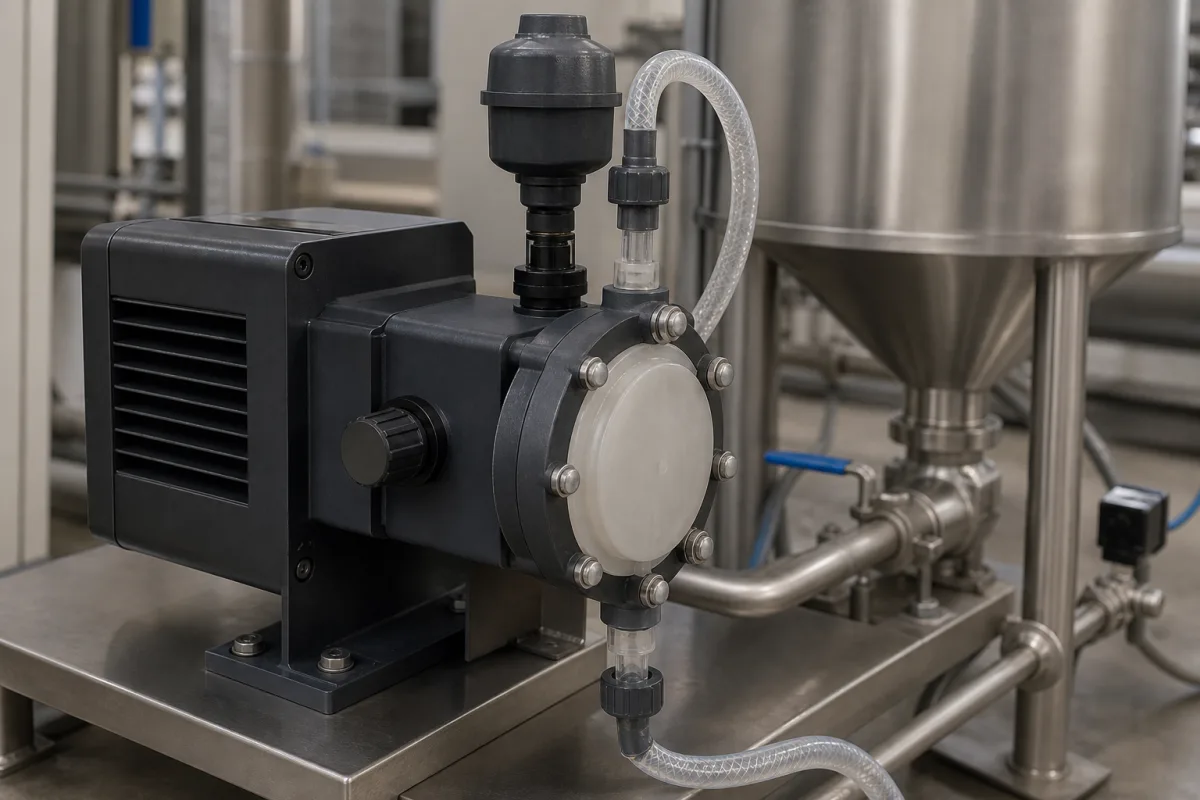
Chemical dosing · Accuracy, turndown and installation
A metering pump is bought for accuracy, so read how the accuracy is stated. A figure quoted against maximum capacity hides large errors at low flow; one tied to set point over a stated turndown does not. Size the pump so normal dosing sits high in its range, and give it the back pressure and calibration point it needs to stay accurate.
Diaphragm, plunger, peristaltic and gear metering pumps for chemical dosing in water treatment, process, food and fibre production. Transfer diaphragm pumps have their own page.
CNFX editorial research · Sources checked October 11, 2026 · 6 sources
Read accuracy, repeatability and linearity correctly
Wanner's metering pump glossary explains that API Standard 675 covers controlled-volume packed-plunger and diaphragm pumps (excluding diaphragm pumps with direct mechanical actuation) and defines steady-state accuracy as flow variation as a percentage of mean delivered flow under fixed conditions, which must stay within ±1%; it also requires flow repeatability and linearity within ±3% of rated capacity. API 674 and API 676 define no such tests. [1]
Pumps & Systems, with material from Milton Roy, warns that accuracy stated as a percentage of maximum capacity can mislead: a 1,000 gph pump at ±1% of maximum may be off by 10 gph at any setting, while accuracy tied to set point keeps the error proportional to the flow being dosed. [2]
As an editorial calculation from that example only: at a 50 gph setting, ±10 gph is ±20% of the dose, whereas ±1% of set point is ±0.5 gph.
Give the supplier the chemical, its concentration and viscosity, the normal, minimum and maximum dose rates, the injection-point pressure and whether control is manual, by analogue signal or by pulse.
02
Tie turndown to accuracy and size for the real dose
Pumps & Systems explains that turndown means little unless tied to measurable accuracy: a 1,000 gph pump with 100:1 turndown should stay within its accuracy down to 10 gph. It notes that "in most processes, a small percentage of applications need to go beyond 10-to-1", and that manufacturers verify turndown with tests such as 10-point curves at five descending and five ascending settings. [2]
The article states that a metering pump should be sized for the job, with the maximum expected flow at 85 to 90% of the pump's capacity. [2]
Ask the supplier for its turndown statement, the accuracy basis (set point or maximum capacity) and test data across the range you will use.
03
Install with back-pressure, relief and calibration
Wanner's glossary describes a back-pressure valve as ensuring constant pressure for the discharge check valves and diaphragm to work against, so the pump delivers accurate, predictable flow; a calibration cylinder to verify the performance of each pump system; and an internal bypass or external pressure relief valve to protect pump, piping and accessories. [1]
It also defines net positive suction head available against that required by the pump, noting that cavitation occurs when NPSHa is below NPSHr, and describes flooded suction and foot valves for suction-lift installations. Ask the supplier for NPSH required and recommended suction arrangement for your chemical. [1]
04
Compare what suppliers offer
Suppliers linked to this page list mechanical diaphragm, peristaltic, pneumatic and gear metering pumps and chemical injection skids. [3][4][5]
Laiko lists mechanical diaphragm metering pumps; Watson-Marlow lists Qdos peristaltic chemical metering pumps for brewing and other processes; CDI lists chemical injection skids and pneumatic metering pumps; Futai lists gear metering pumps for synthetic fibre spinning. [3][4][5][6]
05
Trace the dosing system components
This is a functional reference built from the sources cited; it is not one maker's parts list.
Fill the specification fields with values for your dosing
A metering pump quotation needs dosing-specific values. The table explains each field, gives published values where a reviewed source states them, and says what to obtain from the supplier.
Explore company information and manufacturing capabilities, then discuss the scope of your project with a relevant supplier.
Share this page
Compiled and source-reviewed by the CNFX editorial team.
Published product pages show what a company offers, not tested performance. Confirm the legal seller, factory and scope for your order. How we source and review
· Page last updated 13 October 2026
Buyer questions
What accuracy does API 675 require for metering pumps?
Wanner's glossary states API 675 steady-state accuracy must be within ±1% of mean delivered flow, with flow repeatability and linearity within ±3% of rated capacity. [1]
Why does it matter how accuracy is stated?
Pumps & Systems notes that ±1% of a 1,000 gph maximum allows a 10 gph error at any setting, while accuracy tied to set point keeps the error proportional to the dose. [2]
Why fit a back-pressure valve?
Wanner explains it keeps a constant pressure for the check valves and diaphragm to work against, so the pump delivers accurate, predictable flow. [1]
Sources and what still needs a direct check
Sources checked 2026-10-11. Wanner Engineering's glossary summarises API 675 definitions; Pumps & Systems is a trade magazine using Milton Roy material. Supplier pages describe their own offers. API 675 itself was not read for this page.