Stacking and bonding fixture for self-bonding electrical-steel laminations: holding 0.5 to 5 N/mm² through the oven cure of a backlack core
The clamp a stack of self-bonding (backlack) laminations sits in while it cures · pressure set cold and not touched again, a plate-and-spring build that holds it through the oven, and the time and temperature window of the varnish
Self-bonding electrical steel arrives with a thermosetting varnish, called backlack or bonding varnish, already on both faces. After stamping, the laminations are stacked, pressed together and heated, and the varnish glues every lamination to its neighbour over its whole face, with no weld seam, rivet or interlock tab to disturb the magnetic path. Between stacking and curing, the stack has to be held: located so that slots and holes stay aligned, pressed at a defined pressure, and kept that way through a heating cycle that can last from minutes in a heated press to four hours or more in a convection oven. That is the job of the stacking fixture. Its specification is set less by the laminations' shape than by the varnish's process window.
Fixtures, clamps and baking devices that locate and press stacks of self-bonding (backlack) electrical-steel laminations for transformer, reactor and motor cores during curing in a heated press or oven: base and head plates, locating pins, spring or bolt pressure systems, and the pressure, temperature and time windows they must hold. Automatic stacking machines for cut-sheet transformer cores are covered on the Transformer core lamination stacking machine page; pick-and-place stacking heads on the Precision stacking head for stator laminations page; machines that stack and weld cores on the Electric motor rotor lamination stacking and welding machine page; rotational or skewed stacking of rotor cores on the Rotational and skew stacking mechanism for rotor cores page; and robots and clamps that hold loose grain-oriented transformer cores while they are moved on the Transformer core clamping and handling robot page. Finished cores and stacks are outside this page.
CNFX editorial research · Sources checked October 13, 2026 · 3 sources
Process windows the fixture must hold: 3 MPa for 1 to 5 minutes at 220–260 °C, or 0.5–1 MPa for one to two hours at 130–150 °C
The varnish sets the pressure, temperature and time; the fixture has to deliver all three across the whole stack. These are the windows published for three self-bonding coatings:
voestalpine's rules for stacks and specimens are fixture rules: the pressure load is applied to the stack cold, before bonding starts, and must not be readjusted during bonding; local increases in pressure or temperature must be avoided; cutting and stamping burrs must not exceed 0.03 mm and laminations keep the same cutting orientation; after bonding the stack cools in air or in the closed device to below 80 °C. [1] POSCO adds that a coating thicker than 5.4 µm can flow out to the side during core assembly and lower the core's stacking factor. [2]
Waelzholz reports that its fast-bonding varnish cuts curing time from 1.5 hours to a few minutes, depending on processing method and component size, with temperature and pressure similar to conventional bonding varnish, and that stamping and bonding can then be carried out in one process step. [3]
Editorial calculation: at backlack-v's 0.5–1 K/min, heating a stack from 20 °C to 130 °C takes 110 to 220 minutes before the 120-minute hold begins (110 ÷ 1 and 110 ÷ 0.5), so one fixture is tied up for roughly 4 to 6 hours per cycle; a quick-bond fixture at 240 °C holds pressure for 2 minutes. [1]
Name the varnish and its data-sheet window, the bonding route (heated press, oven, in-die), the stack height and lamination area, and the cycle time the line needs.
02
voestalpine's reference baking device: hardened 1.4122 plates ground to Ra 0.8, 40 disc springs, six M12 12.9 bolts, stacks to 65 mm
voestalpine publishes the drawings and parts list of the baking device it uses to make bonded test stacks. It is a small fixture, but it shows the parts every spring-loaded bonding fixture needs and the materials chosen for a cycle through a 200 °C oven.
In use, specimens up to 65 mm high are stacked in the device at room temperature and separated by a double layer of pressure-resistant paper; the springs are inserted, the device is closed, the defined pressure is applied cold, and the closed device goes into a preheated convection oven. [1] Editorial note: since the pressure is set cold and may not be readjusted, the disc-spring package is what has to keep the load on the stack as it heats and settles.
Editorial calculation: voestalpine's floating-roller specimen is 25 × 200 mm, or 5,000 mm²; at 3 MPa the fixture must apply 15 kN (5,000 × 3), and at backlack-v's 0.5–1 MPa between 2.5 and 5 kN. [1] POSCO's 50 × 50 mm laminate at 0.1 MPa needs only 250 N (2,500 × 0.1). [2] Production cores with larger lamination areas scale the same way, so the spring stack and bolts are sized from area × pressure.
Part
Size or specification
Material
Base plate
210 × 88 × 25 mm, ground, Ra 0.8, edges deburred [1]
1.4122, hardened and tempered to 900–1,100 N/mm² [1]
6 × socket-head M12 × 150, grade 12.9, DIN 912, with washers [1]
—
Pins and guide rods
Pins Ø16 × 37 mm (DIN EN ISO 8734); round bars Ø8 h9 × 140 mm in Ø8 H7 holes [1]
—
Give the lamination outline and area, the locating holes or slots to pin on, the stack height range, the target pressure and the oven or press the fixture must fit, and ask how the supplier verifies the pressure on the stack.
03
Locating the laminations: pins and guide rods for the stack in the picture
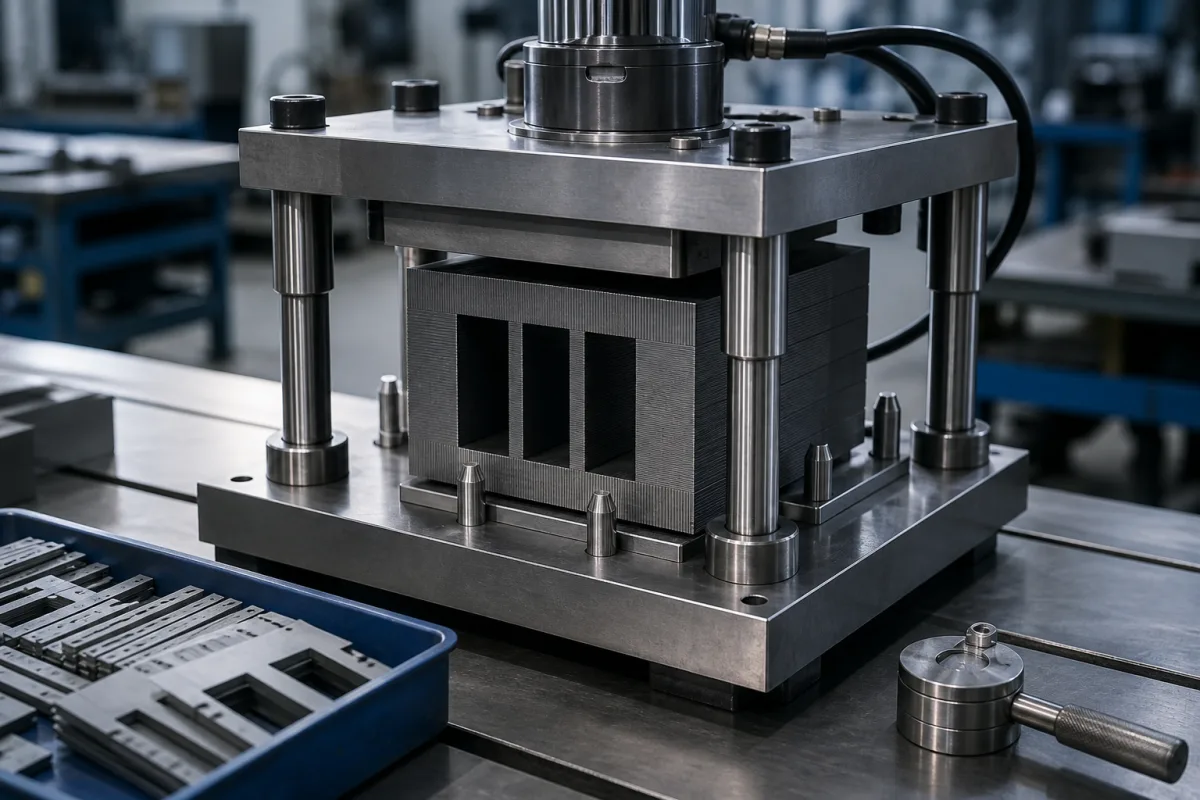
The picture above shows a fixture of this kind on a bench: a stack of laminations with three rectangular windows sits on a ground base plate between four guide posts, held by locating pins at the edges, with a head plate and a pressing cylinder above it and a tray of loose laminations beside it. voestalpine's device locates its plates on Ø8 h9 rods in Ø8 H7 holes and uses Ø16 pins, and requires the same cutting and stamping orientation through the stack. [1] For a production core, the pins go into features already on the lamination (bolt holes, slots or the outer contour), and pin and plate materials have to keep their fit through every oven cycle.
Mark the locating features on the lamination drawing, the alignment tolerance between laminations, and how the cured stack is removed from the pins.
04
Stacking fixture details to send
Paste it into your enquiry below or into an email to a maker, then replace every bracket.
Varnish and process window: [product; pressure; temperature; time]
Bonding route: [heated press; oven; in-die]
Lamination: [outline drawing; area; thickness; locating features]
Stack height: [min–max mm]
Pressure system: [disc springs; bolts; pneumatic or hydraulic]
Fixture materials and finish: [plate steel; hardness; flatness]
Quantity and cycle: [fixtures per oven load; cycle time]
Verification: [how stack pressure is measured]
Explore company information and manufacturing capabilities, then discuss the scope of your project with a relevant supplier.
Share this page
Compiled and source-reviewed by the CNFX editorial team.
Each manufacturer above links to the page on that company's own website where the product is listed, with the date we checked it. How we source and review
· Page last updated 13 October 2026
Buyer questions
What pressure does a backlack stacking fixture apply?
voestalpine gives 3 MPa for Remisol EB 549 rapid and 0.5–1 MPa for backlack-v, applied at room temperature; POSCO gives 1.0–5 N/mm² for its self-bonding sheet. [1][2]
Can the pressure be adjusted during curing?
No. voestalpine requires the pressure to be applied before bonding begins, with no readjustment during the bonding process. [1]
How long does the cure take?
From 1 minute at 260 °C (quick bonding, EB 549 rapid) to at least 120 minutes at 130 °C for backlack-v; Waelzholz reports fast-bonding varnish cutting 1.5 hours to a few minutes. [1][3]
What is the fixture made of?
voestalpine's reference baking device uses 1.4122 steel plates hardened to 900–1,100 N/mm², 40 DIN 2093 disc springs and six M12 12.9 bolts. [1]
Sources and what still needs a direct check
Sources checked 2026-10-13. Three sources from three publishers: voestalpine's Backlack processing guidelines with its baking-device drawings, POSCO's European patent application EP 4 265 409 on self-bonding electrical steel, and a Waelzholz report on fast-bonding varnish.