Motor Control Center
View system integration details
This page explains how Starter Bucket (Unit) is classified within Electrical Equipment Manufacturing. Technical values and manufacturer relationships are research references; confirm the current specification and supplier evidence for each order.
A modular, removable unit within a Motor Control Center (MCC) that houses motor starters and associated control components.
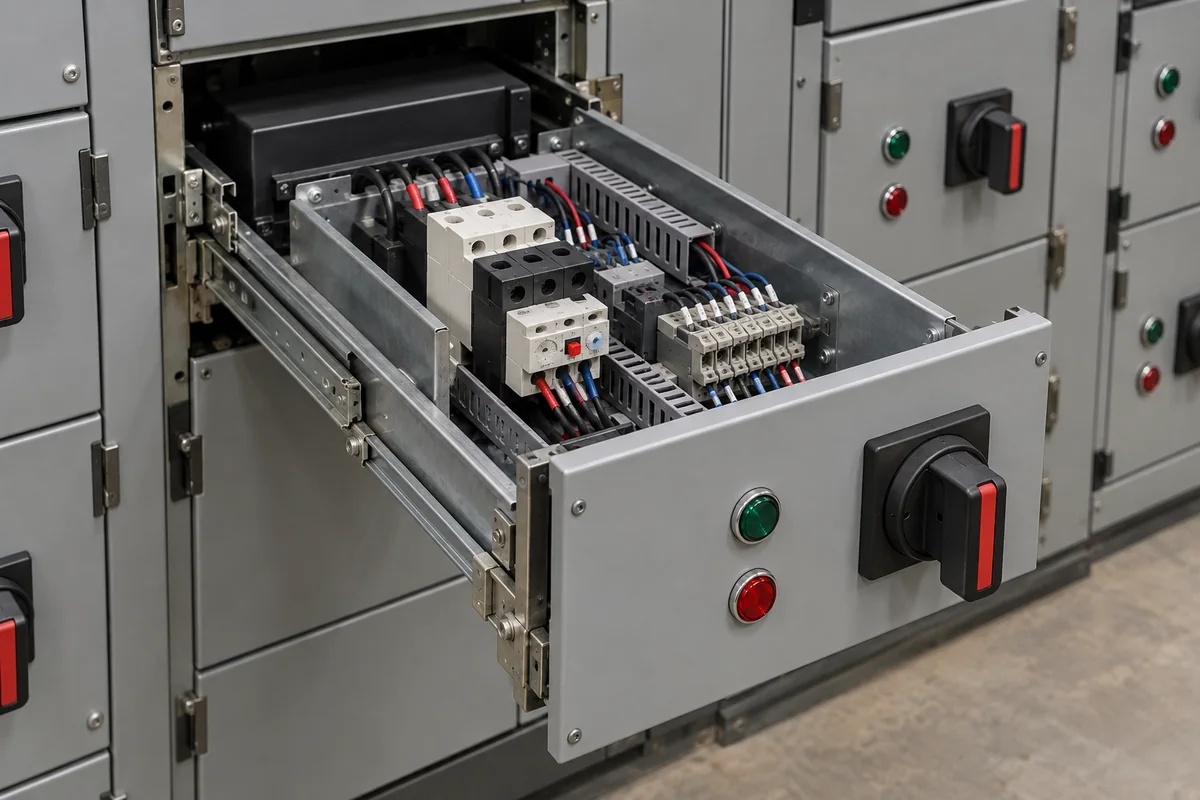
Technical details and manufacturing context for Starter Bucket (Unit)
| Parameter | Typical range | Notes & selection driver |
|---|---|---|
| Rated Operational Voltage | 690 V AC | Max voltage for the unit's bus system.IEC 60947-1 |
| Rated Insulation Voltage | 1000 V | Withstands transient overvoltages.IEC 60947-1 |
| Rated Current | 16–630 A | Depends on starter size and frame.IEC 60947-1 |
| Short-Circuit Withstand Rating | 50–100 kA | With appropriate back-up fuse.IEC 61439-1 |
| Degree of Protection | IP54–IP65 | Higher IP for dusty/hosed areas.IEC 60529 |
| Operating Temperature Range | -5–55 °C | Derating above 40°C.IEC 61439-1 |
| Relative Humidity | 5–95 % | Non-condensing.IEC 60721-3-3 |
| Mechanical Endurance | 10000–30000 cycles | Insertion/withdrawal cycles.IEC 60947-5-1 |
| Electrical Endurance | 1000–5000 cycles | At rated current and voltage.IEC 60947-4-1 |
| Control Voltage | 24–230 V AC/DC | AC and DC versions available.IEC 60947-1 |
| Auxiliary Contacts | 1NO+1NC–4NO+4NC | Configurable for signaling.IEC 60947-5-1 |
| Weight | 15–80 kg | Depends on size and components. |
| Dimensions (W×H×D) | 300×400×250–600×800×500 mm | Modular sizes per MCC design. |
Ranges are indicative industry figures for RFQ preparation, not a supplier commitment. Confirm every value and standard with the legal manufacturer before ordering.
| pressure: | Atmospheric (enclosure rated for NEMA/UL standards) |
| other spec: | Maximum motor current: 600A (typical), Enclosure rating: NEMA 1/12/3R, Voltage range: 208-600V AC |
| temperature: | -20°C to +40°C (ambient operating range) |
Indicative industry ranges for design and RFQ preparation. Confirm the exact figures and applicable standard with the manufacturer before specifying.
Quoted from the published standard.
A practical evidence checklist for RFQ preparation and supplier evaluation.
Compare the published product scope and source details, then include your specifications and quantity in an enquiry.
Manufacturer profiles associated with Starter Bucket (Unit).
Explore company information and manufacturing capabilities, then discuss the scope of your project with a relevant supplier.
Ask for use case, specification boundaries, supplier type, and RFQ preparation information for this product.
A starter bucket is a removable, plug-in unit in a Motor Control Center (MCC) that houses motor starters, overload protection, and control components. It provides a self-contained assembly for controlling and protecting individual motors or related loads, allowing easy maintenance and replacement.
Typical rated operational voltage is up to 690 V AC, rated insulation voltage up to 1000 V, and rated current ranges from 16 to 630 A. These are reference ranges; exact values depend on the specific model and must be confirmed with the manufacturer.
It includes overload relays that monitor current. If an overload condition is detected, the relay trips and opens the circuit, disconnecting the motor from the power supply to prevent damage. The unit can also be isolated and withdrawn for maintenance.
Relevant standards include IEC 60947-1 (low-voltage switchgear), IEC 61439-1 (low-voltage switchgear assemblies), IEC 60529 (degrees of protection), IEC 60721-3-3 (climatic conditions), IEC 60947-5-1 (control circuit devices), and IEC 60947-4-1 (contactors and motor-starters). These are procurement references; compliance must be verified with the manufacturer.
This component is essential for the following industrial systems and equipment:
Commonly used trade names and technical identifiers for Starter Bucket (Unit).
Editorial classification, named public sources where available, and source-reviewed manufacturer records.
Compare manufacturer profiles with relevant product and process capability.