Industry-Verified Manufacturing Data (2026)

Stator

Based on aggregated insights from multiple verified factory profiles within the CNFX directory, the standard Stator used in the Electrical Equipment Manufacturing sector typically supports operational capacities ranging from standard industrial configurations to heavy-duty production requirements.

Technical Definition & Core Assembly

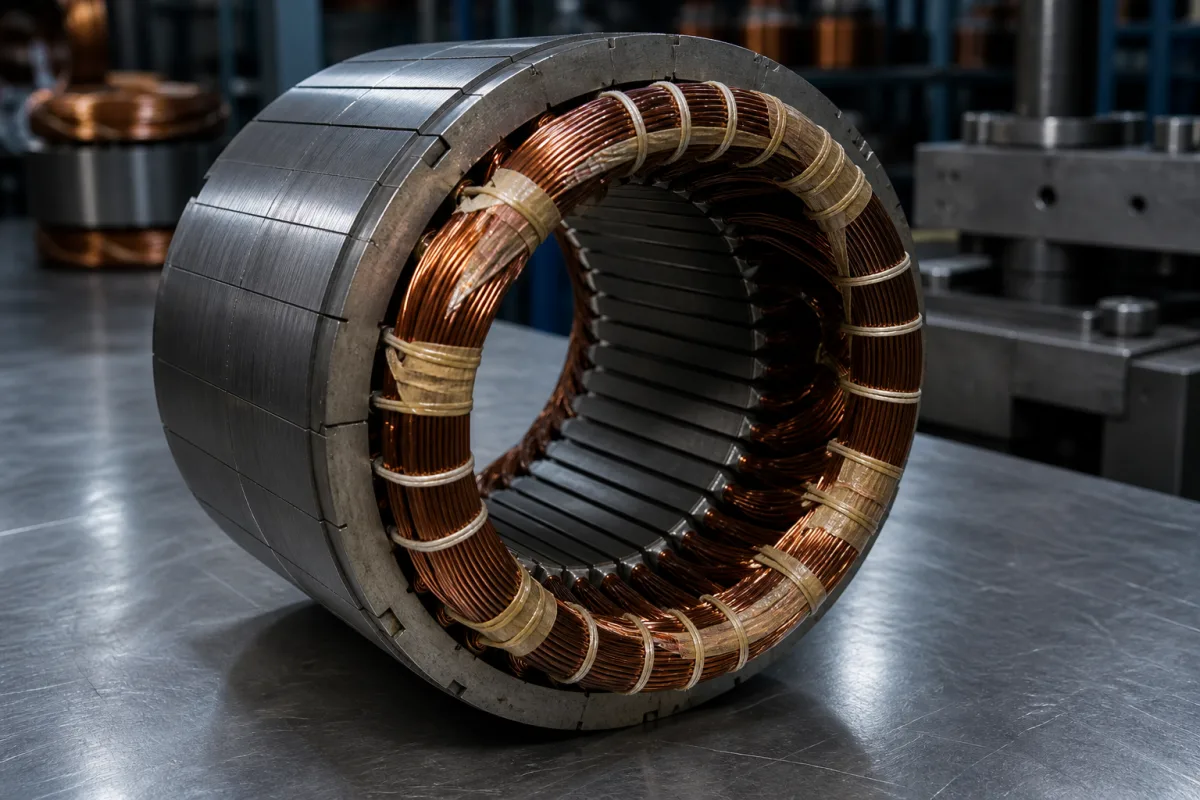
A canonical Stator is characterized by the integration of Stator Core and Stator Windings. In industrial production environments, manufacturers listed on CNFX commonly emphasize Electrical steel laminations construction to support stable, high-cycle operation across diverse manufacturing scenarios.

The stationary part of an electric motor that generates a rotating magnetic field.
Product Specifications

Technical details and manufacturing context for Stator

Definition
In a spindle motor, the stator is the stationary outer component that contains the windings through which electrical current flows to create a rotating magnetic field, which in turn drives the rotation of the rotor (attached to the spindle). It is the primary electromagnetic component responsible for motor torque generation.
Working Principle
When alternating current (AC) is applied to the stator windings, it creates a rotating magnetic field. This field interacts with the magnetic field of the rotor, inducing a force (Lorentz force) that causes the rotor, and consequently the motor spindle, to rotate.
Common Materials
Electrical steel laminations, Copper wire (windings), Insulation materials, Structural steel or aluminum (housing/frame)
Technical Parameters
  • Outer diameter (OD) and inner diameter (ID) of the stator core, critical for fitting within the motor housing and defining the air gap with the rotor. (mm) Customizable
Components / BOM
  • Stator Core
    Provides a low-reluctance path for the magnetic flux. Made of laminated electrical steel to reduce eddy current losses.
    Material: Electrical steel laminations
  • Stator Windings
    Coils of insulated copper wire placed in the slots of the stator core. When energized, they create the electromagnetic field.
    Material: Copper wire, insulation
  • Stator Frame/Housing
    The mechanical structure that holds the stator core and windings, provides mounting points, and often acts as a heat sink.
    Material: Cast iron, aluminum, or structural steel
  • Insulation System
    Electrical insulation between windings and between windings and the stator core to prevent short circuits.
    Material: Polymer films, varnishes, slot liners
Engineering Reasoning
0-180°C winding temperature, 0-15 kV insulation voltage, 0-50 m/s peripheral velocity
Insulation breakdown at >15 kV/mm electric field strength, thermal degradation at >220°C insulation temperature, mechanical resonance at >60 m/s peripheral velocity
Design Rationale: Dielectric breakdown due to Paschen's law at 15 kV/mm, polymer chain scission in insulation at 220°C Arrhenius degradation, centrifugal force exceeding yield strength at 50 m/s
Risk Mitigation (FMEA)
Trigger Partial discharge exceeding 5 pC at 8 kV/mm electric field
Mode: Insulation treeing propagation leading to phase-to-ground fault
Strategy: Corona-resistant mica tape with 20 kV/mm dielectric strength and vacuum pressure impregnation
Trigger Thermal cycling between 20-180°C exceeding 10,000 cycles
Mode: Inter-turn insulation delamination causing turn-to-turn short circuit
Strategy: Class H insulation system with 220°C thermal endurance and epoxy encapsulation

Industry Taxonomies & Aliases

Commonly used trade names and technical identifiers for Stator.

Applied To / Applications

This component is essential for the following industrial systems and equipment:

Industrial Ecosystem & Supply Chain DNA

Complementary Systems
Downstream Applications
Specialized Tooling

Application Fit & Sizing Matrix

Operational Limits
pressure: Atmospheric (enclosure-dependent)
other spec: Max voltage: 15kV typical, Frequency: 50/60Hz standard
temperature: -40°C to 180°C (Class H insulation typical)
Media Compatibility
✓ Clean dry air ✓ Inert gas atmospheres ✓ Non-conductive cooling fluids
Unsuitable: Abrasive particulate-laden environments
Sizing Data Required
  • Motor power rating (kW/HP)
  • Operating voltage and frequency
  • Required torque/speed characteristics

Reliability & Engineering Risk Analysis

Failure Mode & Root Cause
Insulation breakdown
Cause: Thermal degradation from overheating, contamination by moisture/oil, or electrical stress from voltage spikes
Winding short circuit
Cause: Mechanical vibration leading to abrasion, loose connections causing arcing, or manufacturing defects in winding insulation
Maintenance Indicators
  • Excessive vibration or audible humming indicating loose windings or bearing issues
  • Burning smell, smoke, or visible discoloration/charring on stator windings
Engineering Tips
  • Implement regular infrared thermography scans to detect hot spots and prevent thermal degradation before failure occurs
  • Maintain proper alignment and balance of connected rotating equipment to minimize mechanical stress on stator windings

Compliance & Manufacturing Standards

Reference Standards
ISO 1940-1:2003 (Balance quality requirements for rotors in a constant rigid state) IEC 60034-1:2022 (Rotating electrical machines - Part 1: Rating and performance) DIN 42950:1988 (Dimensions of electrical machinery - Frame sizes 56 to 400 and flange sizes 65 to 740)
Manufacturing Precision
  • Bore diameter: +/-0.02 mm
  • Stack length: +/-0.1 mm
Quality Inspection
  • High-potential (hipot) test for insulation integrity
  • Dimensional verification using coordinate measuring machine (CMM)

Factories Producing Stator

Verified manufacturers with capability to produce this product in China

✓ 96% Supplier Capability Match Found

P Project Engineer from Australia Jan 09, 2026
★★★★★
"As a professional in the Electrical Equipment Manufacturing sector, I confirm this Stator meets all ISO standards."
Technical Specifications Verified
S Sourcing Manager from Singapore Jan 06, 2026
★★★★★
"Standard OEM quality for Electrical Equipment Manufacturing applications. The Stator arrived with full certification."
Technical Specifications Verified
P Procurement Specialist from Germany Jan 03, 2026
★★★★★
"Great transparency on the Stator components. Essential for our Electrical Equipment Manufacturing supply chain."
Technical Specifications Verified
Verification Protocol

“Feedback is collected from verified sourcing managers during RFQ (Request for Quote) and factory evaluation processes on CNFX. These reports represent historical performance data and technical audit summaries from our B2B manufacturing network.”

14 sourcing managers are analyzing this specification now. Last inquiry for Stator from USA (1h ago).

Supply Chain Compatible Machinery & Devices

Transformer Winding Machine

Industrial machine for winding copper wire onto transformer cores

Explore Specs →
Circuit Breaker Trip Unit

Protective control module for electrical circuit breakers

Explore Specs →
Circuit Breaker Arc Chute

Electrical component that extinguishes arcs in circuit breakers

Explore Specs →
Medium Voltage Switchgear Assembly Line

Automated production system for assembling medium voltage electrical switchgear.

Explore Specs →

Frequently Asked Questions

What materials are used in stator construction?

Stators are typically constructed from electrical steel laminations for the core, copper wire for windings, insulation materials, and structural steel or aluminum for the housing/frame.

What is the function of a stator in an electric motor?

The stator is the stationary part of an electric motor that generates a rotating magnetic field when energized, which interacts with the rotor to produce mechanical rotation.

What are the main components of a stator assembly?

The main components include the stator core (made of laminated electrical steel), stator windings (copper wire coils), insulation system, and stator frame/housing for structural support.

Can I contact factories directly on CNFX?

CNFX is an open directory, not a transaction platform. Each factory profile provides direct contact information and production details to help you initiate direct inquiries with Chinese suppliers.

Get Quote for Stator

Request technical pricing, lead times, or customized specifications for Stator directly from verified manufacturing units.

Your business information is encrypted and only shared with verified Stator suppliers.

Thank you! Your message has been sent. We'll respond within 1–3 business days.

Need to Manufacture Stator?

Connect with verified factories specializing in this product category

Add Your Factory Contact Us
Previous Product
Starter Bucket (Unit)
Next Product
Stator Assembly