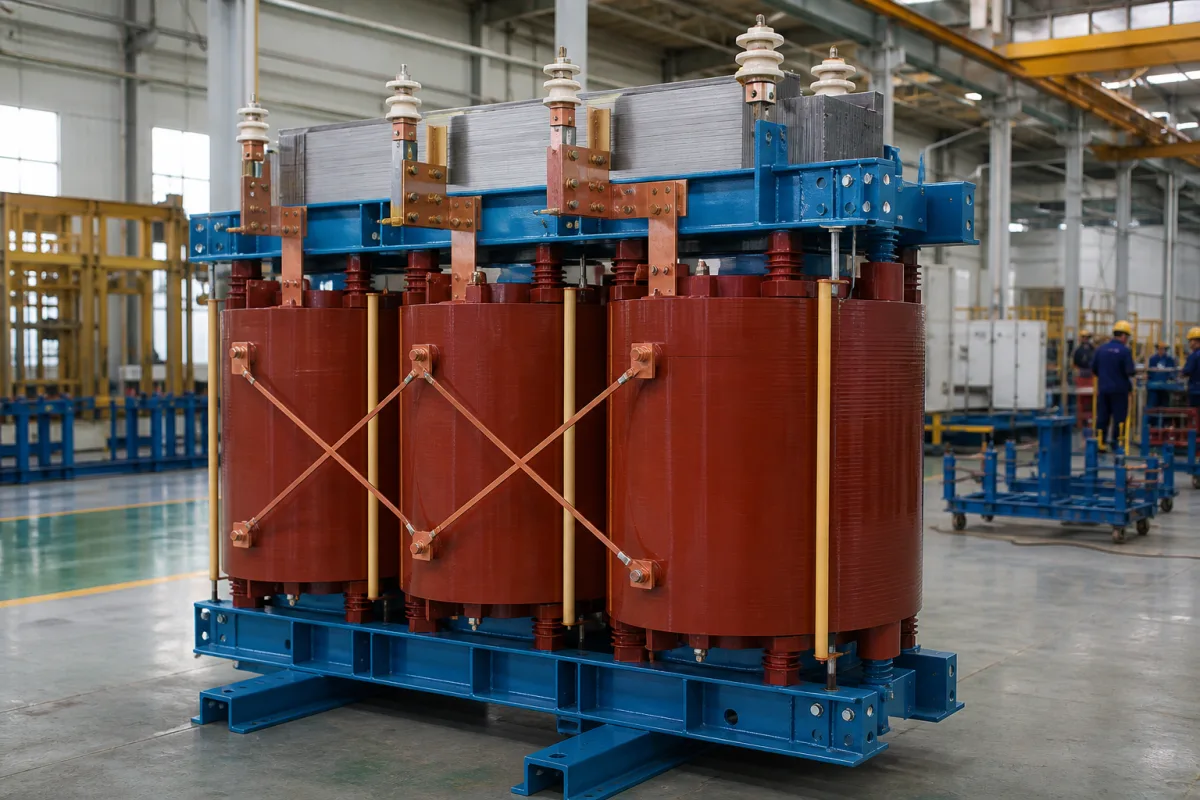
The transformer in the illustration has no tank: three red epoxy-cast coils on a three-limb core, clamped between blue steel frames, with the high-voltage delta made by copper rods across the coil faces. Because the windings are exposed to the room air, the questions a buyer asks are about the room as much as the load: how wet and dirty it gets, how cold, whether fire behaviour matters, and how the winding temperature is watched.
Covers cast-resin (epoxy-encapsulated) dry-type distribution transformers to IEC 60076-11: environmental (E), climatic (C) and fire behaviour (F) classes, partial discharge level, thermal class, natural and forced-air cooling with PT100 temperature control, nameplate reading, inrush and energising, short-term overload, and cleaning and inspection intervals. Choosing between liquid-immersed and dry-type distribution and power transformers, losses and cooling classes are on Power transformer; rectifier and generator step-up transformers, instrument transformers and small power-supply transformers inside equipment are outside this page.
CNFX editorial research · Sources checked October 12, 2026 · 3 sources
Siemens Energy's operating manual for its cast-resin dry-type distribution transformers explains the IEC 60076-11 classes printed on the nameplate.
The manual's sample nameplate, a 2,500 kVA unit at 10 kV / 690 V, Dyn11, cooling AN/AF, is marked E2/C2/F1. Fuji Electric states that its MOLTRA cast-resin transformers passed the IEC 60076-11:2018 special tests for C2 (described as crack resistance), E2 (moisture resistance) and F1 (fire resistance), with third-party certification since 2006. Hitachi Energy lists its RESIBLOC range in classes E2, E3, E4, C2, C3, C4 and F1.
So E2/C2/F1 is the baseline three makers share; higher E and C classes are where ranges differ.
Class
Meaning (Siemens Energy manual)
E0
Pollution negligible; clean, dry indoor installation (see note on the condensation wording)
E1
Occasional condensation, limited pollution
E2
Frequent condensation or heavy pollution, or both
C1
Operation not below −5 °C; transport and storage down to −25 °C
C2
Operation, transport and storage down to −25 °C
F0
No special fire protection measures beyond the transformer's own characteristics
F1
Suitable where there is a fire hazard; restricted flammability; toxic substances and opaque smoke minimised
Ask for the type-test or special-test certificates behind each class on the nameplate, and the laboratory that issued them. The manual's English text for E0 reads "there is condensation on the transformer" while describing a clean, dry indoor site; confirm the E0 definition against IEC 60076-11 itself.
02
Partial discharge and thermal class
Fuji Electric applies a partial discharge test to every unit at twice the operating system voltage and states partial discharge below 10 pC; it attributes this to casting the coils in high-vacuum chambers to remove air and gas from the resin. Hitachi Energy gives partial discharges below 10 pC for RESIBLOC.
Both list insulation system temperature class F; Fuji gives 155 °C (F) as standard with 180 °C (H) as an option, maximum ambient 40 °C with a 20 °C yearly average, and 50 °C ambient as an option. Hitachi Energy lists cooling options AN, AN/AF and AF/WF and protection degrees IP00 to IP54.
Item
Fuji MOLTRA
Hitachi Energy RESIBLOC
Partial discharge
<10 pC, every unit, at 2× system voltage
<10 pC
Insulation system temperature
155 °C (F); 180 °C (H) optional
F
Cooling
AN, AF
AN, AN/AF, AF/WF
Rating range on page
Up to 4,000 kVA
Up to 36 kV
E/C/F classes
C2, E2, F1
E2–E4, C2–C4, F1
Ask at what test voltage the partial discharge figure was measured and whether it is a routine test on every unit or a type test on one.
03
Winding temperature control
Siemens Energy fits PT100 sensors in the three-phase windings, wired to a temperature controller.
The alarm and trip contacts must be wired to the protection of the upstream equipment so it acts when the controller does. The controller must not be fed straight from the transformer's own low-voltage busbar unless the supply has a protection switch, because inrush can damage it. Settings changed to test the controller at room temperature must be put back to the defaults afterwards.
The 20 K gap between fan-on and fan-off keeps the fans from cycling (editorial reading), and the 150 °C trip sits 5 K under the 155 °C class F insulation temperature (Editorial calculation against Fuji's class F value).
Function
Default setting
Fan on
100 °C
Fan off
80 °C
Over-temperature alarm
130 °C
Over-temperature trip
150 °C
Ask for the controller make, the PT100 positions and the default settings, and include the alarm and trip contacts in the switchgear wiring.
04
Energising, overload and cleaning
Inrush on switching can reach 6 to 8 times rated current; Siemens Energy says the instantaneous overcurrent setting must exceed that peak with a time limit of 0.5 s or less, and a no-load energising test checks the protection before service. On the 2,500 kVA nameplate unit (144.3 A on the 10 kV side) that is about 866 to 1,154 A (Editorial calculation).
After more than 3 months in storage, after overhaul, or where ambient is below 0 °C, the manual recommends running at no load for 12 hours, then raising load gradually. Short-term overload follows the dry-type loading guide, with curves given for 40, 30, 20 and 10 °C ambient for natural cooling.
The manual calls cast-resin transformers maintenance-free but asks for yearly inspection and cleaning of windings, bolted joints, alarms and fans, every six months in dusty or polluted locations, and a full inspection every 5 years. Cleaning is with dry, oil-free compressed air (pressure limits are given in the manual), a vacuum cleaner, or a dry cloth with alcohol above 85%, to stop creepage paths forming and cooling ducts blocking; windings should show no blackening or cracks.
Ask for the overload curves with and without fans, the cleaning access in the enclosure, and the inrush figure for the actual design.
05
What to state when buying a cast-resin transformer
Paste it into your enquiry below or into an email to a maker, then replace every bracket.
Give rated power, primary and secondary voltages with tappings, vector group, the room's condensation and pollution conditions, lowest operating and storage temperature, whether fire behaviour class F1 is required, ambient maximum and yearly average, enclosure IP rating, and whether forced-air fans are wanted. Ask for E/C/F class certificates, partial discharge level and test voltage, insulation class, losses, temperature controller settings, inrush current, overload curves AN and AF, and the cleaning and inspection schedule.
Explore company information and manufacturing capabilities, then discuss the scope of your project with a relevant supplier.
Share this page
Compiled and source-reviewed by the CNFX editorial team.
Each manufacturer above links to the page on that company's own website where the product is listed, with the date we checked it. How we source and review
· Page last updated 13 October 2026
Buyer questions
What does E2/C2/F1 mean on a dry-type transformer?
E2: frequent condensation or heavy pollution; C2: operation, transport and storage down to −25 °C; F1: suitable for fire-hazard locations with restricted flammability and minimised toxic smoke, per Siemens Energy's manual. [1]
What partial discharge level should a cast-resin transformer have?
Fuji Electric and Hitachi Energy both state below 10 pC; Fuji tests every unit at twice the system voltage. [3][2]
At what temperatures do the fans start and the transformer trip?
Siemens Energy's defaults are fan on at 100 °C, fan off at 80 °C, alarm at 130 °C and trip at 150 °C winding temperature. [1]
How often should a cast-resin transformer be cleaned?
Yearly, every six months in dusty or polluted locations, with a full inspection every 5 years, according to Siemens Energy. [1]
Sources and what still needs a direct check
Sources checked 2026-10-12. Three cast-resin transformer makers: an operating manual and two product pages.