Industry-Verified Manufacturing Data (2026)

Vertical Riser Busbar

Based on aggregated insights from multiple verified factory profiles within the CNFX directory, the standard Vertical Riser Busbar used in the Electrical Equipment Manufacturing sector typically supports operational capacities ranging from standard industrial configurations to heavy-duty production requirements.

Technical Definition & Core Assembly

A canonical Vertical Riser Busbar is characterized by the integration of Busbar Conductor and Insulation/Coating. In industrial production environments, manufacturers listed on CNFX commonly emphasize Electro-tinned copper construction to support stable, high-cycle operation across diverse manufacturing scenarios.

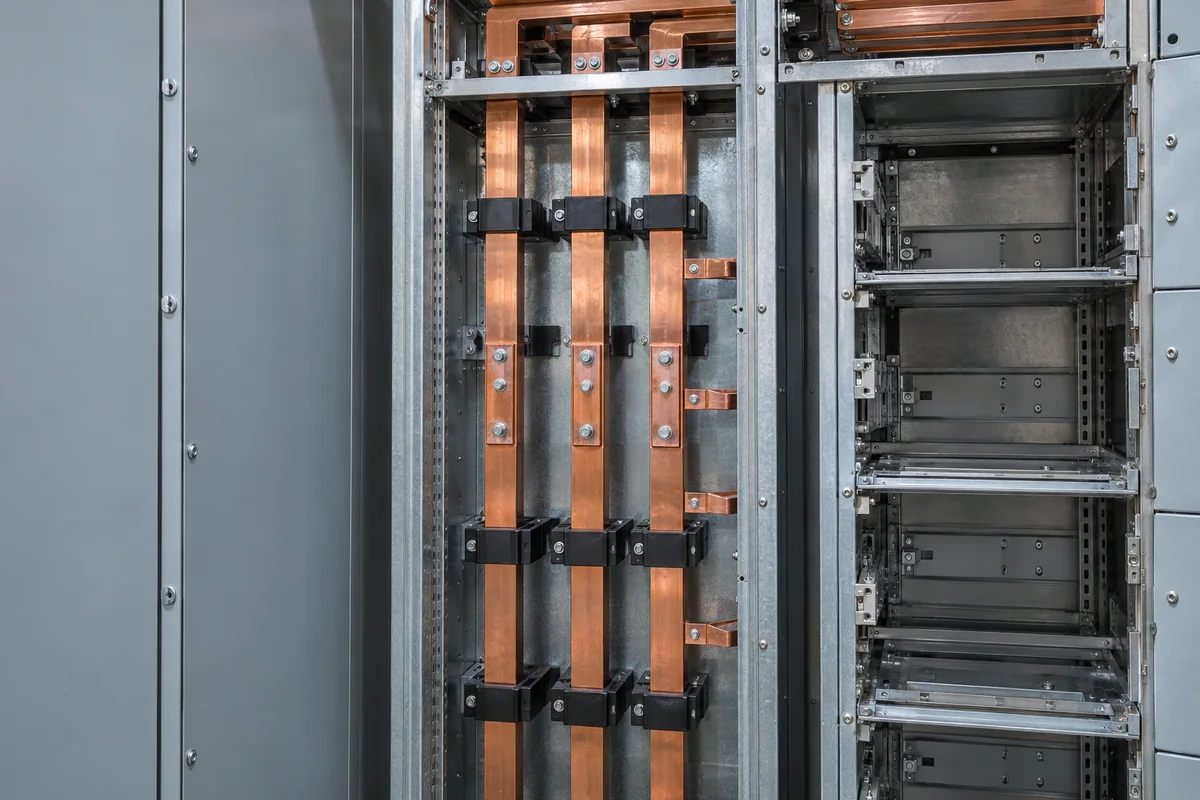
A vertical electrical conductor system within a Motor Control Center that distributes power between horizontal busbars at different levels.
Product Specifications

Technical details and manufacturing context for Vertical Riser Busbar

Definition
A vertical riser busbar is a critical component of a Motor Control Center (MCC) that provides the main vertical power distribution path. It connects the horizontal main busbars on different tiers or sections of the MCC, allowing electrical power to be distributed vertically to various starter units, circuit breakers, and other control devices housed within the cabinet structure. It ensures reliable and organized power transmission from the main incoming supply to all connected loads.
Working Principle
The vertical riser busbar operates as a solid, low-impedance electrical conductor. It is connected at one end to a horizontal main busbar (often the main incoming bus) and runs vertically through the MCC structure. At various tap-off points along its length, connections are made to supply power to individual motor starter units, distribution panels, or other components on different levels. Its design minimizes voltage drop and heat generation while safely carrying the designated current load.
Common Materials
Electro-tinned copper, Aluminum alloy
Technical Parameters
  • Rated current capacity (e.g., 600A, 800A, 1200A) (A) Standard Spec
Components / BOM
  • Busbar Conductor
    The primary solid metal strip or bar that conducts electrical current.
    Material: Copper or Aluminum
  • Insulation/Coating
    A non-conductive layer (e.g., epoxy powder coating, heat-shrink tubing) that provides electrical insulation and corrosion protection.
    Material: Polymer-based insulation
  • Mounting Brackets/Supports
    Hardware used to secure and support the busbar within the MCC structure, ensuring mechanical stability and proper clearance.
    Material: Steel or galvanized steel
Engineering Reasoning
600-1000 V, 1000-5000 A, 40-85°C ambient temperature
Insulation breakdown at 1500 V AC, thermal runaway at 120°C conductor temperature, mechanical deformation at 150 N·m torque
Design Rationale: Dielectric breakdown of air gaps at 3 kV/mm, joule heating exceeding 5 W/cm² heat dissipation capacity, creep deformation of copper at 0.2% yield stress
Risk Mitigation (FMEA)
Trigger Transient overvoltage exceeding 1.5 kV for 100 μs
Mode: Partial discharge leading to insulation carbonization
Strategy: Metal oxide varistor protection with 1.2 kV clamping voltage and 40 kA surge rating
Trigger Continuous 110% rated current for 30 minutes
Mode: Thermal expansion causing 0.5 mm joint separation
Strategy: Bimetallic thermal cutoffs with 105°C trip temperature and 0.1 s response time

Industry Taxonomies & Aliases

Commonly used trade names and technical identifiers for Vertical Riser Busbar.

Applied To / Applications

This component is essential for the following industrial systems and equipment:

Industrial Ecosystem & Supply Chain DNA

Complementary Systems
Downstream Applications
Specialized Tooling

Application Fit & Sizing Matrix

Operational Limits
pressure: N/A (electrical system, not fluid handling)
other spec: Current rating: 600A to 5000A typical, Short-circuit withstand: 50kA to 200kA RMS symmetrical for 3 seconds, Voltage rating: up to 1000V AC, Insulation class: Class B (130°C) or higher
temperature: -20°C to +105°C continuous operation, up to +130°C short-term
Media Compatibility
✓ Industrial power distribution in MCCs ✓ Commercial building electrical systems ✓ Data center power distribution
Unsuitable: Outdoor corrosive environments without proper NEMA/IP rated enclosures
Sizing Data Required
  • Maximum continuous current requirement (Amps)
  • Available vertical space/height constraints in MCC
  • Short-circuit current rating of the system (kA)

Reliability & Engineering Risk Analysis

Failure Mode & Root Cause
Thermal degradation and overheating
Cause: Loose or corroded connections leading to increased electrical resistance, poor heat dissipation, or overloading beyond design capacity.
Insulation breakdown and arcing
Cause: Moisture ingress, contamination (dust, oil), mechanical damage to insulation, or aging of insulating materials causing dielectric failure.
Maintenance Indicators
  • Visible discoloration, scorching, or melting of insulation/busbar material indicating overheating
  • Audible buzzing, crackling, or popping sounds during operation suggesting arcing or loose connections
Engineering Tips
  • Implement regular thermal imaging inspections to detect hot spots before catastrophic failure, and maintain proper torque on all connections per manufacturer specifications
  • Ensure environmental controls (sealing, ventilation, humidity control) to prevent contamination and moisture ingress, and apply protective coatings to inhibit corrosion

Compliance & Manufacturing Standards

Reference Standards
ISO 12944-5:2019 - Corrosion protection of steel structures ANSI C37.20.1 - Metal-enclosed low-voltage power circuit-breaker switchgear DIN 43671 - Busbar systems for rated voltages up to 1000 V AC and 1500 V DC
Manufacturing Precision
  • Flatness: 0.1mm per meter length
  • Hole alignment: +/-0.05mm for mounting positions
Quality Inspection
  • High-potential (Hi-Pot) dielectric withstand test
  • Contact resistance measurement using micro-ohmmeter

Factories Producing Vertical Riser Busbar

Verified manufacturers with capability to produce this product in China

✓ 94% Supplier Capability Match Found

P Project Engineer from United Arab Emirates Feb 10, 2026
★★★★★
"The technical documentation for this Vertical Riser Busbar is very thorough, especially regarding technical reliability."
Technical Specifications Verified
S Sourcing Manager from Australia Feb 07, 2026
★★★★★
"Reliable performance in harsh Electrical Equipment Manufacturing environments. No issues with the Vertical Riser Busbar so far."
Technical Specifications Verified
P Procurement Specialist from Singapore Feb 04, 2026
★★★★★
"Testing the Vertical Riser Busbar now; the technical reliability results are within 1% of the laboratory datasheet."
Technical Specifications Verified
Verification Protocol

“Feedback is collected from verified sourcing managers during RFQ (Request for Quote) and factory evaluation processes on CNFX. These reports represent historical performance data and technical audit summaries from our B2B manufacturing network.”

17 sourcing managers are analyzing this specification now. Last inquiry for Vertical Riser Busbar from Thailand (1h ago).

Supply Chain Compatible Machinery & Devices

Circuit Breaker Trip Unit

Protective control module for electrical circuit breakers

Explore Specs →
Circuit Breaker Arc Chute

Electrical component that extinguishes arcs in circuit breakers

Explore Specs →
Medium Voltage Switchgear Assembly Line

Automated production system for assembling medium voltage electrical switchgear.

Explore Specs →
Motor Terminal Block

Electrical connection interface for motor windings

Explore Specs →

Frequently Asked Questions

What is the primary function of a vertical riser busbar in a Motor Control Center?

A vertical riser busbar distributes electrical power between horizontal busbars at different levels within a Motor Control Center, enabling efficient power transfer across the MCC structure.

What materials are commonly used for vertical riser busbars?

Vertical riser busbars are typically manufactured from electro-tinned copper for superior conductivity or aluminum alloy for lightweight, cost-effective applications, both offering reliable performance.

What components are included in a vertical riser busbar BOM?

The bill of materials includes the busbar conductor, insulation/coating for electrical safety, and mounting brackets/supports for secure installation within the Motor Control Center.

Can I contact factories directly on CNFX?

CNFX is an open directory, not a transaction platform. Each factory profile provides direct contact information and production details to help you initiate direct inquiries with Chinese suppliers.

Get Quote for Vertical Riser Busbar

Request technical pricing, lead times, or customized specifications for Vertical Riser Busbar directly from verified manufacturing units.

Your business information is encrypted and only shared with verified Vertical Riser Busbar suppliers.

Thank you! Your message has been sent. We'll respond within 1–3 business days.

Need to Manufacture Vertical Riser Busbar?

Connect with verified factories specializing in this product category

Add Your Factory Contact Us
Previous Product
Ventilation Fan
Next Product
Vision Inspection System