Editorial Technical Reference

Latch/Clamp System

This page explains how Latch/Clamp System is classified within Fabricated Metal Product Manufacturing. Technical values and manufacturer relationships are research references; confirm the current specification and supplier evidence for each order.

Technical Definition & Core Assembly

A mechanical fastening device used to secure access doors, panels, or covers in closed position.
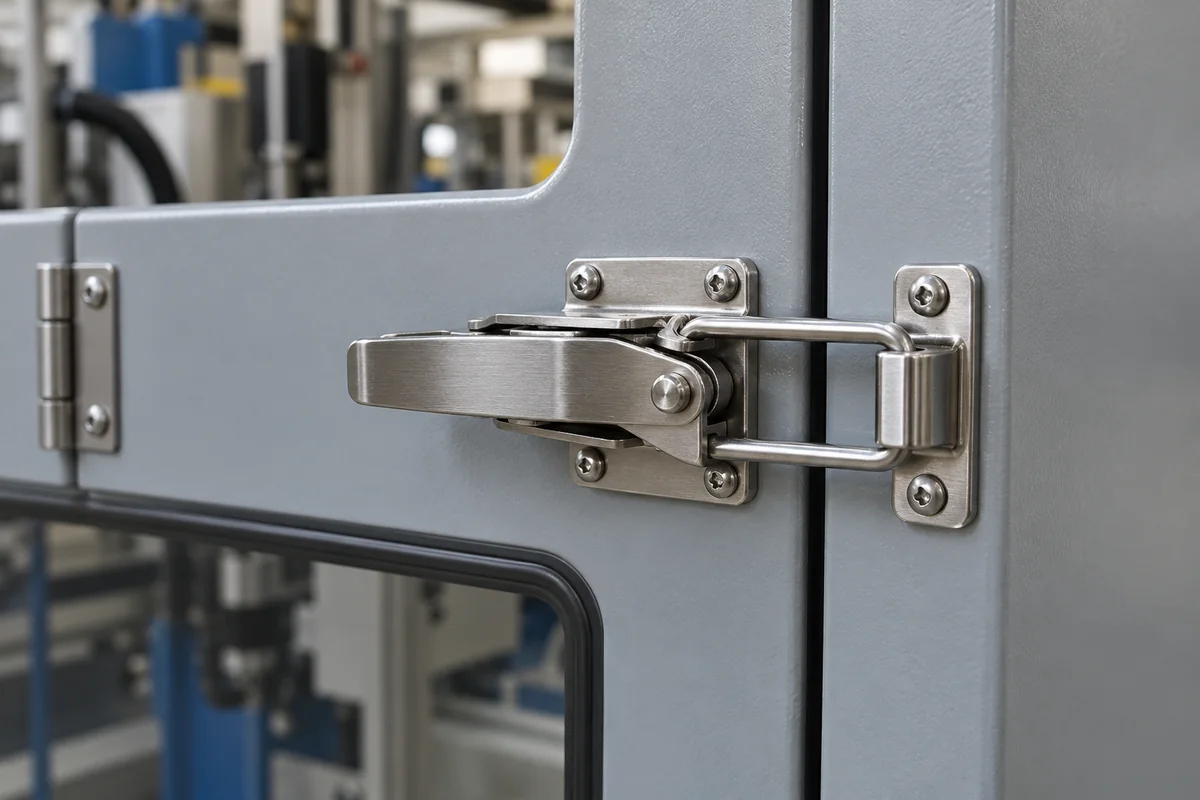
Representative product image. Confirm appearance and specifications with the manufacturer.

Product Specifications

Technical details and manufacturing context for Latch/Clamp System

Definition
A latch/clamp system is a critical component of access doors that provides secure closure and sealing functionality. It consists of mechanical elements designed to engage with a strike or receiver to hold the door firmly shut, preventing accidental opening while allowing authorized access when released. These systems ensure safety, containment, and operational integrity in industrial applications. The system operates through mechanical engagement where a latch mechanism (such as a hook, bolt, or cam) interfaces with a corresponding strike plate or receiver. When activated (typically via a handle, lever, or knob), the latch extends or rotates to secure the door. Clamping action may be applied to create compression for sealing purposes. Release is achieved by reversing the activation mechanism to disengage the latch from the strike. In fabricated metal product manufacturing, these components are often used in access doors for industrial equipment, enclosures, and machinery. Materials commonly specified include stainless steel, carbon steel, and zinc alloy, with material grades such as 304 or 316 stainless steel for corrosive environments. Key parameters to verify for a specific application include clamping force (500–5000 N), maximum operating pressure (1.0–1.6 MPa), operating temperature range (-40 to 85°C), ingress protection rating (IP54–IP65 per IEC 60529), surface treatment (zinc-passivate per ISO 2081), cycle life (10,000–50,000 cycles), weight (0.5–5.0 kg), mounting hole diameter (6–12 mm), and maximum static load (1000–10000 N). These values are reference ranges and must be confirmed with the manufacturer for the actual model. The system's performance depends on correct installation, alignment, and maintenance. Regular inspection for wear, corrosion, or misalignment is recommended. Failure to maintain the system may lead to loss of sealing, accidental opening, or structural damage. Always verify model-specific values and standards with the legal manufacturer or supplier before procurement.
Working Principle
The system operates through mechanical engagement where a latch mechanism (such as a hook, bolt, or cam) interfaces with a corresponding strike plate or receiver. When activated (typically via a handle, lever, or knob), the latch extends or rotates to secure the door. Clamping action may be applied to create compression for sealing purposes. Release is achieved by reversing the activation mechanism to disengage the latch from the strike.
Common Materials
Stainless Steel, Carbon Steel, Zinc Alloy
Technical Parameters
ParameterTypical rangeNotes & selection driver
Clamping Force500–5000 NRequired to maintain seal under pressure
Operating Temperature-40–85 °CSeal material limits range
Material Grade304–316 SS316 for corrosive environmentsASTM A240
Surface TreatmentZinc–PassivateCorrosion resistanceISO 2081
Cycle Life10000–50000 cyclesDepends on load and maintenance
Weight0.5–5.0 kgVaries with size and material
Mounting Hole Diameter6–12 mmStandard metric sizes
Max Static Load1000–10000 NExceeding may deform latch

Ranges are indicative industry figures for RFQ preparation, not a supplier commitment. Confirm every value and standard with the legal manufacturer before ordering.

Components / BOM
  • Latch Bolt Part
    Primary engaging component that extends into the strike plate
    Material: Stainless Steel
  • Strike Plate Part
    Receiving component mounted on the door frame that accepts the latch bolt
    Material: Carbon Steel
  • Actuation Mechanism
    Handle, lever, or knob that controls the latch engagement and release
    Material: Zinc Alloy
  • Mounting Bracket Part
    Structural component that secures the latch system to the door
    Material: Steel

Industry Taxonomies & Aliases

Commonly used trade names and technical identifiers for Latch/Clamp System.

Applied To / Applications

This component is essential for the following industrial systems and equipment:

Industrial Ecosystem & Supply Chain Structure

Complementary Systems
Downstream Applications
Specialized Tooling

Application Fit & Sizing Matrix

Operational Limits
pressure: 0 to 10 bar
other spec: Max door/panel deflection: 5 mm
temperature: -40°C to 150°C
Media Compatibility
✓ Stainless steel panels ✓ Aluminum enclosures ✓ Fiberglass covers
Unsuitable: High-vibration environments with >5g acceleration
Sizing Data Required
  • Door/panel thickness (mm)
  • Required clamping force (N)
  • Mounting surface area (cm²)

Reliability & Engineering Risk Analysis

Failure Mode & Root Cause
Fatigue fracture
Cause: Cyclic loading from repeated clamping/unclamping operations leading to crack initiation and propagation at stress concentration points (e.g., latch pivot holes, clamp jaw roots)
Wear-induced slippage
Cause: Abrasive wear on mating surfaces (latch hooks, clamp contact points) due to contamination (dust, grit) or misalignment, reducing clamping force and causing loss of secure hold
Maintenance Indicators
  • Audible clicking or grinding during operation indicating worn or damaged internal components
  • Visible misalignment or excessive play in the latch mechanism when engaged
Engineering Tips
  • Implement regular lubrication with appropriate anti-wear grease on pivot points and sliding surfaces, following manufacturer's specifications for interval and type
  • Establish periodic torque verification checks using calibrated tools to ensure clamping force remains within design specifications, adjusting/replacing components as needed

Indicative industry ranges for design and RFQ preparation. Confirm the exact figures and applicable standard with the manufacturer before specifying.

Compliance & Manufacturing Standards

Applicable Standards
ISO 2768-1: General tolerances for linear and angular dimensions ANSI/ASME B18.6.3: Machine Screws and Machine Screw Nuts DIN 7981: Cross-recessed pan head tapping screws

Quoted from the published standard.

Manufacturing Precision
  • Bore diameter: +/-0.02mm
  • Surface flatness: 0.1mm per 100mm length
Quality Inspection
  • Dye Penetrant Test for surface crack detection
  • Torque testing for clamping force verification

Manufacturers of Latch/Clamp System

Manufacturer profiles associated with Latch/Clamp System.

Sourcing Latch/Clamp System from China?
Tell us your specification and target quantity — we will match it against manufacturer records and come back with the factories that fit.
Request manufacturers We manufacture this

Manufacturer listings support early research and capability understanding. They are not certification, ranking, or transaction guarantees.

Technical documentation
Request current drawings, revision history, and a signed specification sheet.
Manufacturing capability
Verify equipment lists, process limits, capacity, and representative production evidence.
Inspection readiness
Confirm test methods, calibrated equipment, sampling plans, and traceable reports.
Supplier transparency
Check the legal entity, factory address, ownership, certifications, and direct contacts.

CNFX does not score or rank suppliers. Buyers must verify all claims and documents with the legal manufacturer before ordering.

Supply Chain Compatible Machinery & Devices

Hydraulic Cylinder Piston Rod

A hydraulic cylinder piston rod is a precision-machined, load-bearing component that converts hydraulic pressure into linear mechanical force.

Explore Specs →
Industrial Tube Bending Machine

An industrial tube bending machine is a CNC-controlled device designed to precisely bend metal tubes and pipes to specific angles and radii.

Explore Specs →
Precision Linear Motion Guide Rail

Precision linear guide component for smooth, accurate motion in industrial machinery

Explore Specs →
Precision Aluminum Extrusion Profile

Precision aluminum extrusion profiles are semi-finished structural components produced by forcing heated aluminum alloy through a shaped die.

Explore Specs →

Frequently Asked Questions

What materials are available for latch/clamp systems?

Common materials include stainless steel, carbon steel, and zinc alloy. Stainless steel grades 304 and 316 are specified for corrosion resistance, with 316 recommended for corrosive environments. Surface treatment may include zinc-passivate per ISO 2081.

What is the typical clamping force range?

The clamping force typically ranges from 500 to 5000 N, depending on the model and application. This force is required to maintain a seal under pressure. Verify the exact value for your specific model with the manufacturer.

What operating temperature range is supported?

The operating temperature range is typically -40 to 85°C, limited by seal material. Ensure the chosen model is suitable for your environmental conditions.

How do I verify the ingress protection rating?

Ingress protection ratings are typically IP54 to IP65 per IEC 60529. Higher ratings are suitable for outdoor use. Confirm the rating for the specific model and application with the manufacturer.

Data Basis

Editorial classification, named public sources where available, and source-reviewed manufacturer records.

Preliminary Technical Classification
This page supports structured research, RFQ preparation, and supplier evaluation. It does not replace buyer-led supplier qualification, standards review, or technical approval.
Buyer enquiry

Request manufacturing insight for Latch/Clamp System

Ask for use case, specification boundaries, supplier type, and RFQ preparation information for this product.

Where it goes
Straight to the CNFX editorial desk, and to the manufacturer if this product is linked to a claimed profile. Nothing is broadcast to a supplier list.
Your details stay here
We do not sell or rent enquiry data, and we do not add you to a mailing list. Used only to answer this request.
No commission, no middleman
CNFX is a directory. We take no cut of any order and never negotiate on a supplier's behalf.
What we don't claim
A listing is not an endorsement. Qualify every supplier and verify every figure yourself before ordering.

Your business information is used only to process this request.

Thank you! Your message has been sent. We'll respond within 1–3 business days.
Sorry, we couldn't send your message. Please try again, or email us at contact@cnfx.com.

Need to Manufacture Latch/Clamp System?

Compare manufacturer profiles with relevant product and process capability.

Previous Product
Welding Positioner
Last Product
Get QuotesChat