Industry-Verified Manufacturing Data (2026)

Latching System

Based on aggregated insights from multiple verified factory profiles within the CNFX directory, the standard Latching System used in the Fabricated Metal Product Manufacturing sector typically supports operational capacities ranging from standard industrial configurations to heavy-duty production requirements.

Technical Definition & Core Assembly

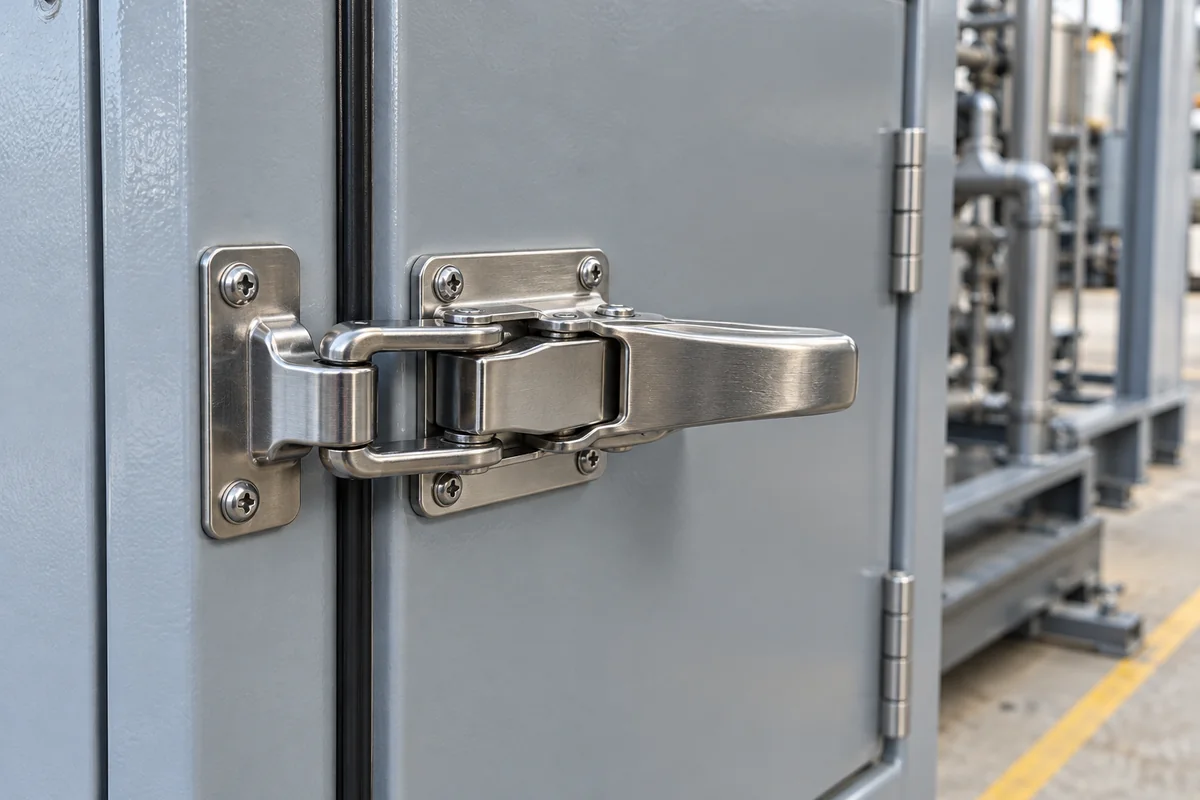
A canonical Latching System is characterized by the integration of Latch Bolt and Strike Plate. In industrial production environments, manufacturers listed on CNFX commonly emphasize Stainless Steel construction to support stable, high-cycle operation across diverse manufacturing scenarios.

A mechanical or electromechanical system that secures an access door in the closed position.
Product Specifications

Technical details and manufacturing context for Latching System

Definition
A latching system is a critical component of an access door with seal, responsible for maintaining door closure and ensuring proper seal compression. It typically consists of a latch mechanism, strike plate, and actuation components that work together to secure the door against the frame while maintaining consistent pressure on the sealing elements.
Working Principle
The latching system operates by engaging a latch mechanism with a corresponding strike plate or receiver. When actuated (manually or automatically), the latch extends to interlock with the strike, creating a secure connection. The system maintains tension to keep the door firmly closed and compress the door seal against the frame, preventing leaks and maintaining environmental integrity.
Common Materials
Stainless Steel, Zinc Alloy, Engineering Plastics
Technical Parameters
  • Latch throw distance (engagement depth) (mm) Standard Spec
Components / BOM
  • Latch Bolt
    Extends to engage with strike plate and secure door
    Material: Stainless Steel
  • Strike Plate
    Receives and retains the latch bolt to secure door closure
    Material: Stainless Steel
  • Actuation Mechanism
    Controls extension and retraction of the latch bolt
    Material: Zinc Alloy
  • Mounting Hardware
    Secures the latching system components to door and frame
    Material: Steel
Engineering Reasoning
0.5-2.5 kN latching force, -40°C to 85°C ambient temperature
Latching force drops below 0.4 kN or exceeds 2.7 kN, temperature exceeds 100°C or drops below -45°C
Design Rationale: Spring fatigue at Hooke's law limit (σ_yield = 450 MPa for 316 stainless), thermal expansion mismatch (Δα = 12×10^-6 K^-1) causing binding
Risk Mitigation (FMEA)
Trigger Cyclic loading exceeding 10^5 cycles at 1.8 kN
Mode: Spring permanent set reducing latching force to 0.3 kN
Strategy: Shot peening surface treatment to induce compressive residual stress of -300 MPa
Trigger Corrosive environment with chloride concentration > 100 ppm
Mode: Pitting corrosion at stress concentration points (K_t = 3.2)
Strategy: Cathodic protection with -0.85 V vs. SCE reference electrode

Industry Taxonomies & Aliases

Commonly used trade names and technical identifiers for Latching System.

Applied To / Applications

This component is essential for the following industrial systems and equipment:

Industrial Ecosystem & Supply Chain DNA

Complementary Systems
Downstream Applications
Specialized Tooling

Application Fit & Sizing Matrix

Operational Limits
pressure: 0 to 15 psi differential
other spec: Maximum door deflection: 5 mm, Cycle life: 100,000 operations
temperature: -40°C to +120°C
Media Compatibility
✓ Stainless steel doors ✓ Aluminum enclosures ✓ Polycarbonate panels
Unsuitable: High-vibration environments (>10g RMS)
Sizing Data Required
  • Door weight (kg)
  • Door dimensions (mm)
  • Required holding force (N)

Reliability & Engineering Risk Analysis

Failure Mode & Root Cause
Wear-induced misalignment
Cause: Progressive wear on mating surfaces (e.g., latch hooks, strike plates) due to repeated cyclic loading, leading to improper engagement or binding.
Fatigue fracture
Cause: High-cycle fatigue from vibration or shock loads, particularly at stress concentration points like latch pivot pins or spring attachment points.
Maintenance Indicators
  • Audible grinding or scraping during operation
  • Visible misalignment or excessive play when latched
Engineering Tips
  • Implement periodic lubrication with appropriate anti-wear grease on moving contact surfaces to reduce friction and wear.
  • Conduct regular torque or force testing to verify latching integrity and detect early-stage wear before functional failure occurs.

Compliance & Manufacturing Standards

Reference Standards
ISO 9001:2015 - Quality management systems ANSI/BHMA A156.13 - American National Standard for Mortise Locks and Latches DIN 18257 - Building hardware - Mechanically operated locks and latches
Manufacturing Precision
  • Latch throw: +/-0.5mm
  • Mounting hole alignment: +/-0.25mm
Quality Inspection
  • Cyclic endurance test (minimum 200,000 cycles)
  • Load capacity verification (static and dynamic)

Factories Producing Latching System

Verified manufacturers with capability to produce this product in China

✓ 97% Supplier Capability Match Found

S Sourcing Manager from Canada Jan 20, 2026
★★★★★
"Impressive build quality. Especially the technical reliability is very stable during long-term operation."
Technical Specifications Verified
P Procurement Specialist from United States Jan 17, 2026
★★★★☆
"As a professional in the Fabricated Metal Product Manufacturing sector, I confirm this Latching System meets all ISO standards. (Delivery took slightly longer than expected, but technical support was excellent.)"
Technical Specifications Verified
T Technical Director from United Arab Emirates Jan 14, 2026
★★★★★
"Standard OEM quality for Fabricated Metal Product Manufacturing applications. The Latching System arrived with full certification."
Technical Specifications Verified
Verification Protocol

“Feedback is collected from verified sourcing managers during RFQ (Request for Quote) and factory evaluation processes on CNFX. These reports represent historical performance data and technical audit summaries from our B2B manufacturing network.”

6 sourcing managers are analyzing this specification now. Last inquiry for Latching System from Poland (57m ago).

Supply Chain Compatible Machinery & Devices

Sheet Metal Guillotine Shear

Industrial machine for straight-line cutting of sheet metal

Explore Specs →
Metal Plate Rolling Machine

Industrial machine for bending metal plates into cylindrical or conical shapes

Explore Specs →
Hydraulic Cylinder Piston Rod

Precision-machined rod that transmits force in hydraulic cylinders.

Explore Specs →
Metal Plate Bending Machine

Industrial machine for bending metal plates into angular shapes

Explore Specs →

Frequently Asked Questions

What materials are best for corrosive environments in fabricated metal products?

Stainless steel latching systems offer superior corrosion resistance for harsh environments, while engineering plastics provide excellent chemical resistance and are ideal for applications where metal-to-metal contact must be avoided.

How do I choose between mechanical and electromechanical latching systems?

Mechanical latches are cost-effective and reliable for manual operation, while electromechanical systems provide remote control, integration with access systems, and automated operation for enhanced security and convenience in industrial settings.

What mounting considerations are important for latching systems on fabricated metal doors?

Proper alignment between latch bolt and strike plate is critical. Consider door thickness, material compatibility, and environmental factors when selecting mounting hardware. Reinforced mounting may be needed for heavy-duty industrial applications.

Can I contact factories directly on CNFX?

CNFX is an open directory, not a transaction platform. Each factory profile provides direct contact information and production details to help you initiate direct inquiries with Chinese suppliers.

Get Quote for Latching System

Request technical pricing, lead times, or customized specifications for Latching System directly from verified manufacturing units.

Your business information is encrypted and only shared with verified Latching System suppliers.

Thank you! Your message has been sent. We'll respond within 1–3 business days.

Need to Manufacture Latching System?

Connect with verified factories specializing in this product category

Add Your Factory Contact Us
Previous Product
Latch/Clamp System
Next Product
Locking Mechanism