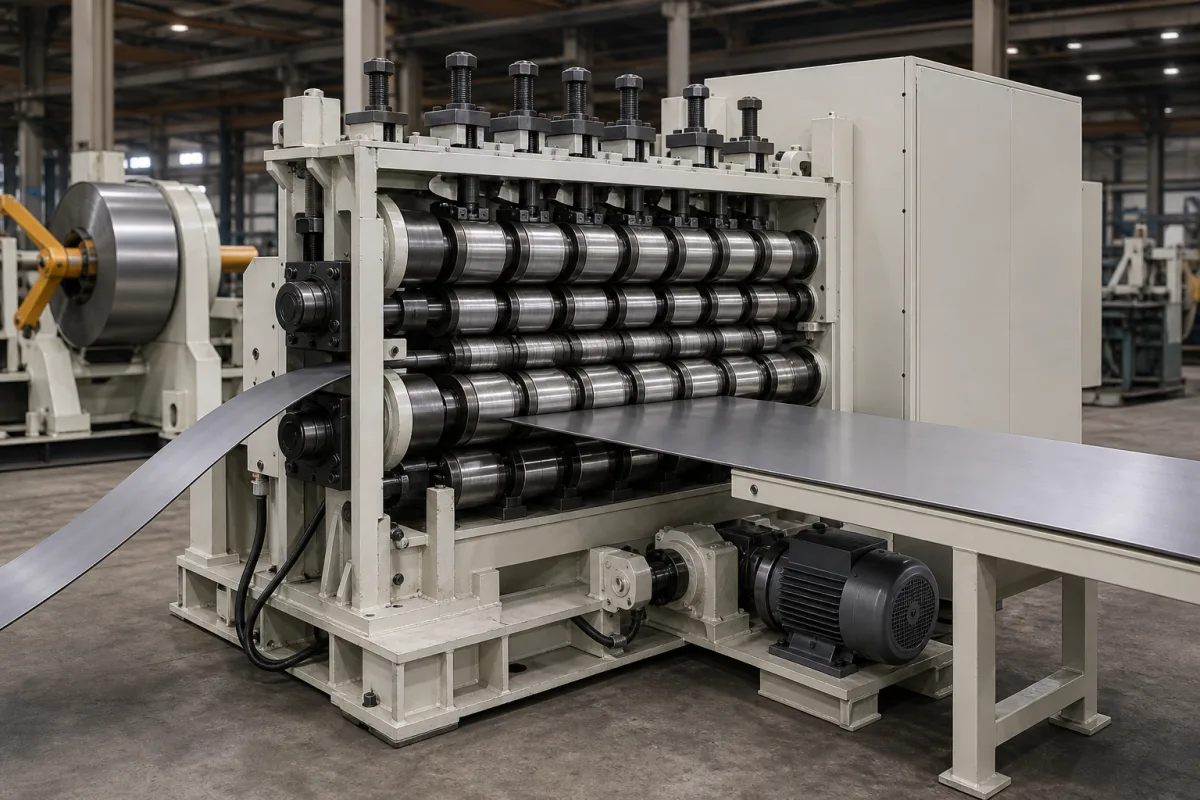
Coil straighteners and roller levelers · removing coil set and crossbow by alternating bending, roll pitch and roll count, material thickness, width and yield strength range, line speed, and part levelers for laser-cut and flame-cut plate
A straightener (or roller leveler) passes metal strip or plate between offset upper and lower rolls that bend it back and forth with diminishing curvature, removing coil set, crossbow and waviness so that the material leaves flat for pressing, cutting or welding. Ask three things first: what thickness, width and strength range the machine must handle, how flat and stress-free the output must be, and at what line speed and in which line it will run.
Coil straighteners for press feeding and coil lines, and precision roller levelers for coil, sheet and cut parts. Feeders, uncoilers, cut-to-length lines and hydraulic plate-straightening presses sold alone are outside this page except where compared.
CNFX editorial research · Sources checked October 12, 2026 · 5 sources
ARKU, a leveling machine maker, describes roller leveling as a roll-bending process that flattens sheet and reduces residual stress by elastic-plastic alternating bending: staggered leveling rolls bend the blank or strip up and down with progressively smaller curvature, starting with a curvature greater than the strongest in the uneven material; uneven sections exceed the yield strength and spring back flat, while straight sections stay below yield and keep their shape. Residual stresses arise from rolling, mechanical and thermal cutting and heat, are hard to measure non-destructively, and matter for downstream steps such as welding. It names as quality factors a rigid frame, a block design of the leveling unit set by infeed and outfeed values, a small roll pitch that minimises residual stress, adequate roll support against deflection, and enough leveling rolls for high flatness. [1]
ARKU lists precision levelers for laser-cut and punched parts from 0.1 mm thick, straightening thin sheet to within hundredths of a millimetre, and levelers for flame- and plasma-cut parts and plates up to 60 mm thick. [2]
Give the supplier the materials and grades with yield strength, thickness and width range, coil or part form, defects to remove (coil set, crossbow, edge wave, residual stress), required flatness, line speed, position in the line (with feeder, uncoiler, press or cutting), roll count and diameter preferences, surface protection needs, drive power and controls.
02
Size the machine for material and speed
COE Press Equipment states that its precision coil straighteners remove coil set across cold-rolled, hot-rolled, galvanised, pre-painted, dual- and triple-phase steels, aluminium and copper, and remove crossbow in a range of applications. Its specifications cover coil widths of 1 to 78 in., material thickness of 0.010 to 0.725 in., yield strength of 10 to 300 ksi, pull-off capacity up to 60,000 lb and speeds up to 250 FPM, for aluminium, AHSS, cold- and hot-rolled steel, galvanised, stainless and pre-painted material. [3]
Editorial calculation: 0.010–0.725 in. is about 0.25–18.4 mm, 78 in. is about 1,981 mm, and 250 FPM is about 76 m/min. These are the stated limits of one maker's whole range; ask for the thickness-versus-strength chart of the exact model.
03
Check thickness range, drive and wave correction on part levelers
KOHLER, a German leveling machine maker, states that its Peak Performer part leveling machines level sheets 0.2 to 66 mm thick. Within that family it describes one versatile machine for sheets up to 16 mm thick with patented dynamic leveling gap control, and another for materials up to 65 mm thick with energy-efficient direct drives for the leveling rollers; it says its part levelers use no hydraulics. For edge and centre waves, one machine type pre-bends the leveling rollers with a wedge system that adjusts the lower supporting roller blocks individually or together, and KOHLER offers patented reversible leveling rollers. [4] For strip, its compact CPL 120 for connector manufacturing has 19 leveling rollers backed by supporting rollers, with a small roller diameter chosen so thin strip can be leveled with precision. [5]
Set these maker figures beside the roll-bending principle and the coil straightener ranges described above; the machine must match both the thinnest and the thickest part you will level. [1][2][3]
Editorial calculation: a 0.2–66 mm range spans a factor of 330 in thickness, which is why a maker splits it across machines with different roller diameters rather than one machine covering it all.
KOHLER machine or feature
Published value
Peak Performer thickness range
0.2–66 mm
Versatile part leveler
Sheets up to 16 mm; dynamic leveling gap control
Heavy part leveler
Material up to 65 mm; direct-drive leveling rollers
Wave correction
Wedge system pre-bends leveling rollers via lower supporting roller blocks
CPL 120 strip leveler
19 leveling rollers, small diameter, backed by supporting rollers
Give the supplier your thinnest and thickest part, material grade and width, and ask which machine size, roller diameter and wave-correction method it proposes, and whether the drive is hydraulic or servo-electric.
04
Compare machine types
No manufacturer record has been reviewed for this product yet; the types below come from the sources cited.
Types include coil straighteners in press-feeding lines, straightener-feeder combinations, precision levelers for laser-cut and punched parts, and heavy levelers for flame-cut plate. [3][2]
05
Trace the machine components
This is a functional reference built from the sources cited; it is not one maker's specification.
Fill the specification fields with values for your material
A straightener quotation needs values for your material. The table explains each field, gives published values where a reviewed source states them, and says what to obtain from the supplier.
Field
What it means and published values
Ask the supplier for
Thickness
Examples: 0.010–0.725 in.; 0.1–60 mm (parts). [3][2]
Explore company information and manufacturing capabilities, then discuss the scope of your project with a relevant supplier.
Share this page
Compiled and source-reviewed by the CNFX editorial team.
Published product pages show what a company offers, not tested performance. Confirm the legal seller, factory and scope for your order. How we source and review
· Page last updated 13 October 2026
Buyer questions
How does a roller leveler flatten metal?
ARKU explains it bends the material up and down through staggered rolls with decreasing curvature so uneven sections yield and spring back flat. [1]
What does a coil straightener remove?
COE says its straighteners remove coil set and, in a range of applications, crossbow. [3]
What thickness range can straighteners handle?
COE's range covers 0.010–0.725 in.; ARKU part levelers run from 0.1 mm up to 60 mm plate. [3][2]
How thick a sheet can a roller leveler flatten?
KOHLER states its Peak Performer part levelers handle sheets 0.2 to 66 mm thick, split across machines such as one for up to 16 mm and one for up to 65 mm. [4]
Sources and what still needs a direct check
Sources checked 2026-10-12. ARKU and COE Press Equipment are makers describing their own leveling and straightening machines; their figures are examples, not limits.