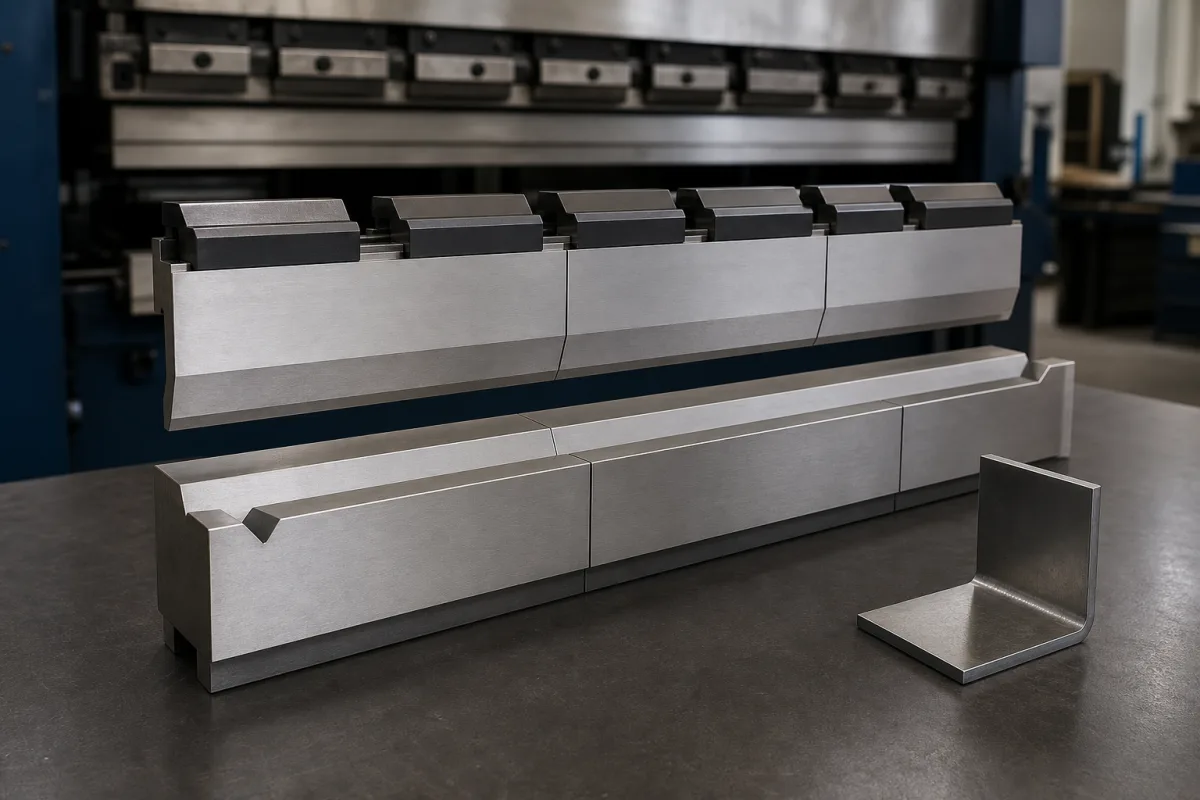
Press brake V-die sets · Matched punches and V-dies for air bending or bottom bending, specified by V-opening, working height, shoulder radius, segment lengths and maximum load in kN per metre, with clamping and crowning that hold the bend angle along the length
A V-die set is the punch and V-shaped die that a press brake uses to bend sheet metal. The punch pushes the sheet into the die opening, either partway (air bending) or fully into the die (bottom bending). Ask three things first: which bending method and angles the parts need, which V-opening, height and radius suit the sheet thickness and material, and what load the tools must carry along the bend length.
Punches and V-dies for press brakes, in single, multi-V or segmented sets, with their load ratings and clamping interfaces. Press brakes themselves (see hydraulic press brake), progressive stamping dies (see progressive die set) and tube bending tools are outside this page.
CNFX editorial research · Sources checked October 11, 2026 · 4 sources
WILA calls air bending the method with the greatest flexibility to bend sheet metal on a press brake and says that with its tooling "air bending is the preferred bending method for the majority of bending applications": with segmented tooling, a limited set of tools can make a variety of bend angles and lengths, and its modular standard tools come in a range of standard lengths so almost any bending length can be built up. [1]
Bottom bending, by WILA's description, forms the angle by enclosing the sheet between punch and die. It suits higher accuracy than air bending, controlling springback and bending near cuts and holes, but needs more force and a different tool set for each bend radius; WILA offers 90° tools for it and says an angle accuracy of ±0.25° can be achieved under optimal circumstances. [2]
WILA also offers clamping and crowning systems, hydraulic, mechanical or pneumatic, for changing tools and for keeping the bend angle consistent along the product length. [1][2]
Give the supplier the press brake make, tonnage, bed length and clamping system, sheet materials and thickness range, bend angles, inside radii and flange lengths, part lengths, bending method (air or bottom), any mark-free or coated-sheet requirement, and the segment lengths wanted.
02
Size the V-opening, shoulder radius and load rating
WILA marks maximum tool loads in kN per metre on the tool, in its catalogue and online: a 100 mm segment rated at 1,000 kN per metre can carry 100 kN, about 10 metric tons, as an evenly distributed load. It notes that the required bending force peaks at a bend angle of about 120°, so a 90° bend needs the same force as a 120° bend, and that horned tools have the same rating but their horns can deflect and cause angle deviation at part corners. [3]
The shoulder radius is the transition from the die's bearing surface into the V-groove. WILA says a larger radius spreads the force over a larger contact area so the sheet unrolls with less marking, helpful for coated or film-protected sheet, and combined with a larger V-opening can give mark-free bending. On its New Standard Premium tools, the shoulder radius is about 10% of the V-opening on 55 mm high tools and about 20% on 100 mm high tools. [4]
Editorial calculation: 1,000 kN per metre is 1 kN per millimetre of tool length, so a 100 mm segment carries 100 kN, as WILA states. [3]
03
Find V-die set manufacturers
The companies in the manufacturer list below show this product on their own websites. Confirm the legal seller, factory and scope for your order.
Ask any supplier for V-openings and angles, working heights, shoulder radii, maximum load in kN/m, segment lengths, tool steel and hardening, clamping system compatibility, precision grade, coatings for galling, and bend tables for your materials.
04
Trace what each part does
This is a functional reference built from the sources cited; it is not one maker's specification.
Fill the specification fields with values for your order
A V-die quotation needs values for your parts. The table explains each field, gives published values where a reviewed source states them, and says what to obtain from the supplier.
Field
What it means and published values
Ask the supplier for
Die Width (V-opening) (mm)
Set by sheet thickness and radius; larger V helps mark-free bending. [4]
Explore company information and manufacturing capabilities, then discuss the scope of your project with a relevant supplier.
Share this page
Compiled and source-reviewed by the CNFX editorial team.
Published product pages show what a company offers, not tested performance. Confirm the legal seller, factory and scope for your order. How we source and review
· Page last updated 13 October 2026
Buyer questions
Air bending or bottom bending?
WILA says air bending offers the greatest flexibility; bottom bending gives higher accuracy at more force, with a tool set per radius. [1][2]
How is press brake tool load rated?
WILA rates tools in kN per metre; a 100 mm segment at 1,000 kN/m carries 100 kN evenly distributed. [3]
How do I reduce bend marks?
WILA says a larger shoulder radius and larger V-opening, with foil or cloth, can give mark-free bending. [4]
Sources and what still needs a direct check
Sources checked 2026-10-11. WILA makes press brake tooling, clamping and crowning systems.