Industry-Verified Manufacturing Data (2026)

Actuator (Pneumatic/Servo)

Based on aggregated insights from multiple verified factory profiles within the CNFX directory, the standard Actuator (Pneumatic/Servo) used in the Food Manufacturing sector typically supports operational capacities ranging from standard industrial configurations to heavy-duty production requirements.

Technical Definition & Core Assembly

A canonical Actuator (Pneumatic/Servo) is characterized by the integration of Piston/cylinder assembly and Position sensor. In industrial production environments, manufacturers listed on CNFX commonly emphasize Stainless steel (316L) construction to support stable, high-cycle operation across diverse manufacturing scenarios.

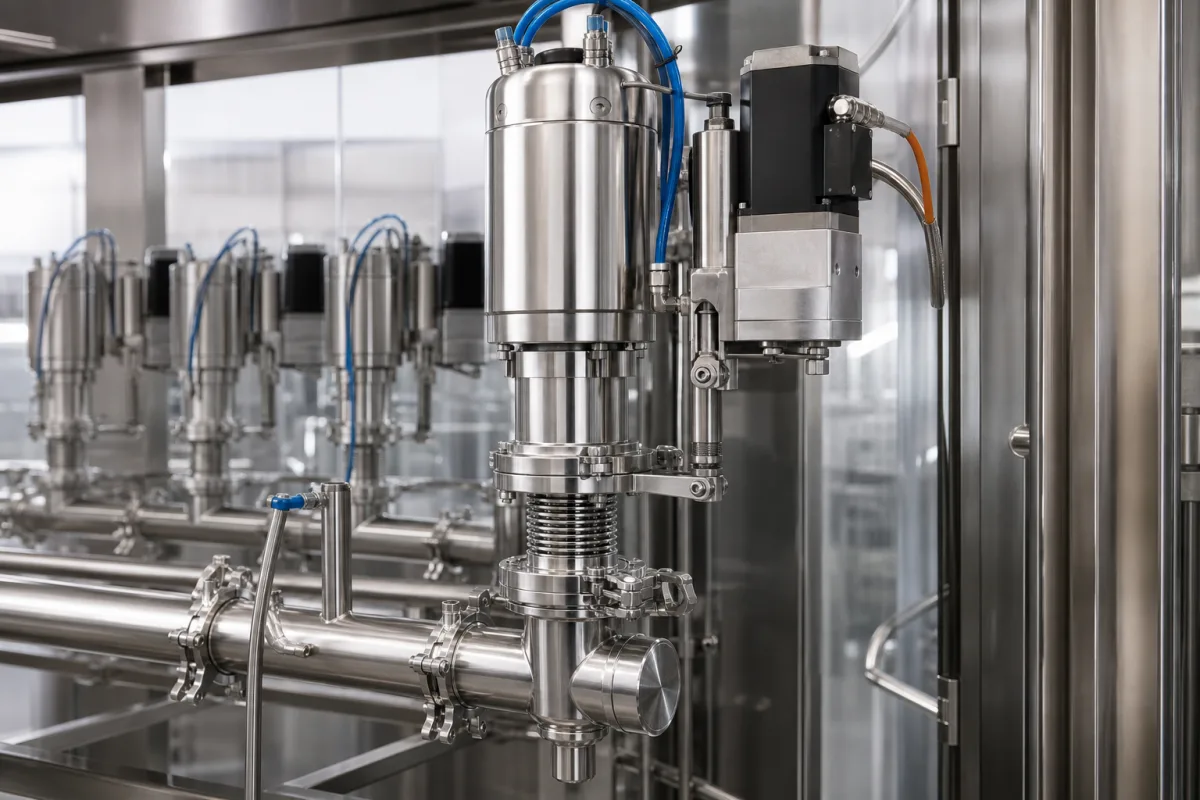
A mechanical device that converts energy into motion to control valve operation in aseptic filling systems.
Product Specifications

Technical details and manufacturing context for Actuator (Pneumatic/Servo)

Definition
An actuator is a critical component of the Aseptic Filling Valve Assembly that provides the precise mechanical force needed to open, close, or modulate the valve during sterile filling operations. It ensures accurate positioning and movement control to maintain aseptic conditions while handling liquid products.
Working Principle
Pneumatic actuators use compressed air to create linear or rotary motion through pistons or diaphragms, while servo actuators use electric motors with feedback control systems for precise positioning. Both types convert energy into mechanical movement to operate the valve mechanism.
Common Materials
Stainless steel (316L), Aluminum alloy, Engineering plastics (PTFE, PEEK)
Technical Parameters
  • Stroke length or rotation angle (mm) Customizable
Components / BOM
  • Piston/cylinder assembly
    Converts air pressure into linear motion
    Material: Stainless steel
  • Position sensor
    Provides feedback for precise control
    Material: Electronic components
  • Seals and gaskets
    Maintains pressure integrity and prevents contamination
    Material: Food-grade elastomers (EPDM, silicone)
Engineering Reasoning
0.5-10 bar (pneumatic), 0-24 VDC (servo control signal)
Pneumatic: 12 bar burst pressure for standard aluminum bodies, 150°C thermal limit for seals; Servo: 32 VDC input voltage maximum, 85°C winding insulation class F limit
Design Rationale: Pneumatic: Seal extrusion failure at 12+ bar due to differential pressure exceeding elastomer yield strength; Servo: Permanent magnet demagnetization at 85°C+ due to Curie temperature of NdFeB magnets (320-380°C theoretical, 80-100°C practical)
Risk Mitigation (FMEA)
Trigger Condensate accumulation in pneumatic supply lines reaching actuator
Mode: Seal swelling and increased friction causing 15+ N·m stiction torque
Strategy: Install coalescing filter with 0.01 μm rating at actuator inlet with automatic drain
Trigger Encoder feedback cable shield grounding loop creating 50 mV+ noise
Mode: Servo position error exceeding ±0.05 mm during homing sequence
Strategy: Star-point grounding at drive cabinet with 10 mm² copper busbar

Industry Taxonomies & Aliases

Commonly used trade names and technical identifiers for Actuator (Pneumatic/Servo).

Applied To / Applications

This component is essential for the following industrial systems and equipment:

Industrial Ecosystem & Supply Chain DNA

Complementary Systems
Downstream Applications
Specialized Tooling

Application Fit & Sizing Matrix

Operational Limits
pressure: 0 to 10 bar (pneumatic), 0 to 150 bar (servo hydraulic)
flow rate: Up to 60,000 L/h (depending on valve size)
temperature: -20°C to 120°C
slurry concentration: Up to 40% solids by weight
Media Compatibility
✓ Sterile water for injection (WFI) ✓ High-viscosity pharmaceutical suspensions ✓ Aseptic dairy products
Unsuitable: Corrosive chemical slurries with pH <2 or >12
Sizing Data Required
  • Required valve stroke length (mm)
  • Maximum operating pressure (bar)
  • Cycle frequency (cycles/hour)

Reliability & Engineering Risk Analysis

Failure Mode & Root Cause
Seal degradation
Cause: Contamination ingress (moisture, particulates) or incompatible lubricants causing hardening/cracking of elastomeric seals
Position feedback failure
Cause: Encoder/sensor contamination, electrical noise interference, or mechanical misalignment in servo systems
Maintenance Indicators
  • Audible hissing or air leaks indicating seal failure or fitting issues in pneumatic actuators
  • Erratic movement or position drift beyond tolerance limits suggesting feedback or control system problems
Engineering Tips
  • Implement proper filtration (5 micron for pneumatic, 3 micron for servo hydraulic) and moisture separation in supply lines
  • Establish regular calibration cycles for servo feedback systems and verify pneumatic pressure/flow parameters monthly

Compliance & Manufacturing Standards

Reference Standards
ISO 15552: Pneumatic fluid power - Standard cylinders ANSI/NFPA T3.6.7: Fluid power systems and components - Cylinders - Bore and rod dimensions and mounting dimensions DIN ISO 6432: Pneumatic fluid power - Single rod cylinders, 10 bar (1000 kPa) series - Bore and rod dimensions and mounting dimensions
Manufacturing Precision
  • Bore diameter: +/-0.02 mm
  • Rod straightness: 0.05 mm per 100 mm length
Quality Inspection
  • Leakage test: Pressure decay method per ISO 19973-1
  • Endurance test: Cycle life verification per ISO 19973-2

Factories Producing Actuator (Pneumatic/Servo)

Verified manufacturers with capability to produce this product in China

✓ 97% Supplier Capability Match Found

P Procurement Specialist from Canada Jan 03, 2026
★★★★★
"Reliable performance in harsh Food Manufacturing environments. No issues with the Actuator (Pneumatic/Servo) so far."
Technical Specifications Verified
T Technical Director from United States Dec 31, 2025
★★★★★
"Testing the Actuator (Pneumatic/Servo) now; the technical reliability results are within 1% of the laboratory datasheet."
Technical Specifications Verified
P Project Engineer from United Arab Emirates Dec 28, 2025
★★★★★
"Impressive build quality. Especially the technical reliability is very stable during long-term operation."
Technical Specifications Verified
Verification Protocol

“Feedback is collected from verified sourcing managers during RFQ (Request for Quote) and factory evaluation processes on CNFX. These reports represent historical performance data and technical audit summaries from our B2B manufacturing network.”

8 sourcing managers are analyzing this specification now. Last inquiry for Actuator (Pneumatic/Servo) from Turkey (1h ago).

Supply Chain Compatible Machinery & Devices

Intelligent Food Grade Metal Detector

Automated metal contamination detection system for food processing lines.

Explore Specs →
Automated Food Packaging Integrity Tester

Automated system for non-destructive testing of food package seals and integrity.

Explore Specs →
Automated Food Moisture Analyzer

Automated system for precise moisture content measurement in food products

Explore Specs →
Automated Food Color Consistency Analyzer

Automated inline system for real-time color measurement and consistency control in food processing.

Explore Specs →

Frequently Asked Questions

What makes this actuator suitable for aseptic filling systems in food manufacturing?

This actuator is specifically designed for aseptic environments with 316L stainless steel construction, FDA-compliant engineering plastics (PTFE/PEEK), and precision motion control to maintain sterile conditions during valve operation in filling systems.

How does the servo option differ from pneumatic in food processing applications?

Servo actuators offer superior precision and programmability for exact valve positioning in aseptic filling, while pneumatic actuators provide faster response and simpler maintenance. Both options use food-grade materials suitable for sanitary environments.

What maintenance is required for actuators in food manufacturing environments?

Regular inspection of seals and gaskets (especially PTFE/PEEK components), cleaning per sanitary protocols, and monitoring position sensor accuracy. The 316L stainless steel and aluminum alloy construction resists corrosion from cleaning chemicals.

Can I contact factories directly on CNFX?

CNFX is an open directory, not a transaction platform. Each factory profile provides direct contact information and production details to help you initiate direct inquiries with Chinese suppliers.

Get Quote for Actuator (Pneumatic/Servo)

Request technical pricing, lead times, or customized specifications for Actuator (Pneumatic/Servo) directly from verified manufacturing units.

Your business information is encrypted and only shared with verified Actuator (Pneumatic/Servo) suppliers.

Thank you! Your message has been sent. We'll respond within 1–3 business days.

Need to Manufacture Actuator (Pneumatic/Servo)?

Connect with verified factories specializing in this product category

Add Your Factory Contact Us
Previous Product
Actuator (Pneumatic/Electric)
Next Product
Agitation Mechanism