Industry-Verified Manufacturing Data (2026)

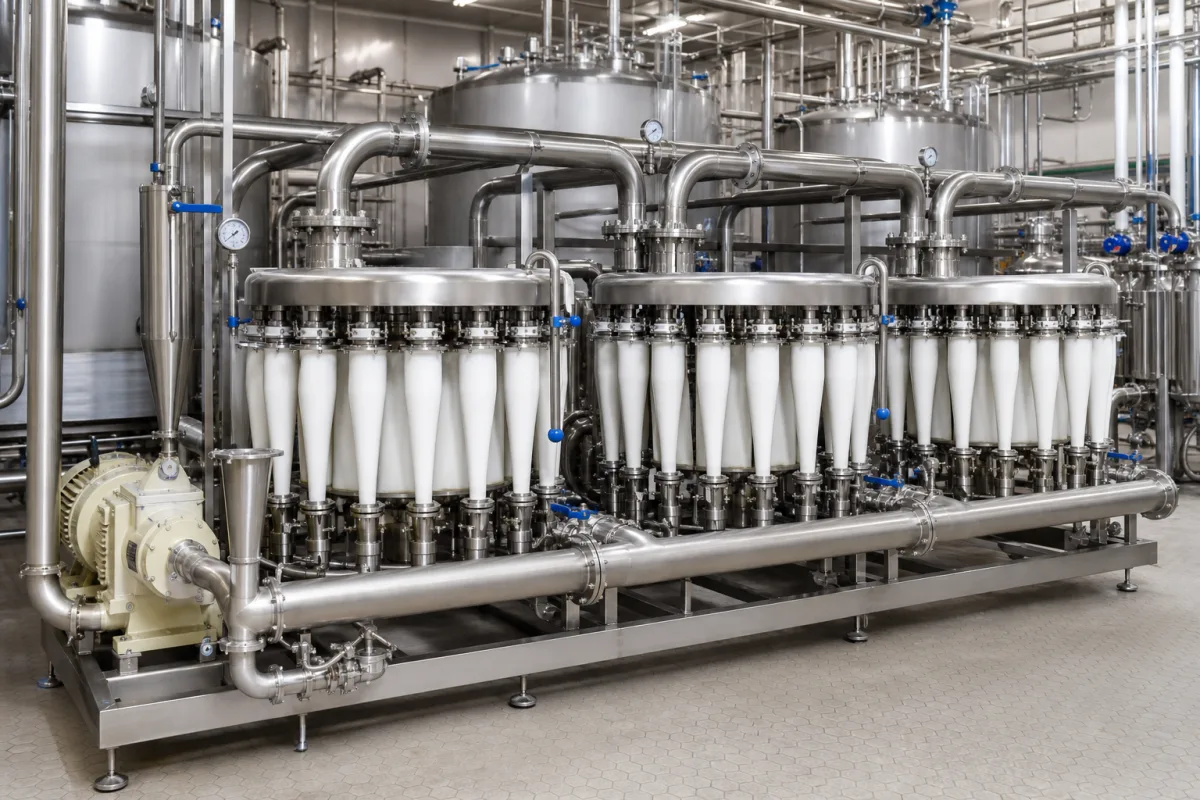
Continuous Starch Hydrocyclone Separator

Based on aggregated insights from multiple verified factory profiles within the CNFX directory, the standard Continuous Starch Hydrocyclone Separator used in the Food Manufacturing sector typically supports operational capacities ranging from standard industrial configurations to heavy-duty production requirements.

Technical Definition & Core Assembly

A canonical Continuous Starch Hydrocyclone Separator is characterized by the integration of Hydrocyclone Cone and Inlet Nozzle. In industrial production environments, manufacturers listed on CNFX commonly emphasize Stainless Steel 316L construction to support stable, high-cycle operation across diverse manufacturing scenarios.

Industrial centrifugal separator for starch purification and protein removal.

Product Specifications

Technical details and manufacturing context for Continuous Starch Hydrocyclone Separator

Definition
A continuous-flow hydrocyclone separator designed specifically for starch processing applications. This industrial machine utilizes centrifugal force to separate starch granules from protein and other impurities in slurry form. It operates as a key purification stage in starch manufacturing plants, enabling higher purity starch products for food, pharmaceutical, and industrial applications. The continuous operation allows for high-volume processing with minimal downtime, making it essential for modern starch production facilities.
Working Principle
Starch slurry enters tangentially, creating centrifugal vortex that separates denser starch from lighter protein particles.
Common Materials
Stainless Steel 316L, Polyurethane, Ceramic
Technical Parameters
  • Maximum dry starch throughput (tons/hour) Standard Spec
  • Protein removal efficiency from starch slurry (%) Standard Spec
Components / BOM
  • Hydrocyclone Cone
    Creates centrifugal separation vortex
    Material: Stainless Steel 316L
  • Inlet Nozzle
    Directs slurry tangentially into cyclone
    Material: Ceramic
  • Underflow Apex
    Controls discharge of concentrated starch
    Material: Polyurethane
  • Overflow Vortex Finder
    Extracts protein-rich overflow stream
    Material: Stainless Steel 316L
  • Pressure Gauge Optional
    Monitors inlet pressure for optimal operation
    Material: Stainless Steel
Engineering Reasoning
0.5-2.0 MPa (5-20 bar) differential pressure across hydrocyclone
3.5 MPa (35 bar) differential pressure causing structural deformation of polyurethane liners
Design Rationale: Excessive centrifugal force exceeding 1500g acceleration causes liner delamination from steel housing due to differential thermal expansion (polyurethane CTE: 150×10⁻⁶/°C vs steel CTE: 12×10⁻⁶/°C)
Risk Mitigation (FMEA)
Trigger Starch slurry solids concentration exceeding 40% w/w
Mode: Hydrocyclone apex blockage leading to overflow contamination
Strategy: Install Coriolis mass flow meter with 0.1% accuracy for real-time density control and automatic dilution valve
Trigger Inlet velocity drop below 8 m/s due to pump cavitation (NPSH margin < 0.5 m)
Mode: Reduced centrifugal separation efficiency (protein removal drops from 95% to <70%)
Strategy: Implement variable frequency drive maintaining 2900±50 RPM with pressure transducer feedback loop

Industry Taxonomies & Aliases

Commonly used trade names and technical identifiers for Continuous Starch Hydrocyclone Separator.

Industrial Ecosystem & Supply Chain DNA

Complementary Systems
Downstream Applications
Specialized Tooling

Application Fit & Sizing Matrix

Operational Limits
pressure: Max 0.6 MPa (87 psi) inlet pressure
flow rate: 10-200 m³/h (44-880 gpm) per unit
temperature: 5-60°C (41-140°F)
slurry concentration: 5-40% solids by weight
Media Compatibility
✓ Corn starch slurry ✓ Potato starch slurry ✓ Wheat starch slurry
Unsuitable: High-viscosity, non-Newtonian fluids with yield stress (e.g., drilling muds)
Sizing Data Required
  • Feed slurry flow rate (m³/h)
  • Target starch recovery efficiency (%)
  • Inlet solids concentration (% by weight)

Reliability & Engineering Risk Analysis

Failure Mode & Root Cause
Abrasive erosion of cyclone liners
Cause: High-velocity starch slurry containing abrasive particles (e.g., sand, grit) causing progressive material loss, especially at inlet and apex regions, leading to reduced separation efficiency and eventual leakage.
Blockage or plugging of apex/orifice
Cause: Accumulation of oversized particles, fibrous materials, or agglomerated starch causing flow restriction, increased pressure drop, and potential overflow or underflow imbalance, often due to improper feed particle size control or insufficient flushing.
Maintenance Indicators
  • Audible high-frequency whistling or vibration from the cyclone body, indicating air ingress, cavitation, or severe internal wear altering flow dynamics.
  • Visible starch slurry leakage at flange joints or liner seams, accompanied by a drop in separation efficiency (e.g., cloudy overflow or thickened underflow).
Engineering Tips
  • Implement routine ultrasonic thickness testing on cyclone liners to monitor erosion rates and schedule proactive liner replacements before failure, optimizing material selection (e.g., ceramic or polyurethane liners) based on slurry abrasiveness.
  • Install and maintain a pre-screening system (e.g., vibrating screen or sieve) upstream to remove oversized particles and debris, and program automated back-flushing cycles to prevent apex blockages, ensuring consistent feed quality and flow.

Compliance & Manufacturing Standards

Reference Standards
ISO 9001:2015 - Quality management systems ANSI/ASME B31.3 - Process piping DIN EN 1092-1 - Flanges and their joints
Manufacturing Precision
  • Cylindricity tolerance: 0.05mm for hydrocyclone cone sections
  • Surface roughness: Ra ≤ 1.6μm for internal flow surfaces
Quality Inspection
  • Hydrostatic pressure test at 1.5x operating pressure
  • Material composition verification via XRF analysis

Factories Producing Continuous Starch Hydrocyclone Separator

Verified manufacturers with capability to produce this product in China

✓ 95% Supplier Capability Match Found

S Sourcing Manager from Brazil Feb 01, 2026
★★★★★
"Impressive build quality. Especially the Flow Rate (m³/h) is very stable during long-term operation."
Technical Specifications Verified
P Procurement Specialist from Canada Jan 29, 2026
★★★★☆
"As a professional in the Food Manufacturing sector, I confirm this Continuous Starch Hydrocyclone Separator meets all ISO standards. (Delivery took slightly longer than expected, but technical support was excellent.)"
Technical Specifications Verified
T Technical Director from United States Jan 26, 2026
★★★★★
"Standard OEM quality for Food Manufacturing applications. The Continuous Starch Hydrocyclone Separator arrived with full certification."
Technical Specifications Verified
Verification Protocol

“Feedback is collected from verified sourcing managers during RFQ (Request for Quote) and factory evaluation processes on CNFX. These reports represent historical performance data and technical audit summaries from our B2B manufacturing network.”

9 sourcing managers are analyzing this specification now. Last inquiry for Continuous Starch Hydrocyclone Separator from Mexico (1h ago).

Supply Chain Commonly Integrated Components

Temperature Control Module

A precision electronic component that regulates and maintains optimal temperature conditions within fermentation vessels.

Explore Specs →
Pressure Regulation Unit

A specialized component within fermentation systems that maintains precise pressure levels during microbial growth processes.

Explore Specs →
Sensor Array Network

A network of multiple sensors distributed throughout a fermentation system to monitor and collect real-time data on critical parameters.

Explore Specs →
Agitation System

A mechanical subsystem within an automated fermentation control system designed to mix and homogenize fermentation media through controlled agitation.

Explore Specs →

Frequently Asked Questions

What is the primary function of the Continuous Starch Hydrocyclone Separator?

The primary function is to purify starch by separating it from proteins and other impurities using centrifugal force, improving starch quality and recovery rates in grain milling and starch production processes.

What materials are used in the construction of this hydrocyclone separator?

It is constructed from Stainless Steel 316L for corrosion resistance, Polyurethane for wear resistance in key components, and Ceramic for durability in high-abrasion areas, ensuring long service life in industrial environments.

How does this separator improve starch production efficiency?

It enhances efficiency by continuously operating to reduce protein content and increase starch recovery rates, minimizing downtime and maximizing throughput in grain mill and starch manufacturing operations.

Can I contact factories directly on CNFX?

CNFX is an open directory, not a transaction platform. Each factory profile provides direct contact information and production details to help you initiate direct inquiries with Chinese suppliers.

Get Quote for Continuous Starch Hydrocyclone Separator

Request technical pricing, lead times, or customized specifications for Continuous Starch Hydrocyclone Separator directly from verified manufacturing units.

Your business information is encrypted and only shared with verified Continuous Starch Hydrocyclone Separator suppliers.

Thank you! Your message has been sent. We'll respond within 1–3 business days.

Need to Manufacture Continuous Starch Hydrocyclone Separator?

Connect with verified factories specializing in this product category

Add Your Factory Contact Us
Previous Product
Continuous Screw Press for Oil Extraction
Next Product
Control Panel