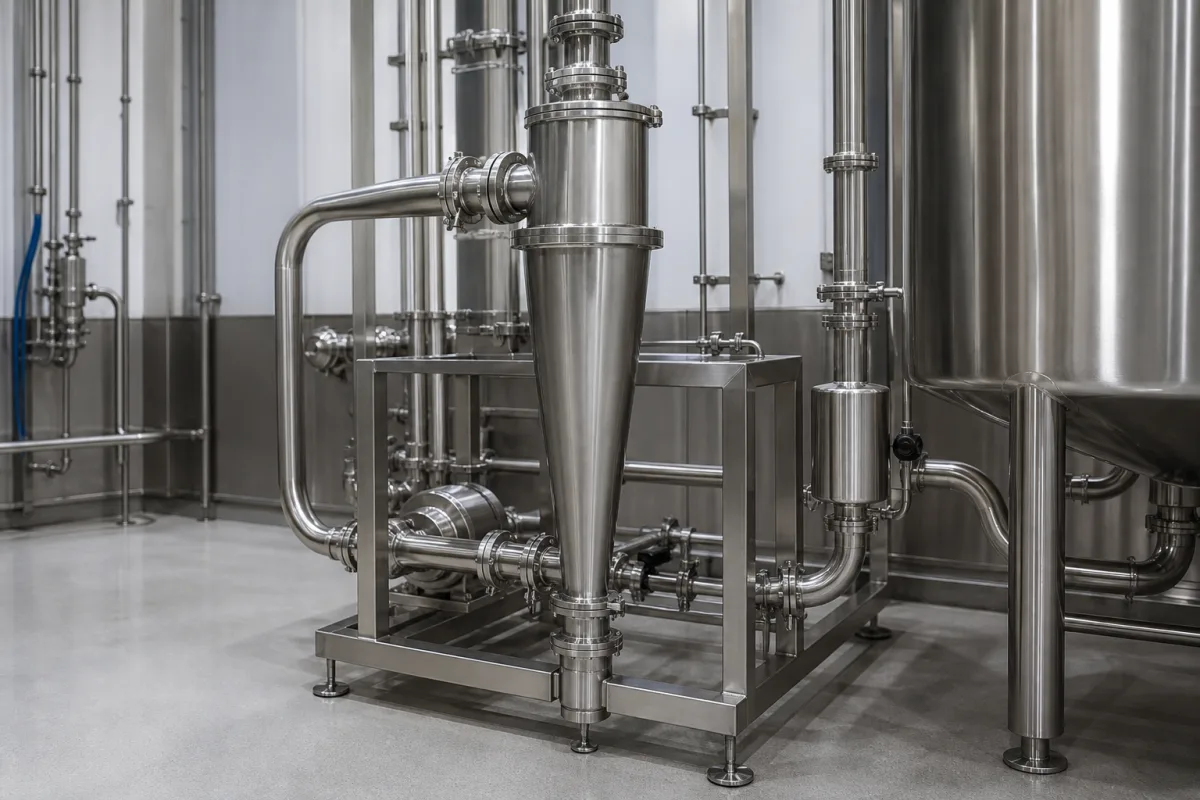
Hydrocyclone cone and apex: choosing the cone angle and length, sizing the underflow apex, and keeping the taper continuous from inlet section to discharge
The conical section and apex of a hydrocyclone · a 6° cone and 2.3 mm apex on a 10 mm starch cyclone, 20° and 10° single cones and a 20° + 6° stepped cone on large classifiers, and what cone length, apex size and joints do to a separation
Inside a hydrocyclone, the cone is where the separation is decided. The spinning feed is squeezed into a narrowing taper, the coarse or dense fraction is forced out through the apex at the bottom, and the rest turns back up through the vortex finder. The angle of that taper, its length, the size of the apex and how smoothly the cone meets the apex piece are design choices with published consequences.
The conical section and apex (spigot) of hydrocyclones used for starch and other solid–liquid separation and classification: included cone angle, single and multi-stage cones, cone length, underflow apex and overflow sizes, the transition between cone and apex piece, and cone materials and liners. Multi-cyclone (cyclonette) housings and complete starch washing and concentration stations, with their stage counts, Baumé, protein and wash-water duties, are covered on the Continuous starch hydrocyclone separator page. Pumps, feed manifolds and oil–water deoiling cyclones are not covered here.
CNFX editorial research · Sources checked October 13, 2026 · 4 sources
Cone angle from 6° to 20°: the narrow cones of 10 mm starch cyclones, and single or stepped cones on large classifiers
Krebs's case for the stepped cone is that slurry passing from the broad upper cone into the narrow lower one lets finer particles report to the overflow further down the cyclone, giving a sharper and finer separation; its figure compares the 20° + 6° cyclone with single cones of 10.5° and 20°. [3] In the starch case, Dorr-Oliver notes that cone angle, apex and overflow sizes and vortex-finder length influence a volute hydrocyclone's performance and that suitable values for conventional small cyclones are well known; its own invention changes only the feed passage. [1]
Cyclone
Cone
Other published dimensions
10 mm volute starch hydrocyclone tested by Dorr-Oliver
Pressure drop 145 psi on stage P2, 114 psi on P1, about 90 psi on each washing stage [2]
Large classifying cyclone, prior art in a Krebs patent
Single 20° cone in mining applications; 10° cones adopted in about the 10 years before the filing, particularly for coal [3]
Cone in two bolted pieces with liners and a tapered apex section [3]
Krebs stepped-cone design
First cone 15–45° (20° preferred), then 4–15° (6° preferred); a three-cone version at 20°, 10° and 6° [3]
9 11/16 in inlet section; 63 11/16 in overall chamber length in the 20° + 6° example [3]
Ask for the included cone angle (not the half-angle), whether the cone is single or stepped, and the separation data behind the choice for your solids.
02
Cone length and apex size: about 73 mm of 6° cone between a 10 mm chamber and a 2.3 mm apex, and what a longer cone did in a design study
Editorial calculation: the length of a straight cone between chamber diameter D and apex diameter Du at included angle θ is (D − Du) / (2 tan(θ/2)). For a 10 mm chamber and a 2.3 mm apex, that is about 73 mm at 6°, 75 mm at 5°52′ and 22 mm at 20°. [1][2] The combination is illustrative: the 2.3 mm apex is from the Dorr-Oliver test cyclone, the 5°52′ angle from the corn-starch patent.
Xu and colleagues at East China University of Science and Technology varied vortex finder, spigot, inlet and cone length on a 75 mm hydrocyclone with a 25 µm separation target. With the spigot at 4–6 mm, a sharpness index of 91 % was reached at cone lengths of 133–150 mm, falling to 88 % at 94–100 mm; across the spigot range studied, spigot diameter had little effect on sharpness, while the vortex finder ranked first in effect, the index falling from 92 % to 84 % as it widened from 26.25 to 45 mm. Their redesigned cyclone raised sharpness from 80.5 % to 93.3 %. [4]
State the solids, the target cut or concentration, and whether the apex is fixed or replaceable; ask for the apex and overflow diameters as a pair.
03
Where the cone meets the apex piece, and what the cone is made of
Krebs points to the apex section of a conventional cyclone, internally tapered to match the end of the cone to the underflow line: the discontinuity in cone angle there can disrupt the accelerated flow and degrade performance. Its stepped design and liners address the whole separating chamber, and its inlet-head liner, thicker with an integral top cover and rounded corners, gave a slight increase in capacity and a substantial increase in liner wear life. [3]
At the other end of the size range, the 10 mm starch cyclone in Dorr-Oliver's tests was moulded in polyamide 6.6. Dorr-Oliver reports that such volute cyclones in starch plants run at a pressure drop of 6 to 6.5 bar, against 3 to 3.5 bar for older designs of similar throughput. [1] Editorial calculation: the Bestfoods stage pressure drops of 145, 114 and about 90 psi are about 10.0, 7.9 and 6.2 bar. [2]
Ask for cone and apex materials, liner thickness and replacement parts, and whether the inside of the cone is continuous across every joint down to the apex.
04
What to send when specifying a hydrocyclone cone and apex
Paste it into your enquiry below or into an email to a maker, then replace every bracket.
Service: [starch washing, concentration or recovery; other solids; temperature]
Cyclone size: [chamber diameter; single cyclone or cyclonette]
Cone: [included angle; single or stepped; length]
Apex and overflow: [diameters; fixed or replaceable]
Pressure: [pressure drop per cyclone]
Materials: [cone and apex material; liners; food contact]
Explore company information and manufacturing capabilities, then discuss the scope of your project with a relevant supplier.
Share this page
Compiled and source-reviewed by the CNFX editorial team.
Each manufacturer above links to the page on that company's own website where the product is listed, with the date we checked it. How we source and review
· Page last updated 13 October 2026
Buyer questions
What cone angle do starch hydrocyclones use?
A Dorr-Oliver test cyclone of 10 mm had a 6° cone; a corn wet-milling patent used 10 mm cyclones with a 5°52′ conical angle. [1][2]
What is a stepped-cone hydrocyclone?
A cyclone with a broad upper cone and a narrower lower cone; Krebs prefers 20° followed by 6°, and describes a three-cone version at 20°, 10° and 6°. [3]
Does a longer cone improve separation?
In one design study on a 75 mm cyclone, the sharpness index was 91 % at cone lengths of 133–150 mm and 88 % at 94–100 mm. [4]
What apex size does a 10 mm starch cyclone have?
In Dorr-Oliver's tests, a 2.3 mm underflow aperture with a 2.5 mm overflow. [1]
Sources and what still needs a direct check
Sources checked 2026-10-13. Starch cyclone geometry comes from patents by Dorr-Oliver and Bestfoods; large-cyclone cone angles and the cone–apex transition from a Krebs International patent; cone length and spigot effects from a 2019 Royal Society Open Science study.