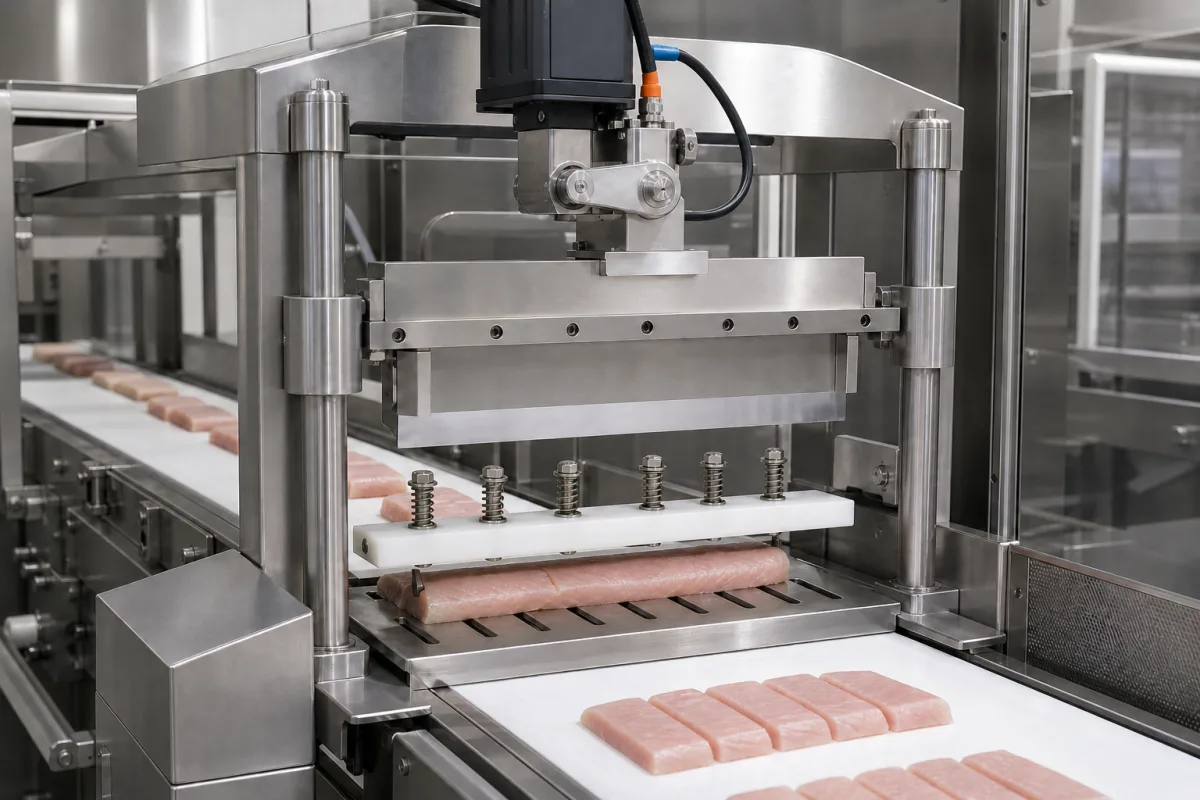
Cutting assembly for fish and meat portion cutters: the servo blade, conveyor gap and cut rate behind fixed-weight portions
Blade cutting unit of a fish and meat portion cutter · blade through the gap between two belts, 1,000 to over 2,100 cuts per minute, 225–270 mm product width, 45–90° cut angles, scan-driven fixed-weight portions
In a portion cutter, the cutting assembly is the blade, its servo drive and the blade housing that sit between the infeed belt, which carries the scanned fillet, loin or breast, and the outfeed belt. The blade passes through a narrow gap between the two belts once per cut, timed by the computer so each portion meets a target weight or length. Settle three things first: the cut rate and product envelope the assembly must handle, the cut angles needed for the portions, and how scanning and blade control hold weight accuracy and giveaway.
Blade cutting units of automatic portion cutters for fish, poultry and meat: the blade, servo drive, blade guard, conveyor gap and hold-down, and the control that times each cut from a 3D or laser scan. Machines that cut fillets from whole headed and gutted fish are covered on the Industrial fish filleting machine page. Water-jet portioners, deheaders, skinners, pin-bone removers and filtration or purification equipment are outside this page.
CNFX editorial research · Sources checked October 12, 2026 · 4 sources
Blade through the belt gap: 20 to 30 cuts a second and what a slow blade does to the cut
A John Bean Technologies patent granted in 2018 describes the portioning blade as a rotating blade that passes through a narrow gap formed between the ends of the infeed and outfeed conveyors; such a blade may make about 20 to 30 cuts per second, so the timing of each pass through the gap has to be tightly controlled. [1]
The patent explains the cut itself: the blade first compresses the meat fibres until they fracture below it, and the fracture then runs through the meat. With little support under the product the meat compresses and moves with the blade instead of fracturing, so the gap must be as small as possible; if the blade runs too slowly the meat is pushed into the gap rather than cut cleanly, which lowers cut quality and makes portion weights vary. [1]
Its remedy is to adjust the blade's rotational speed profile and the feed rate from monitored data: motor operating parameters, including motor heating, the measured accuracy of the cut portions and the throughput. A third, faster conveyor after the cut separates the portions so that they and the cuts can be scanned again. [1]
Editorial calculation: 20 to 30 cuts per second is 1,200 to 1,800 cuts per minute. [1]
Give the supplier the product (species, fresh or frozen, skin on or off), product width, height and length, target portion weights or lengths and tolerances, cut angles, required throughput, belt type for cleaning, and whether trim must be sorted out on a separate outfeed.
02
Cuts per minute, product envelope and cut angles on three portion cutters
Published cut rates span about a factor of two. Marel's I-Cut 130 for salmon makes up to 1,000 cuts per minute; BAADER's 358 is described as reaching up to 2,200 cuts per minute on a single lane, while its technical data list a maximum cutting frequency of 2,170 cuts/min; Borncut's BC225 is reported at more than 2,100 cuts per minute with a blade speed of up to 200 km/h. [2][3][4]
Marel's throughput examples for the I-Cut 130 depend on product and portion size: an 800 g, 500 mm salmon loin cut into 125 g portions at 90° gives up to 2,600 kg/h, and a 3,500 g whole de-headed salmon cut into 175 g steaks up to 4,800 kg/h. [2] Editorial calculation: 4,800 kg/h in 175 g steaks is about 27,400 steaks an hour, or about 460 cuts per minute, under half the stated 1,000 cuts/min, so on that product the blade runs well below its stated maximum. [2]
Editorial note: ask for the cut rate at your portion size and product length, and for the minimum cut thickness, rather than the top figure alone; BAADER, for example, sets its minimum cut thickness at 8 mm. [3]
Blade speed up to 200 km/h; single or dual lane [4]
03
Scan, cut and giveaway: what 0.5% of accuracy is worth on 10 t of salmon a day
Borncut's CEO Gorm Sørensen, in a Beckhoff application report, puts the value of cutting precision this way: on 10 t of salmon a day, a machine output improved by only 0.5% saves around DKK 5,000 a day, about DKK 1.25 million or €170,000 a year. Their machine scans the product in 3D and runs servo drives over EtherCAT. [4]
Marel equips the I-Cut 130 with a laser vision system using 200 Hz camera technology, servo motors for the cut, active product holders for round and odd-shaped products and Ropanyl belts for sanitation. [2] BAADER states that the 358's software analyses product density in real time and turns it into cutting instructions. [3] JBT's patent describes a laser light stripe across the infeed belt viewed by a camera, the shadow line showing the product's profile. [1]
Editorial note: weight accuracy depends on the scan and the cut together; ask for the portion weight distribution and giveaway on your own product at the target rate, and how trim and odd ends are sorted.
04
Product, portion and rate data for a portion cutter cutting unit
Paste it into your enquiry below or into an email to a maker, then replace every bracket.
Product: [species or meat; fresh or frozen; skin on or off; max width, height, length]
Portions: [fixed weight or length; target and tolerance; cut angles; minimum thickness]
Rate: [kg/h; cuts per minute at your portion size; lanes]
Scanning: [laser or 3D; density compensation]
Hygiene: [belt type; washdown; materials]
Outfeed: [trim sorting; spacing for packing]
Explore company information and manufacturing capabilities, then discuss the scope of your project with a relevant supplier.
Share this page
Compiled and source-reviewed by the CNFX editorial team.
Each manufacturer above links to the page on that company's own website where the product is listed, with the date we checked it. How we source and review
· Page last updated 13 October 2026
Buyer questions
How fast does a portion cutter blade cut?
A JBT patent puts it at about 20 to 30 cuts per second; Marel lists up to 1,000 cuts/min for the I-Cut 130, BAADER 2,170 cuts/min for the 358, and Borncut more than 2,100 cuts/min. [1][2][3][4]
Why must the gap between the conveyors be small?
JBT's patent explains that without support under the product the meat compresses and moves with the blade instead of fracturing, and a slow blade pushes meat into the gap. [1]
What cut angles can a fish portion cutter make?
Marel's I-Cut 130 cuts at 45, 55, 65 and 90 degrees; the BAADER 358 at 90, 75, 60, 52 and 45 degrees. [2][3]
How wide a product can a portion cutter take?
Marel lists 270 mm maximum width for the I-Cut 130; BAADER lists 225 mm for the 358. [2][3]
Sources and what still needs a direct check
Sources checked 2026-10-12. Marel, BAADER and Borncut publish figures for their own machines (Borncut's via a Beckhoff application report); the John Bean Technologies patent explains blade timing and cut quality rather than a specific current model.