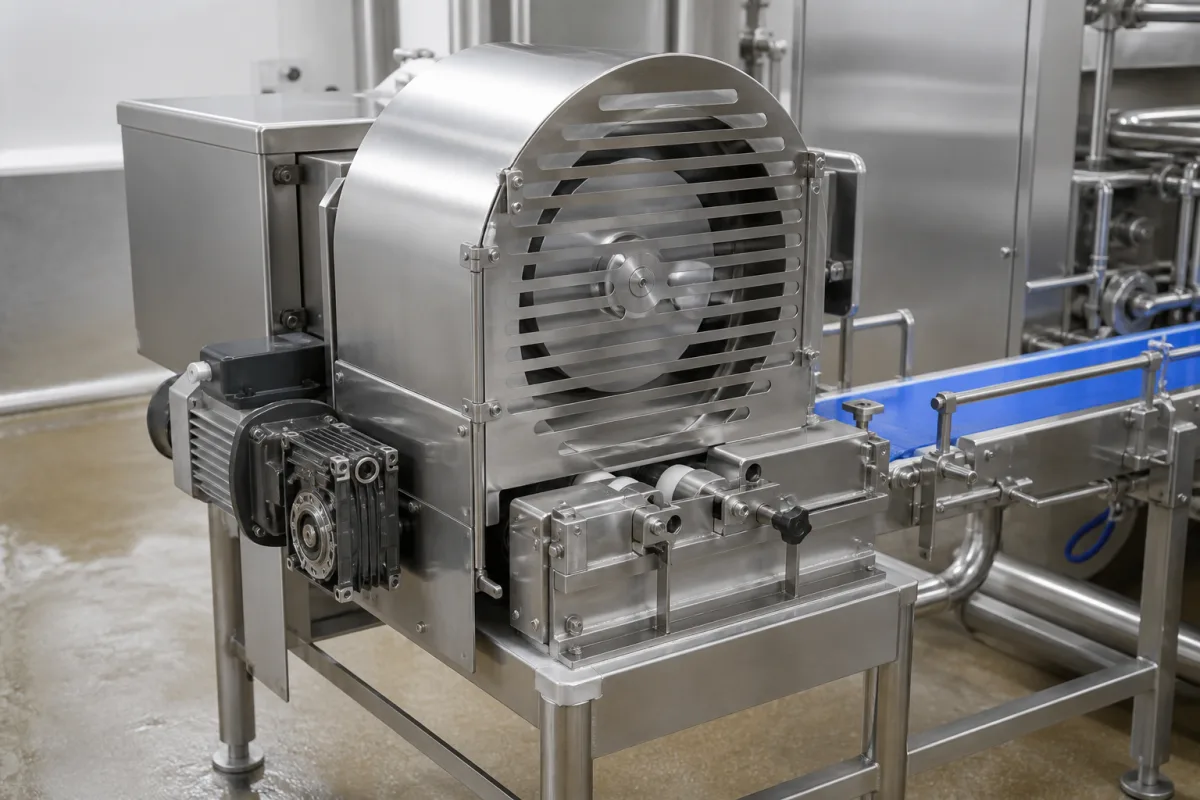
Cutting mechanism for food extruders: rotary knives that set piece length and shape as the extrudate leaves the die
Rotary cutters on food and feed extruders · Piece length from extrudate speed and cuts per minute, 4 or 8 knives up to 1,125 rpm, knife-to-die gap, knives of two lengths that notch then cut, face cutters against belt and guillotine cutters, and the knife checks that keep fragments out of product
This page covers the cutting mechanism of a food or feed extruder: the rotary knife hub at the die face, or the rotary or guillotine cutter on a belt after it, with its drive, knife holder and guard. Ask three things first: which piece length range and shapes the cutter must produce at your extrusion rate, how the knife-to-die gap and knife speed are set and held, and how knives are checked so that worn or broken pieces never reach the product.
Cutting mechanisms of food, snack and pet food extruders: die-face cutters, belt-mounted rotary cutters and guillotine cutters for extrudate, with their knives, drives and guards. Complete extruders and forming lines are covered on the Industrial food extrusion and forming machine page. Polymer pelletizers, bread and cake slicers and meat portion cutters are outside this page.
CNFX editorial research · Sources checked October 12, 2026 · 4 sources
Piece length follows extrudate speed and cuts per minute; knife speed outside its window spoils the piece
Brabender's CuttingDevice for its single- and twin-screw extruders cuts snack or feed extrudates to a set length as they leave the die, with 4 or 8 blades, a maximum blade speed of 1,125 rpm and up to 9,000 cuts per minute with 8 blades; length is changed through the cutting gap and the blade-to-die distance is set with a threaded spindle, and its safety concept prevents the knives from stopping directly in front of the die opening. [2] Galen Rokey of Wenger tells Pet Food Processing that if knife rpm is too fast the pieces come out too short with accelerated blade wear, and if too slow the knives disrupt the product flow leaving the die and create a rounded, mushroom-topped piece. [1]
Editorial calculation: piece length is roughly extrudate exit speed divided by cuts per second. At 9,000 cuts per minute (150 per second), an extrudate leaving at an assumed 1 m/s is cut into pieces of about 6.7 mm; with 4 knives at the same 1,125 rpm (4,500 cuts per minute) the same flow gives about 13 mm. [2]
Give the supplier the products and their target lengths and shapes, the extrusion rate and die layout, the extrudate temperature and moisture at the die, whether pieces are cut at the die face or downstream, the guard and washdown requirements, and how the cutter is synchronised with the extruder.
02
Knives of two lengths for shaped pieces, and face, belt or guillotine cutting
A Nestec patent for cutting extruded pet food uses a rotary shaft carrying knives of different lengths: the shorter knife incises the extrusion column at the die exit to form a surface effect such as a fish's mouth or cat's paw, and the longer one cuts the piece off; in a preferred form four knives sit at right angles, the longest about twice the length of the shortest. It notes that an earlier design with the knife axis offset from the extruder axis left the blades rotating through air over much of their turn, raising guarding and adjustment problems because of the large centrifugal force. [3]
In Pet Food Processing, Wenger describes knife blades for short goods, flexible or rigid, that travel along the die surface, and for long goods a guillotine cutter that cuts straight down and retracts and can cut more than one stream at a time, and a rotary belt cutter with a knife turning at high rpm over a conveyor for a more rugged, handmade look; Clextral's Sylvie Brunel says its die-face cutters allow the blade position to be fine-tuned during operation and the cutter to be positioned in front of the die safely after the extruder starts, since product leaving the die is hot and malleable. [1] A 2026 review of pet food processing in Frontiers in Veterinary Science describes kibble dough cooked at 125–150 °C for 10–270 s, leaving through a die and face cutter onto a belt, and drying at 90–180 °C. [4]
03
Knife checks that keep fragments out of the product
Wenger's Daniel Tramp says operators need to check die knives regularly so that they are sharp and none are missing or damaged, since a missing knife leaves gaps and damaged knives deform product, and knife assemblies need regular sanitising; Rokey adds that a 15-minute operator check can make all the difference, that the cutting operation needs proper shielding, and that worn knives can shed pieces into the product stream, which a downstream X-ray or metal detector can catch before a recall. [1]
04
Send the products, rates and cutter position together
Paste it into your enquiry below or into an email to a maker, then replace every bracket.
Products: [shapes; lengths; textures]
Extruder: [rate; die layout; temperature]
Cutter: [die face; belt rotary; guillotine]
Knives: [count; lengths; rigid or flexible]
Control: [rpm range; sync; gap adjust]
Safety: [guarding; knife checks; detection downstream]
Explore company information and manufacturing capabilities, then discuss the scope of your project with a relevant supplier.
Share this page
Compiled and source-reviewed by the CNFX editorial team.
Each manufacturer above links to the page on that company's own website where the product is listed, with the date we checked it. How we source and review
· Page last updated 13 October 2026
Buyer questions
How do knife count and speed set piece length on an extruder cutter?
Length is roughly exit speed divided by cuts per second; Brabender's cutter gives up to 9,000 cuts per minute with 8 knives at 1,125 rpm. [2]
What happens if the cutter knives turn too fast or too slow?
Wenger says too fast gives short pieces and faster blade wear, too slow disrupts the flow and gives mushroom-topped pieces. [1]
How are shaped pieces such as a fish's mouth cut?
A Nestec patent uses a shorter knife to notch the extrudate and a longer knife to cut it off. [3]
Sources and what still needs a direct check
Sources checked 2026-10-12. Pet Food Processing quotes Wenger and Clextral staff; Brabender publishes its cutter data; a Nestec patent and a Frontiers review describe cutting and the extrusion process.