Industry-Verified Manufacturing Data (2026)

Alignment Sensors

Based on aggregated insights from multiple verified factory profiles within the CNFX directory, the standard Alignment Sensors used in the Machinery and Equipment Manufacturing sector typically supports operational capacities ranging from standard industrial configurations to heavy-duty production requirements.

Technical Definition & Core Assembly

A canonical Alignment Sensors is characterized by the integration of Emitter and Receiver. In industrial production environments, manufacturers listed on CNFX commonly emphasize Stainless Steel Housing construction to support stable, high-cycle operation across diverse manufacturing scenarios.

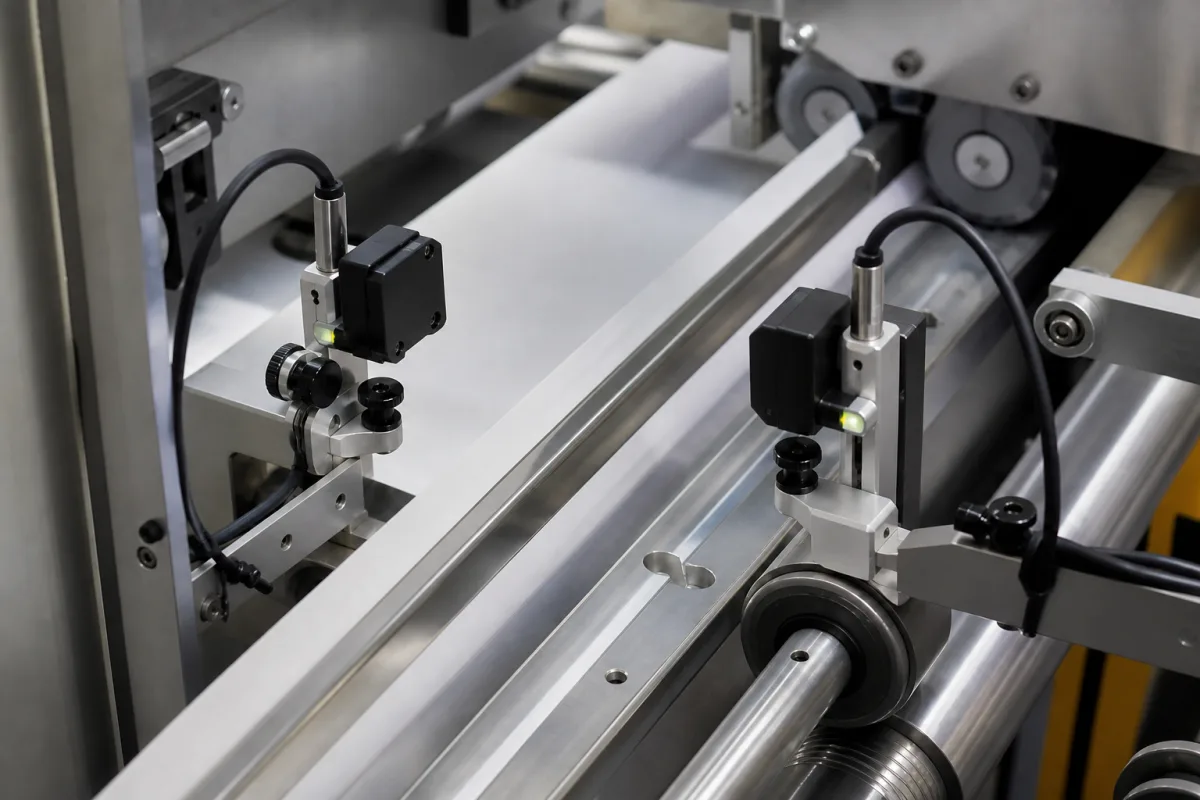
Electronic sensors that detect and monitor the precise alignment of components within a folding mechanism.
Product Specifications

Technical details and manufacturing context for Alignment Sensors

Definition
Alignment sensors are critical components within folding mechanisms that provide real-time feedback on the position, orientation, and alignment of moving parts. They ensure that folding operations occur with high precision, preventing misalignment that could lead to jamming, product defects, or mechanical failure. These sensors are typically integrated into the control system to enable automated adjustments and maintain operational accuracy.
Working Principle
Alignment sensors operate by emitting a signal (optical, magnetic, or inductive) and detecting changes in the received signal caused by the position of a target component within the folding mechanism. Common types include photoelectric sensors that detect the presence or absence of light beams interrupted by moving parts, inductive proximity sensors that detect metallic objects, and laser displacement sensors that measure precise distance and angle. The sensor output is converted into an electrical signal sent to a controller, which compares it to a predefined alignment threshold and triggers corrective actions if deviations are detected.
Common Materials
Stainless Steel Housing, Polycarbonate Lens, Copper Wiring, Silicon Semiconductor
Technical Parameters
  • Sensing distance range, typically from 2mm to 200mm depending on sensor type and application. (mm) Customizable
Components / BOM
  • Emitter
    Generates and projects the sensing signal (light beam, magnetic field, etc.) toward the target area.
    Material: LED/Laser Diode (optical), Copper Coil (inductive)
  • Receiver
    Detects the reflected or interrupted signal from the target and converts it into an electrical signal.
    Material: Phototransistor/Photodiode (optical), Ferrite Core (inductive)
  • Signal Processing Circuit
    Amplifies, filters, and conditions the raw signal from the receiver for reliable output to the controller.
    Material: Printed Circuit Board (PCB), Silicon ICs
  • Housing
    Provides mechanical protection, environmental sealing, and mounting interface for the sensor components.
    Material: Stainless Steel, Aluminum, Engineering Plastic
Engineering Reasoning
0.1-5.0 mm displacement, 0-100°C ambient temperature, 12-24 VDC supply voltage
Displacement measurement error exceeding ±0.05 mm, operating temperature beyond -20°C to 120°C, supply voltage below 10.5 VDC or above 26.4 VDC
Design Rationale: Hall effect sensor saturation at magnetic flux densities exceeding 0.5 T, piezoelectric crystal depolarization above Curie temperature of 150°C, photodiode quantum efficiency degradation below 650 nm wavelength
Risk Mitigation (FMEA)
Trigger Electromagnetic interference from adjacent 400 Hz AC motors generating 50 mV noise
Mode: Signal-to-noise ratio degradation below 20 dB causing false alignment detection
Strategy: Shielded twisted-pair cabling with 90% coverage copper braid and ferrite chokes at 100 MHz
Trigger Mechanical vibration at 120 Hz resonance frequency exceeding 5 g acceleration
Mode: Piezoelectric sensor crystal fracture at 35 MPa stress concentration
Strategy: Viscous damping mounts with 0.7 critical damping ratio and 2000 N·s/m damping coefficient

Industry Taxonomies & Aliases

Commonly used trade names and technical identifiers for Alignment Sensors.

Applied To / Applications

This component is essential for the following industrial systems and equipment:

Industrial Ecosystem & Supply Chain DNA

Complementary Systems
Downstream Applications
Specialized Tooling

Application Fit & Sizing Matrix

Operational Limits
pressure: 0 to 1 bar (non-pressurized applications)
other spec: Vibration tolerance: ≤5g RMS, IP67 ingress protection
temperature: -20°C to +85°C
Media Compatibility
✓ Clean air environments ✓ Dry mechanical assemblies ✓ Non-corrosive industrial atmospheres
Unsuitable: High-moisture or condensing environments with potential for water ingress
Sizing Data Required
  • Required alignment tolerance (mm or arc-minutes)
  • Mounting distance from target (mm)
  • Required response time (ms)

Reliability & Engineering Risk Analysis

Failure Mode & Root Cause
Signal Drift/Inaccuracy
Cause: Thermal expansion of mounting hardware, vibration-induced misalignment, or sensor element degradation from environmental contaminants (dust, moisture, oil mist) affecting optical or magnetic components.
Complete Signal Loss
Cause: Electrical connection failure (corroded terminals, broken wires), internal circuit board damage from voltage spikes or moisture ingress, or physical damage to sensing elements from mechanical impact or excessive misalignment.
Maintenance Indicators
  • Erratic or fluctuating readings on monitoring displays despite stable operating conditions
  • Audible alarms or warning lights from associated control systems indicating loss of signal or out-of-tolerance alignment
Engineering Tips
  • Implement regular laser alignment verification during preventive maintenance, using calibrated tools to check and adjust mounting positions to compensate for thermal and vibrational drift.
  • Install protective enclosures or seals to shield sensors from environmental contaminants, and use shielded, strain-relieved cabling with drip loops to prevent moisture ingress and connection fatigue.

Compliance & Manufacturing Standards

Reference Standards
ISO 9001:2015 - Quality Management Systems IEC 61010-1:2010 - Safety Requirements for Electrical Equipment for Measurement, Control, and Laboratory Use CE Marking - Conformity with EU Directives (e.g., EMC Directive 2014/30/EU)
Manufacturing Precision
  • Repeatability: +/-0.001 mm
  • Flatness of Mounting Surface: 0.005 mm
Quality Inspection
  • Laser Interferometry for Accuracy Verification
  • Environmental Testing (IP Rating Validation for Dust/Water Ingress)

Factories Producing Alignment Sensors

Verified manufacturers with capability to produce this product in China

✓ 94% Supplier Capability Match Found

T Technical Director from United Arab Emirates Jan 30, 2026
★★★★★
"Reliable performance in harsh Machinery and Equipment Manufacturing environments. No issues with the Alignment Sensors so far."
Technical Specifications Verified
P Project Engineer from Australia Jan 27, 2026
★★★★☆
"Testing the Alignment Sensors now; the technical reliability results are within 1% of the laboratory datasheet. (Delivery took slightly longer than expected, but technical support was excellent.)"
Technical Specifications Verified
S Sourcing Manager from Singapore Jan 24, 2026
★★★★★
"Impressive build quality. Especially the technical reliability is very stable during long-term operation."
Technical Specifications Verified
Verification Protocol

“Feedback is collected from verified sourcing managers during RFQ (Request for Quote) and factory evaluation processes on CNFX. These reports represent historical performance data and technical audit summaries from our B2B manufacturing network.”

10 sourcing managers are analyzing this specification now. Last inquiry for Alignment Sensors from Poland (40m ago).

Supply Chain Compatible Machinery & Devices

Hydraulic Press

Industrial machine using hydraulic pressure to compress, form, or assemble materials

Explore Specs →
Heavy-Duty CNC Plasma Cutting Machine

Industrial machine for precision metal cutting using plasma arc technology

Explore Specs →
Automated Assembly Line System

Integrated production system for sequential component assembly operations

Explore Specs →
Automated Powder Coating System

Integrated industrial system for applying dry powder coatings to metal substrates.

Explore Specs →

Frequently Asked Questions

What is the typical accuracy range of these alignment sensors?

Our alignment sensors typically achieve accuracy within ±0.1mm, making them ideal for precision applications in folding mechanisms where exact component positioning is critical.

How do these sensors withstand industrial environments?

The stainless steel housing provides excellent corrosion resistance and durability, while the polycarbonate lens offers impact resistance, ensuring reliable performance in demanding machinery manufacturing settings.

Can these sensors be integrated with existing control systems?

Yes, these alignment sensors feature standardized output signals and can be easily integrated with most industrial PLCs and control systems through the signal processing circuit.

Can I contact factories directly on CNFX?

CNFX is an open directory, not a transaction platform. Each factory profile provides direct contact information and production details to help you initiate direct inquiries with Chinese suppliers.

Get Quote for Alignment Sensors

Request technical pricing, lead times, or customized specifications for Alignment Sensors directly from verified manufacturing units.

Your business information is encrypted and only shared with verified Alignment Sensors suppliers.

Thank you! Your message has been sent. We'll respond within 1–3 business days.

Need to Manufacture Alignment Sensors?

Connect with verified factories specializing in this product category

Add Your Factory Contact Us
Previous Product
Alignment Sensor
Next Product
Alignment System