Industry-Verified Manufacturing Data (2026)

Flow Sensor / Transducer

Based on aggregated insights from multiple verified factory profiles within the CNFX directory, the standard Flow Sensor / Transducer used in the Food Manufacturing sector typically supports operational capacities ranging from standard industrial configurations to heavy-duty production requirements.

Technical Definition & Core Assembly

A canonical Flow Sensor / Transducer is characterized by the integration of Sensing Element and Signal Conditioning Circuitry. In industrial production environments, manufacturers listed on CNFX commonly emphasize 316L Stainless Steel construction to support stable, high-cycle operation across diverse manufacturing scenarios.

A component that detects and converts fluid flow rate into an electrical signal within sanitary flow measurement systems.
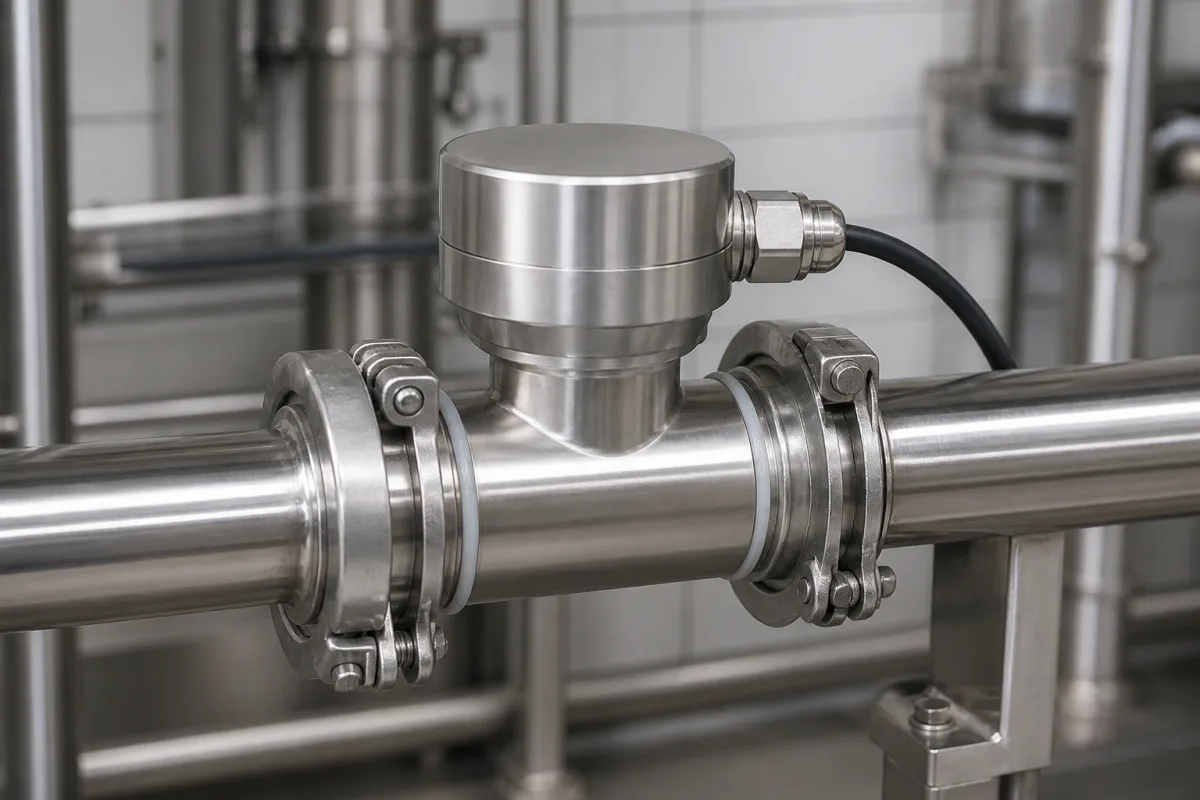
Product Specifications

Technical details and manufacturing context for Flow Sensor / Transducer

Definition
The flow sensor/transducer is a critical component of sanitary flow meters, specifically designed to measure the volumetric or mass flow rate of liquids in hygienic applications. It operates by detecting fluid movement through various sensing principles and converts this physical parameter into a standardized electrical output signal (such as 4-20mA, 0-10V, or digital protocols) for monitoring, control, and data acquisition in sanitary processing systems.
Working Principle
Common working principles include electromagnetic induction (measuring voltage induced by conductive fluid moving through a magnetic field), ultrasonic time-of-flight or Doppler shift measurement, or thermal dispersion (measuring heat transfer from a heated element to the flowing fluid). The transducer element converts the sensed physical phenomenon into a proportional electrical signal.
Common Materials
316L Stainless Steel, PTFE (Polytetrafluoroethylene), Ceramic, Hastelloy
Technical Parameters
  • Process connection size (e.g., Tri-clamp, DIN, SMS fittings) and sensor insertion length or flow tube diameter. (mm) Per Request
Components / BOM
  • Sensing Element
    Directly interacts with the fluid flow to generate a primary measurement signal (e.g., electrodes, ultrasonic transducers, thermal element).
    Material: 316L Stainless Steel, Platinum, Ceramic
  • Signal Conditioning Circuitry
    Amplifies, linearizes, and converts the raw signal from the sensing element into a standardized output.
    Material: Electronic components on PCB
  • Housing / Body
    Provides structural integrity, protects internal components, and interfaces with the sanitary process connection.
    Material: 316L Stainless Steel
  • Process Connection Fitting
    Provides a hygienic, leak-proof seal between the sensor and the process piping.
    Material: 316L Stainless Steel
  • Electrical Connection
    Conduit or connector for power supply and output signal wiring.
    Material: Stainless Steel, Plastic (e.g., PEEK)
Engineering Reasoning
0.1-10 m/s flow velocity, -20°C to 85°C ambient temperature, 0-16 bar pressure
Flow velocity exceeding 12 m/s causes permanent mechanical deformation of turbine blades, temperature exceeding 90°C degrades piezoelectric crystal response by 40%, pressure exceeding 20 bar ruptures diaphragm seals
Design Rationale: Turbine blade fatigue failure at Reynolds numbers > 2×10⁵, Curie point thermal degradation of piezoelectric materials at 90°C, diaphragm seal rupture at hoop stress exceeding 250 MPa
Risk Mitigation (FMEA)
Trigger Particulate contamination exceeding 50 μm diameter in fluid stream
Mode: Turbine bearing seizure causing complete signal loss
Strategy: Installation of 40 μm absolute filtration upstream with differential pressure monitoring
Trigger Electromagnetic interference from adjacent VFDs exceeding 100 V/m field strength
Mode: Signal conditioning circuit saturation producing 4-20 mA output lock at 22 mA
Strategy: Shielded conduit routing with ferrite chokes and 0.1 μF bypass capacitors at signal terminals

Industry Taxonomies & Aliases

Commonly used trade names and technical identifiers for Flow Sensor / Transducer.

Applied To / Applications

This component is essential for the following industrial systems and equipment:

Industrial Ecosystem & Supply Chain DNA

Complementary Systems
Downstream Applications
Specialized Tooling

Application Fit & Sizing Matrix

Operational Limits
pressure: 0 to 16 bar (232 psi)
flow rate: 0.1 to 100 L/min
temperature: -20°C to 120°C
slurry concentration: ≤ 5% solids by weight
Media Compatibility
✓ Water and aqueous solutions ✓ Pharmaceutical-grade fluids ✓ Food and beverage liquids
Unsuitable: Abrasive slurries with high particulate content
Sizing Data Required
  • Required flow rate range (L/min)
  • Pipe diameter and connection type
  • Required output signal type (e.g., 4-20mA, pulse, digital)

Reliability & Engineering Risk Analysis

Failure Mode & Root Cause
Drift in calibration
Cause: Sensor element degradation due to prolonged exposure to process media, temperature fluctuations, or aging of electronic components
Complete signal loss
Cause: Electrical connection failure from corrosion, moisture ingress, or physical damage to wiring/connectors
Maintenance Indicators
  • Erratic or unstable flow readings on the control system display
  • Audible clicking or buzzing from the transducer housing
Engineering Tips
  • Implement regular calibration checks using a traceable reference standard to detect and correct drift early
  • Ensure proper sealing of electrical enclosures and use conduit seals to prevent moisture ingress and corrosion

Compliance & Manufacturing Standards

Reference Standards
ISO 5167: Measurement of fluid flow by means of pressure differential devices ANSI/ISA 7.0.01: Quality Standard for Instrument Air DIN EN 60529: Degrees of protection provided by enclosures (IP Code)
Manufacturing Precision
  • Flow rate accuracy: +/-0.5% of reading
  • Pressure rating: +/-2% of specified maximum pressure
Quality Inspection
  • Calibration verification against NIST-traceable standards
  • Leak test under maximum rated pressure

Factories Producing Flow Sensor / Transducer

Verified manufacturers with capability to produce this product in China

✓ 97% Supplier Capability Match Found

P Procurement Specialist from Canada Jan 31, 2026
★★★★★
"Testing the Flow Sensor / Transducer now; the technical reliability results are within 1% of the laboratory datasheet."
Technical Specifications Verified
T Technical Director from United States Jan 28, 2026
★★★★★
"Impressive build quality. Especially the technical reliability is very stable during long-term operation."
Technical Specifications Verified
P Project Engineer from United Arab Emirates Jan 25, 2026
★★★★★
"As a professional in the Food Manufacturing sector, I confirm this Flow Sensor / Transducer meets all ISO standards."
Technical Specifications Verified
Verification Protocol

“Feedback is collected from verified sourcing managers during RFQ (Request for Quote) and factory evaluation processes on CNFX. These reports represent historical performance data and technical audit summaries from our B2B manufacturing network.”

7 sourcing managers are analyzing this specification now. Last inquiry for Flow Sensor / Transducer from Thailand (36m ago).

Supply Chain Compatible Machinery & Devices

Automated Food Moisture Analyzer

Automated system for precise moisture content measurement in food products

Explore Specs →
Automated Food Color Consistency Analyzer

Automated inline system for real-time color measurement and consistency control in food processing.

Explore Specs →
Control Panel

A centralized interface for monitoring and controlling industrial equipment and processes

Explore Specs →
Industrial Vacuum Tumbler

Industrial machine for massaging and marinating meat under vacuum to enhance texture and flavor.

Explore Specs →

Frequently Asked Questions

What makes this flow sensor suitable for food manufacturing applications?

This flow sensor is designed with sanitary materials like 316L stainless steel, PTFE, and ceramic that meet food-grade standards, ensuring compatibility with food products and easy cleaning to prevent contamination.

How does the flow sensor handle cleaning processes like CIP (Clean-in-Place)?

The sensor's construction with smooth surfaces, PTFE seals, and corrosion-resistant materials like Hastelloy allows it to withstand high-temperature CIP cycles and harsh cleaning chemicals without degradation.

What types of fluids can this sanitary flow transducer measure?

It accurately measures various food industry fluids including water, dairy products, juices, sauces, syrups, and viscous liquids, with material options optimized for different pH levels and temperatures.

Can I contact factories directly on CNFX?

CNFX is an open directory, not a transaction platform. Each factory profile provides direct contact information and production details to help you initiate direct inquiries with Chinese suppliers.

Get Quote for Flow Sensor / Transducer

Request technical pricing, lead times, or customized specifications for Flow Sensor / Transducer directly from verified manufacturing units.

Your business information is encrypted and only shared with verified Flow Sensor / Transducer suppliers.

Thank you! Your message has been sent. We'll respond within 1–3 business days.

Need to Manufacture Flow Sensor / Transducer?

Connect with verified factories specializing in this product category

Add Your Factory Contact Us
Previous Product
Flow Diversion Valve
Next Product
Folding Mechanism