Editorial Technical Reference

Gas Mixing & Injection System

This page explains how Gas Mixing & Injection System is classified within Food Manufacturing. Technical values and manufacturer relationships are research references; confirm the current specification and supplier evidence for each order.

Technical Definition & Core Assembly

A system that precisely blends and injects specific gas mixtures into packaging to modify the internal atmosphere.
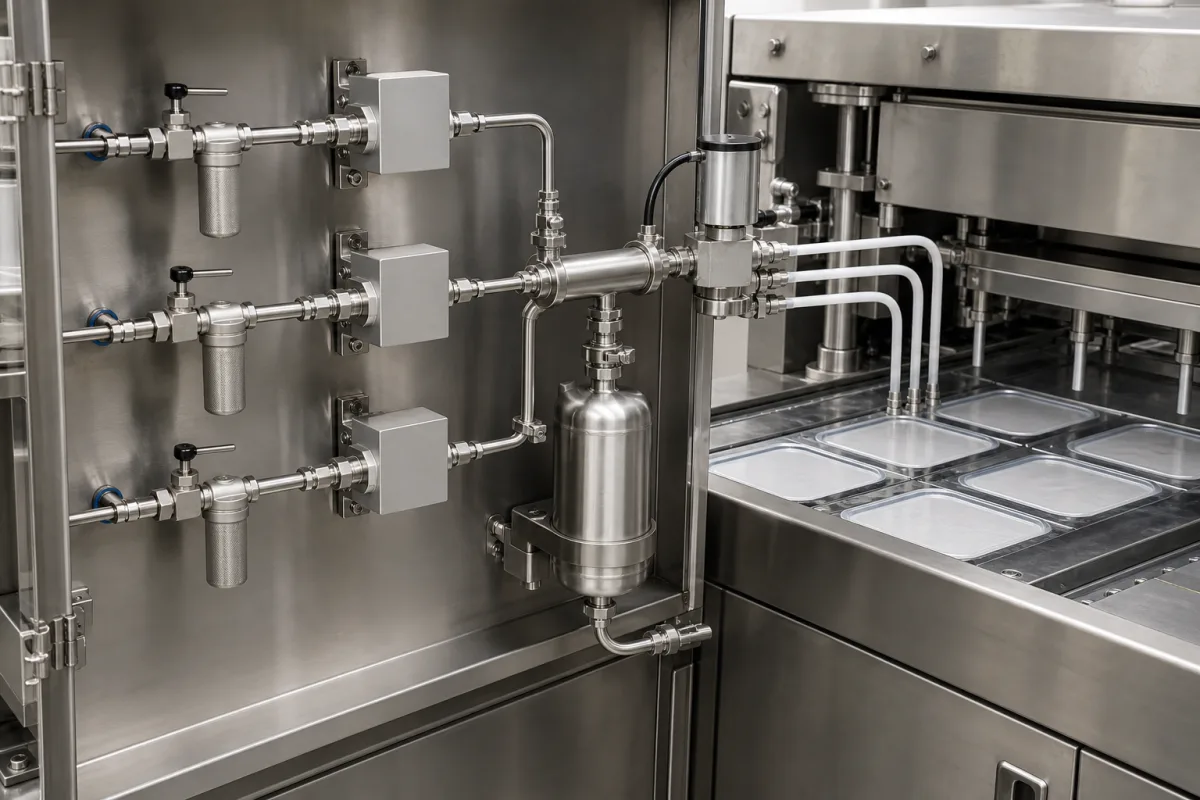
Representative product image. Confirm appearance and specifications with the manufacturer.

Product Specifications

Technical details and manufacturing context for Gas Mixing & Injection System

Definition
The Gas Mixing & Injection System is a component used in food manufacturing, specifically within a Controlled Atmosphere Packaging (CAP) Station. Its function is to create precise gas mixtures—typically nitrogen, carbon dioxide, and oxygen in varying ratios—and inject them into sealed food packaging. By displacing oxygen, the system slows oxidation and microbial growth, thereby extending shelf life and preserving the quality of perishable food products. The system receives pure gases from supply lines. A central controller, based on pre-set recipes, regulates the flow of each gas via precision mass flow controllers or valves into a mixing chamber. The blended gas mixture is then delivered under controlled pressure through an injection head or nozzle into the food package, which is simultaneously evacuated or flushed of ambient air. Key parameters include a gas flow rate of 0.5–5 m³/h per gas channel (adjustable), gas mixing accuracy of ±0.5% for each component, and a gas purity requirement of 99.9–99.999% depending on gas type. Operating pressure ranges from 1.0 to 1.6 MPa, with a gas temperature range of -10 to 50°C (non-condensing) and an ambient temperature range of 0 to 40°C for the control unit. Supply voltage is 24 V DC ±10% (optional 230 V AC), with power consumption of 50–200 W depending on configuration. The control cabinet has an ingress protection rating of IP54–IP65 (IEC 60529). Gas connection size is 6–12 mm OD for tubing. Weight ranges from 15 to 60 kg without gas cylinders, and dimensions (W×H×D) for the control unit are 400×600×300 to 600×900×500 mm. Materials on file include stainless steel (AISI 316L), food-grade plastics (e.g., PTFE, PEEK), precision solenoid valves, and electronic mass flow controllers. These specifications are directory reference ranges; verify model-specific values and standards with the legal manufacturer or supplier before procurement.
Working Principle
The system receives pure gases from supply lines. A central controller, based on pre-set recipes, regulates the flow of each gas via precision mass flow controllers or valves into a mixing chamber. The blended gas mixture is then delivered under controlled pressure through an injection head or nozzle into the food package, which is simultaneously being evacuated or flushed of ambient air.
Common Materials
Stainless Steel (AISI 316L), Food-grade plastics (e.g., PTFE, PEEK), Precision solenoid valves, Electronic mass flow controllers
Technical Parameters
ParameterTypical rangeNotes & selection driver
Gas Flow Rate0.5–5 m³/hPer gas channel, adjustable
Gas Mixing Accuracy±0.5 %For each gas component
Gas Purity Requirement99.9–99.999 %Depends on gas type
Operating Pressure1.0–1.6 MPa
Gas Temperature Range-10–50 °CNon-condensing
Ambient Temperature Range0–40 °CFor control unit
Supply Voltage24 ±10% V DCOptional 230 V AC
Power Consumption50–200 WDepends on configuration
Ingress Protection RatingIP54–IP65For control cabinetIEC 60529
Gas Connection Size6–12 mmOD for tubing
Weight15–60 kgWithout gas cylinders
Dimensions (W×H×D)400×600×300–600×900×500 mmControl unit only

Ranges are indicative industry figures for RFQ preparation, not a supplier commitment. Confirm every value and standard with the legal manufacturer before ordering.

Components / BOM
  • Gas Mixing Chamber/Manifold
    The central hub where individual gas streams converge and are homogenized into the desired final mixture.
    Material: Stainless Steel
  • Precision Mass Flow Controller (MFC)
    Electronically controls and measures the volumetric flow rate of each input gas with high accuracy to achieve the target gas ratio.
    Material: Stainless Steel, Electronics
  • Injection Head/Nozzle
    The interface that directs the blended gas mixture into the food package. Often includes sealing mechanisms to prevent gas leakage during injection.
    Material: Stainless Steel, Food-grade Seal
  • System Control Unit (PLC/HMI)
    The programmable logic controller and human-machine interface that stores gas recipes, automates the mixing/injection sequence, and monitors system parameters.
    Material: Electronics, Plastic/Steel Enclosure

Applied To / Applications

This component is essential for the following industrial systems and equipment:

Industrial Ecosystem & Supply Chain Structure

Complementary Systems
Downstream Applications
Specialized Tooling

Application Fit & Sizing Matrix

Operational Limits
accuracy: ±0.5% of setpoint for gas composition
pressure: Up to 10 bar (injection pressure), 0.5-2 bar (mixing pressure)
flow rate: 0.1-100 L/min (gas mixture)
temperature: 5°C to 40°C (ambient operation)
response time: <2 seconds for composition changes
Media Compatibility
✓ Nitrogen (N₂) for inerting ✓ Carbon Dioxide (CO₂) for preservation ✓ Oxygen (O₂) for modified atmosphere packaging
Unsuitable: Corrosive gases (e.g., chlorine, hydrogen sulfide) or environments with explosive dust concentrations
Sizing Data Required
  • Required gas mixture composition (percentage of each component)
  • Total gas flow rate needed for packaging line speed
  • Required injection pressure based on packaging material and sealing method

Reliability & Engineering Risk Analysis

Failure Mode & Root Cause
Corrosion fatigue in injection nozzles
Cause: Cyclic stress from pulsating flow combined with chemical attack from reactive gas mixtures (e.g., H2S, CO2) leading to crack initiation and propagation
Control valve stiction and hysteresis
Cause: Contaminant buildup (particulates, polymerization products) on valve trim and stem, combined with inadequate lubrication, causing erratic flow control and calibration drift
Maintenance Indicators
  • Audible: Irregular knocking or chattering sounds from injection points indicating flow instability or partial blockage
  • Visual: Discoloration or crystalline deposits around flange connections and valve bodies signaling gas leakage or chemical reaction byproducts
Engineering Tips
  • Implement real-time corrosion monitoring using ultrasonic thickness gauges at critical injection nozzles and install sacrificial anodes in mixing chambers for cathodic protection
  • Establish a predictive maintenance program with quarterly valve signature tests using digital valve controllers to detect stiction early, combined with installation of dual coalescing filters in gas supply lines to maintain 3-micron particulate purity

Indicative industry ranges for design and RFQ preparation. Confirm the exact figures and applicable standard with the manufacturer before specifying.

Compliance & Manufacturing Standards

Applicable Standards
ISO 8573-1:2010 (Compressed air purity classes) ANSI/ISA 84.00.01 (Functional safety of safety instrumented systems) DIN EN 13480-3 (Metallic industrial piping)

Quoted from the published standard.

Manufacturing Precision
  • Flow rate accuracy: +/-1% of full scale
  • Pressure control: +/-0.5% of setpoint
Quality Inspection
  • Helium leak test (per ASME B31.3)
  • Material composition verification via XRF analysis

Manufacturers of Gas Mixing & Injection System

Manufacturer profiles associated with Gas Mixing & Injection System.

Sourcing Gas Mixing & Injection System from China?
Tell us your specification and target quantity — we will match it against manufacturer records and come back with the factories that fit.
Request manufacturers We manufacture this

Manufacturer listings support early research and capability understanding. They are not certification, ranking, or transaction guarantees.

Technical documentation
Request current drawings, revision history, and a signed specification sheet.
Manufacturing capability
Verify equipment lists, process limits, capacity, and representative production evidence.
Inspection readiness
Confirm test methods, calibrated equipment, sampling plans, and traceable reports.
Supplier transparency
Check the legal entity, factory address, ownership, certifications, and direct contacts.

CNFX does not score or rank suppliers. Buyers must verify all claims and documents with the legal manufacturer before ordering.

Supply Chain Compatible Machinery & Devices

Intelligent Food Grade Metal Detector

This industrial-grade metal detection system is designed for integration into food processing and packaging lines.

Explore Specs →
Automated Food Packaging Integrity Tester

Automated system for non-destructive testing of food package seals and integrity.

Explore Specs →
Control Panel

A centralized interface for monitoring and controlling industrial equipment and processes

Explore Specs →
High-Purity Sodium Nitrite Curing Salt

High-purity sodium nitrite curing salt is a critical raw material in industrial meat processing for preservation and color fixation.

Explore Specs →

Frequently Asked Questions

What gases can be mixed with this system?

The system is designed to mix gases such as nitrogen, carbon dioxide, and oxygen in varying ratios, as specified in the source facts. The exact gas types and ratios depend on the application and pre-set recipes.

What is the gas mixing accuracy?

The gas mixing accuracy is ±0.5% for each gas component, as listed in the parameters. This value is a reference range and should be confirmed for the specific model and application with the manufacturer.

What are the operating pressure and temperature ranges?

The operating pressure is 1.0–1.6 MPa, and the gas temperature range is -10 to 50°C (non-condensing). The ambient temperature range for the control unit is 0 to 40°C. These are reference values; verify for your specific configuration.

What materials are used in the system?

Materials on file include stainless steel (AISI 316L), food-grade plastics such as PTFE and PEEK, precision solenoid valves, and electronic mass flow controllers. These materials are typical, but confirm with the manufacturer for your specific model.

Data Basis

Editorial classification, named public sources where available, and source-reviewed manufacturer records.

Preliminary Technical Classification
This page supports structured research, RFQ preparation, and supplier evaluation. It does not replace buyer-led supplier qualification, standards review, or technical approval.
Buyer enquiry

Request manufacturing insight for Gas Mixing & Injection System

Ask for use case, specification boundaries, supplier type, and RFQ preparation information for this product.

Where it goes
Straight to the CNFX editorial desk, and to the manufacturer if this product is linked to a claimed profile. Nothing is broadcast to a supplier list.
Your details stay here
We do not sell or rent enquiry data, and we do not add you to a mailing list. Used only to answer this request.
No commission, no middleman
CNFX is a directory. We take no cut of any order and never negotiate on a supplier's behalf.
What we don't claim
A listing is not an endorsement. Qualify every supplier and verify every figure yourself before ordering.

Your business information is used only to process this request.

Thank you! Your message has been sent. We'll respond within 1–3 business days.
Sorry, we couldn't send your message. Please try again, or email us at contact@cnfx.com.

Need to Manufacture Gas Mixing & Injection System?

Compare manufacturer profiles with relevant product and process capability.

Previous Product
Tubular Heat Exchanger
Last Product
Get QuotesChat