Industry-Verified Manufacturing Data (2026)

Hydrostatic Tank

Based on aggregated insights from multiple verified factory profiles within the CNFX directory, the standard Hydrostatic Tank used in the Food Manufacturing sector typically supports operational capacities ranging from standard industrial configurations to heavy-duty production requirements.

Technical Definition & Core Assembly

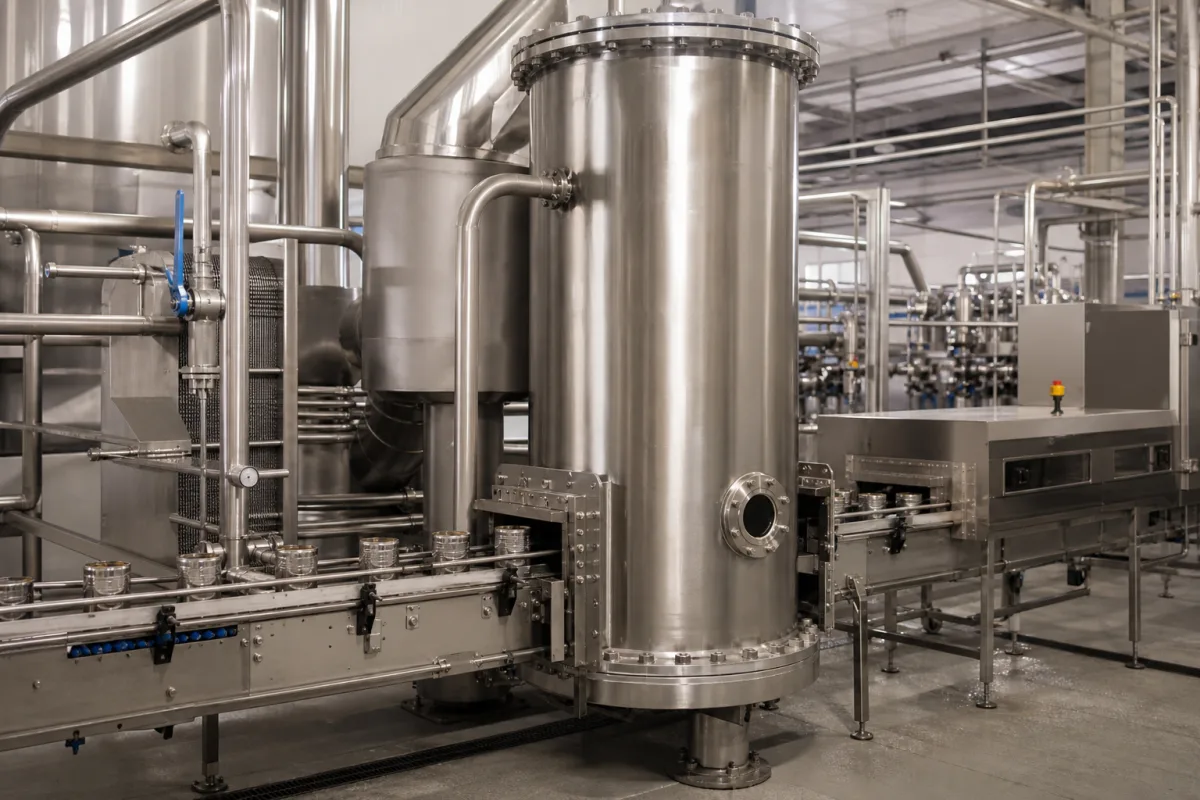
A canonical Hydrostatic Tank is characterized by the integration of Pressure Vessel Shell and Inlet/Outlet Ports. In industrial production environments, manufacturers listed on CNFX commonly emphasize Stainless Steel 316L construction to support stable, high-cycle operation across diverse manufacturing scenarios.

A sealed pressure vessel that maintains hydrostatic pressure for blanching processes
Product Specifications

Technical details and manufacturing context for Hydrostatic Tank

Definition
The hydrostatic tank is a critical component of the Industrial Hydrostatic Blancher that creates and maintains a controlled hydrostatic pressure environment. It serves as the main processing chamber where food products are subjected to precise pressure and temperature conditions for blanching, cooking, or pasteurization while maintaining product integrity and quality.
Working Principle
The tank operates by maintaining a column of water at a specific height to create hydrostatic pressure. As food products pass through the tank, they experience uniform pressure from all directions, which allows for precise temperature control and prevents product damage while ensuring thorough thermal processing.
Common Materials
Stainless Steel 316L
Technical Parameters
  • Diameter and height specifications for pressure vessel design (mm) Customizable
Components / BOM
  • Pressure Vessel Shell
    Main structural component that contains the hydrostatic pressure
    Material: Stainless Steel
  • Inlet/Outlet Ports
    Connections for product entry and exit from the tank
    Material: Stainless Steel
  • Pressure Relief Valve
    Safety device to prevent over-pressurization
    Material: Stainless Steel/Brass
  • Temperature Sensor Port
    Mounting point for temperature monitoring equipment
    Material: Stainless Steel
Engineering Reasoning
1.5-6.0 bar (22-87 psi)
8.2 bar (119 psi) at 120°C water temperature
Design Rationale: Yield strength of 316L stainless steel (205 MPa) exceeded at 8.2 bar internal pressure with 120°C water, causing plastic deformation and eventual rupture
Risk Mitigation (FMEA)
Trigger Thermal expansion of water from 20°C to 120°C without pressure relief
Mode: Pressure vessel rupture at welded seams
Strategy: Install 6.5 bar pressure relief valve with 0.2 bar hysteresis
Trigger Cavitation at pump discharge due to NPSH margin below 0.5 meters
Mode: Pitting corrosion and material fatigue at tank inlet
Strategy: Increase pump NPSH margin to 1.2 meters with tapered inlet design

Industry Taxonomies & Aliases

Commonly used trade names and technical identifiers for Hydrostatic Tank.

Industrial Ecosystem & Supply Chain DNA

Complementary Systems
Downstream Applications
Specialized Tooling

Application Fit & Sizing Matrix

Operational Limits
pressure: Up to 10 bar (145 psi) working pressure
flow rate: Dependent on pump and piping; typical 50-500 m³/h
temperature: Ambient to 150°C (302°F)
slurry concentration: Up to 40% solids by weight
Media Compatibility
✓ Food-grade water solutions ✓ Vegetable/root crop slurries ✓ Chemical blanching solutions (e.g., sodium metabisulfite)
Unsuitable: Highly acidic or caustic media (pH <3 or >11)
Sizing Data Required
  • Required blanching capacity (kg/h)
  • Required residence time for product (seconds/minutes)
  • Available floor space and connection points

Reliability & Engineering Risk Analysis

Failure Mode & Root Cause
Corrosion-induced leakage
Cause: Chemical attack from stored fluid or external environment, often accelerated by improper material selection, coating degradation, or cathodic protection failure.
Structural fatigue cracking
Cause: Cyclic loading from pressure variations, thermal expansion/contraction, or seismic/vibration stresses, leading to crack initiation and propagation at weld joints or stress concentrators.
Maintenance Indicators
  • Visible weeping, staining, or active dripping from tank seams, welds, or penetrations indicating loss of containment integrity.
  • Abnormal audible 'pinging' or 'creaking' sounds during pressure cycles, suggesting stress or deformation issues.
Engineering Tips
  • Implement routine non-destructive testing (NDT) such as ultrasonic thickness gauging and visual inspections to monitor corrosion rates and detect early-stage cracking.
  • Maintain strict pressure and temperature operating limits, ensuring safety relief valves are calibrated and functional to prevent overpressure scenarios.

Compliance & Manufacturing Standards

Reference Standards
ISO 9001:2015 - Quality management systems ASME BPVC Section VIII - Rules for construction of pressure vessels EN 13445 - Unfired pressure vessels
Manufacturing Precision
  • Wall thickness: +/-5% of nominal thickness
  • Circularity: 1% of diameter
Quality Inspection
  • Hydrostatic pressure test (1.5x design pressure)
  • Ultrasonic thickness testing

Factories Producing Hydrostatic Tank

Verified manufacturers with capability to produce this product in China

✓ 92% Supplier Capability Match Found

P Project Engineer from United States Feb 02, 2026
★★★★★
"The Hydrostatic Tank we sourced perfectly fits our Food Manufacturing production line requirements."
Technical Specifications Verified
S Sourcing Manager from United Arab Emirates Jan 30, 2026
★★★★★
"Found 47+ suppliers for Hydrostatic Tank on CNFX, but this spec remains the most cost-effective."
Technical Specifications Verified
P Procurement Specialist from Australia Jan 27, 2026
★★★★★
"The technical documentation for this Hydrostatic Tank is very thorough, especially regarding technical reliability."
Technical Specifications Verified
Verification Protocol

“Feedback is collected from verified sourcing managers during RFQ (Request for Quote) and factory evaluation processes on CNFX. These reports represent historical performance data and technical audit summaries from our B2B manufacturing network.”

6 sourcing managers are analyzing this specification now. Last inquiry for Hydrostatic Tank from Turkey (1h ago).

Supply Chain Compatible Machinery & Devices

Intelligent Food Grade Metal Detector

Automated metal contamination detection system for food processing lines.

Explore Specs →
Automated Food Packaging Integrity Tester

Automated system for non-destructive testing of food package seals and integrity.

Explore Specs →
Automated Food Moisture Analyzer

Automated system for precise moisture content measurement in food products

Explore Specs →
Automated Food Color Consistency Analyzer

Automated inline system for real-time color measurement and consistency control in food processing.

Explore Specs →

Frequently Asked Questions

What are the main advantages of using a hydrostatic tank for food blanching?

Hydrostatic tanks provide uniform pressure distribution, consistent temperature control, and efficient blanching that preserves food quality while meeting food safety standards through precise pressure maintenance.

Why is Stainless Steel 316L recommended for food manufacturing hydrostatic tanks?

Stainless Steel 316L offers superior corrosion resistance, especially against chlorides and acids common in food processing. It's non-reactive, easy to clean, and meets stringent food-grade sanitation requirements.

How does the pressure relief valve ensure safety in hydrostatic blanching operations?

The pressure relief valve automatically releases excess pressure if it exceeds safe operating limits, preventing equipment damage and ensuring operator safety while maintaining process integrity during blanching cycles.

Can I contact factories directly on CNFX?

CNFX is an open directory, not a transaction platform. Each factory profile provides direct contact information and production details to help you initiate direct inquiries with Chinese suppliers.

Get Quote for Hydrostatic Tank

Request technical pricing, lead times, or customized specifications for Hydrostatic Tank directly from verified manufacturing units.

Your business information is encrypted and only shared with verified Hydrostatic Tank suppliers.

Thank you! Your message has been sent. We'll respond within 1–3 business days.

Need to Manufacture Hydrostatic Tank?

Connect with verified factories specializing in this product category

Add Your Factory Contact Us
Previous Product
Hydrocyclone Cone
Next Product
Industrial Dough Conditioner Base Powder