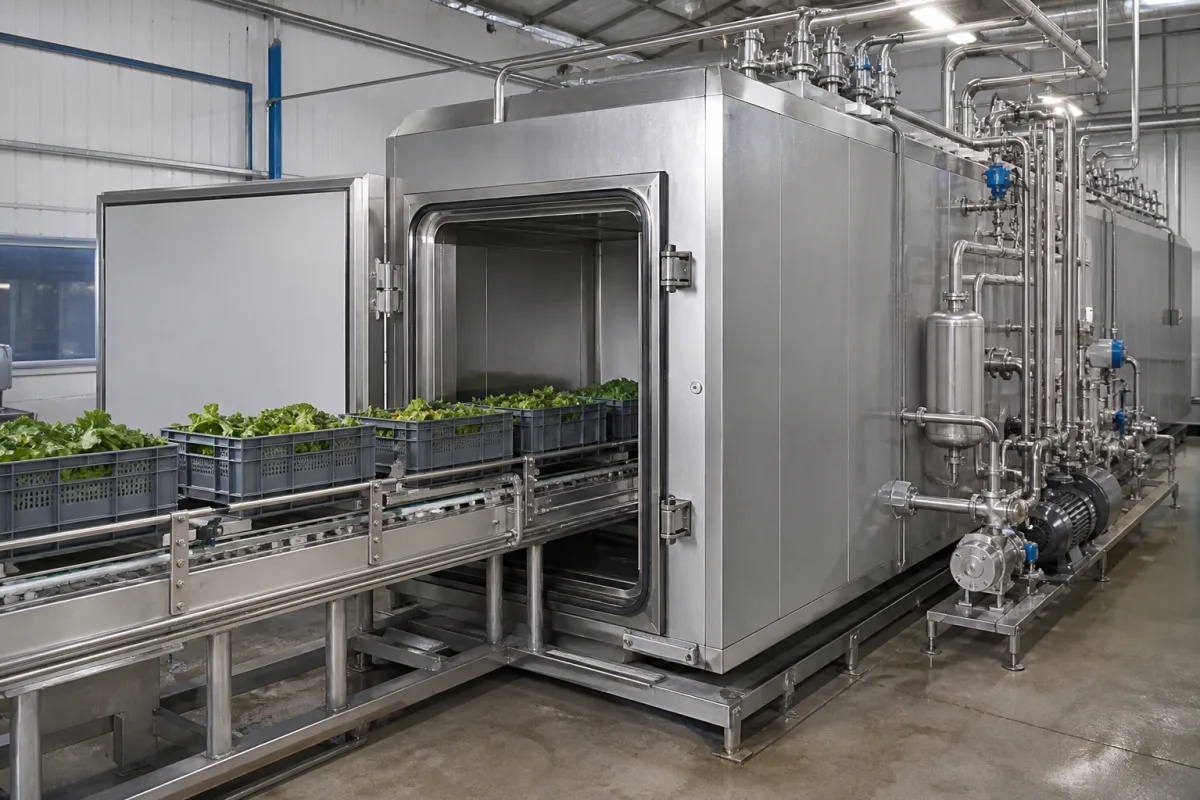
Vacuum coolers for produce · Evaporative cooling cycle, flash point pressure, cooling time, weight loss per degree, suitable and unsuitable crops
An industrial vacuum cooler is a sealed steel chamber, loaded with boxed or crated produce, in which vacuum pumps lower the pressure until water in the produce boils at low temperature and its evaporation removes the field heat. Ask three things first: whether your crops can be vacuum cooled without wilting or damage, how fast the pump reaches the flash point and finishes the cycle for a full load, and how much weight the produce will lose and whether water spray (hydrovac) is needed.
Batch and continuous vacuum coolers for vegetables, leafy greens, mushrooms, cut flowers and cooked foods, including hydrovac versions. Forced-air, hydro and ice cooling systems, cold rooms and freeze dryers are outside this page.
CNFX editorial research · Sources checked October 11, 2026 · 4 sources
Run the cooling cycle to the flash point and beyond
NC State Extension's postharvest engineering guide explains that vacuum cooling works by evaporating a small amount of the produce's own moisture: the vacuum pump lowers the chamber below 0.20 atmospheres, the boiling point of water falls, and the heat of vaporisation comes from the produce's sensible heat. The chamber and cartons stay at ambient temperature because they have no water to evaporate. [1]
In the guide's cycle the pump first brings the chamber to the saturation pressure of the produce's starting temperature, about 0.05 atm for produce at 85 °F, which takes 7–10 minutes in the guide's example depending on chamber size and pump capacity; little cooling happens until this flash point, after which water evaporates rapidly until the target temperature, set by final pressure and time, is reached. Cooling takes 20–30 minutes in the guide for a 45 F° drop from 85 °F to 40 °F, and the cooling is as fast in the centre of a lettuce head as outside, even wrapped and boxed. [1]
Editorial calculation: 0.20 atm is about 203 mbar and 0.05 atm about 51 mbar; 85 °F and 40 °F are about 29.4 °C and 4.4 °C. Ask the supplier for pump capacity, time to flash point and total cycle time for your full load. [1]
Give the supplier the crops and packaging, load per cycle (pallets or crates), starting and target temperatures, cycle time, number of cycles per day, need for water spray (hydrovac), chamber size and doors, loading method, refrigeration or condenser arrangement, power supply and site altitude.
02
Plan for weight loss and choose suitable crops
The guide states that the evaporated moisture causes a measurable weight loss averaging 1% for each 10 F° of temperature drop; for leafy greens it may show as wilting, and since produce is sold by weight a 3.6% loss cuts the margin. Hydrovac systems spray a light mist of clean water over the produce before or during the cycle to reduce wilting. [1]
Vacuum cooling suits lettuce and leafy greens, mushrooms, cut flowers, broccoli and cauliflower, but not produce whose skin resists moisture loss, such as thick-skinned fruits; bell peppers, eggplant and tomatoes have been known to split. [1]
Editorial calculation: cooling a reefer load of about 29,900 lb of lettuce from 85 °F to 40 °F (a 45 F° drop) at 1% per 10 F° removes about 4.5%, or roughly 1,350 lb (610 kg) of water. Ask suppliers how hydrovac spray or packaging limits this for your crop. [1]
03
Size the chamber, load and cycle
One builder's published range runs from a 1-pallet cooler with a 1.4 × 1.5 × 2.2 m chamber taking 500–600 kg per cycle at 20 kW to a 16-pallet cooler with a 2.5 × 8.6 × 2.2 m (47.3 m³) chamber taking 8,000–8,500 kg per batch; it gives 15–30 minutes to pre-cool vegetables, fruits, mushrooms and flowers, carbon or stainless steel chambers, hydraulic lifting or sliding doors, refrigerants R404A, R134a, R507A or R449A, air or evaporative cooling, 380–600 V three-phase supply and an optional loading conveyor. [2]
Weber Vacuum states cooling from 20–25 °C to 1–5 °C in 10–20 minutes for leafy greens and herbs and 30–45 minutes for compact vegetables such as broccoli, even cooling regardless of packaging as long as it is not airtight, hydronic glycol-based cooling as standard on its single and double pallet versions, and ranges for 2 standard or 3 Euro pallets up to 16 pallets and aircraft pallets. [3]
A 2024 CIGR Journal review describes modified atmosphere vacuum cooling, which adds gas cylinders, a mixer and a gas tank to the vacuum chamber; a mix of 7% O₂, 7% CO₂ and 86% N₂ was applied to flowering cabbage, Chinese cabbage and green cabbage cooled to 4 °C, and produce with a thick moisture barrier or a low surface-to-mass ratio, such as mango, tomato and okra, is not suited to it. [4]
Editorial calculation: 2.5 × 8.6 × 2.2 m = 47.3 m³, matching the stated volume; the 2-pallet unit's 32 kW running for a 30-minute cycle is up to 16 kWh for 1,000–1,200 kg, or about 13–16 kWh per tonne if the full listed power were drawn throughout. Ask for measured energy per cycle on your crop. [2]
Model (pallets)
Load per cycle
Chamber (m)
Power
HXV-1P (1)
500–600 kg
1.4 × 1.5 × 2.2
20 kW
HXV-2P (2)
1,000–1,200 kg
1.4 × 2.6 × 2.2
32 kW
HXV-4P (4)
2,000–2,500 kg
1.4 × 5.2 × 2.2
56 kW
HXV-8P (8)
4,000–4,500 kg
1.4 × 9.8 × 2.2
106 kW
HXV-12P (12)
6,000–6,500 kg
2.5 × 7.4 × 2.2
200 kW
HXV-16P (16)
8,000–8,500 kg
2.5 × 8.6 × 2.2
Not listed in the table
State pallets and kg per cycle, crop mix with start and end temperatures, cycle time target, door type, refrigerant, condenser cooling (air or evaporative), supply voltage, chamber material and loading method.
04
Vacuum coolers sold beside cold rooms and ice machines
Listings include vacuum coolers for vegetables and ready food alongside cold rooms and ice machines.
05
What the pump, controls and hydrovac spray each do
Crop cooling time, pressure and pallet capacity to give a cooler builder
Cooling time and pressure come from the NC State guide and Weber; power, chamber length and load per cycle come from one builder's range, so ask for the figures for your crop and pallet count.
Field
What it means and published values
Ask the supplier for
Cooling rate (°C/min)
About 25 °C in 20–30 min for lettuce [1]; 10–20 min leafy greens, 30–45 min broccoli to 1–5 °C. [3]
Rate for your crop.
Vacuum level (mbar)
Below about 203 mbar; flash near 51 mbar at 85 °F. [1]
Ultimate pressure.
Power consumption (kW)
Pump and refrigeration; 20 kW (1 pallet) to 200 kW (12 pallets) in one range. [2]
Power.
Tunnel length (m)
Chamber size; 1.5 m (1 pallet) to 9.8 m (8 pallets). [2]
Explore company information and manufacturing capabilities, then discuss the scope of your project with a relevant supplier.
Share this page
Compiled and source-reviewed by the CNFX editorial team.
Each manufacturer above links to the page on that company's own website where the product is listed, with the date we checked it. How we source and review
· Page last updated 13 October 2026
Buyer questions
How long does vacuum cooling take?
NC State Extension gives 20–30 minutes for a 45 F° drop (85 to 40 °F) in lettuce, after 7–10 minutes to reach the flash point. [1]
How much weight does produce lose in a vacuum cooler?
About 1% for each 10 F° of temperature drop on average. [1]
Which crops should not be vacuum cooled?
Fruits with thick skins; bell peppers, eggplant and tomatoes have been known to split. [1]
How much produce does a vacuum cooler take per cycle?
One builder's range runs from 500–600 kg in a 1-pallet chamber to 8,000–8,500 kg in a 16-pallet chamber. [2]
What is modified atmosphere vacuum cooling?
Vacuum cooling with a controlled gas mix in the chamber, such as 7% O₂, 7% CO₂ and 86% N₂ applied to leafy cabbages. [4]
Sources and what still needs a direct check
Sources checked 2026-10-11. NC State Extension's guide describes vacuum cooling of produce; cooked-food cooling and crops outside its list need their own trials.