Industry-Verified Manufacturing Data (2026)

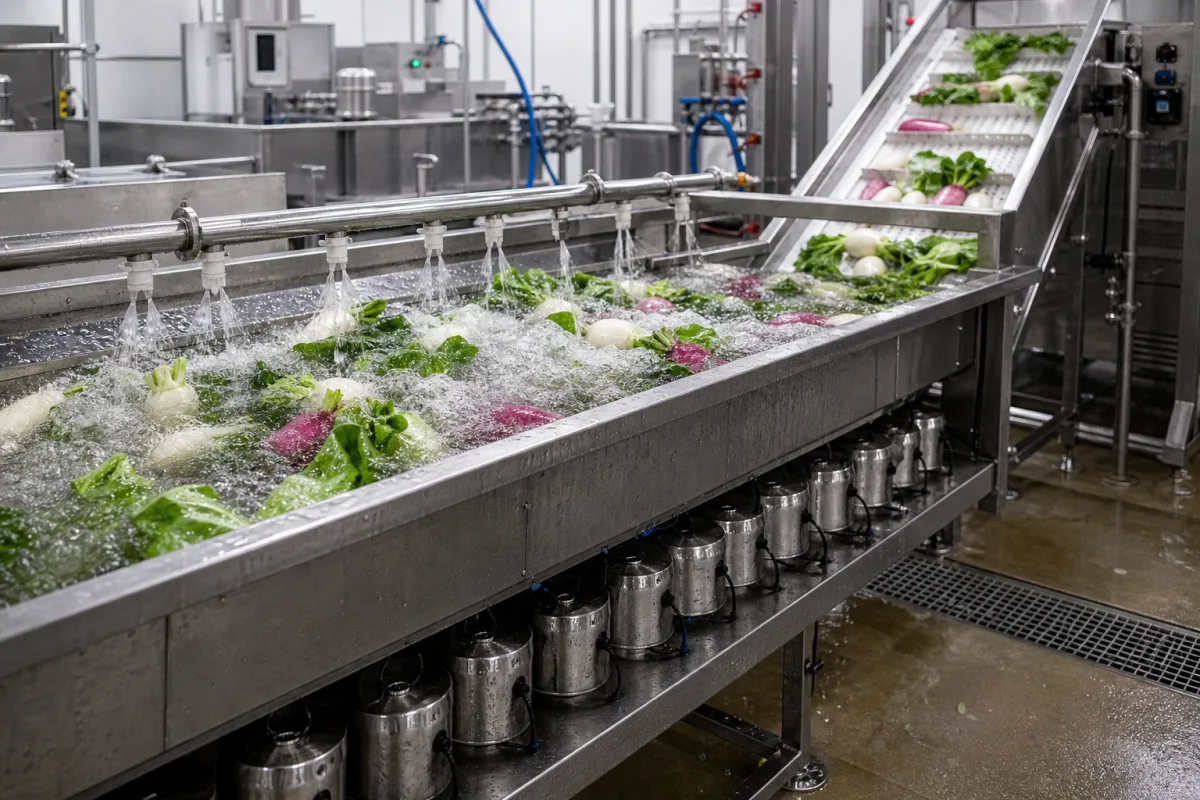
Industrial Ultrasonic Vegetable Washer

Based on aggregated insights from multiple verified factory profiles within the CNFX directory, the standard Industrial Ultrasonic Vegetable Washer used in the Food Manufacturing sector typically supports operational capacities ranging from standard industrial configurations to heavy-duty production requirements.

Technical Definition & Core Assembly

A canonical Industrial Ultrasonic Vegetable Washer is characterized by the integration of Ultrasonic Transducer Array and Stainless Steel Washing Tank. In industrial production environments, manufacturers listed on CNFX commonly emphasize Stainless Steel 304 construction to support stable, high-cycle operation across diverse manufacturing scenarios.

Industrial machine using ultrasonic cavitation to remove contaminants from vegetables.

Product Specifications

Technical details and manufacturing context for Industrial Ultrasonic Vegetable Washer

Definition
An industrial-grade ultrasonic washing machine designed specifically for vegetable processing lines. It employs high-frequency ultrasonic waves to create microscopic cavitation bubbles that dislodge soil, pesticides, and microorganisms from vegetable surfaces without damaging delicate tissues. This equipment is essential in B2B food processing supply chains for ensuring food safety compliance and extending shelf life. It integrates seamlessly with sorting and packaging lines to maintain continuous production flow.
Working Principle
High-frequency ultrasonic transducers generate sound waves in water, creating cavitation bubbles that implode and produce micro-jets that scrub contaminants off vegetable surfaces.
Common Materials
Stainless Steel 304, Food-grade Polypropylene, Piezoelectric Ceramic Transducers
Technical Parameters
  • Maximum throughput capacity (kg/hour) Per Request
  • Ultrasonic frequency range (kHz) Per Request
Components / BOM
Engineering Reasoning
20-100 kHz ultrasonic frequency, 0.5-3.0 W/cm² power density, 15-40°C water temperature
Cavitation threshold exceeded at 150 W/cm² power density causing transducer piezoelectric ceramic fracture at 120°C Curie temperature
Design Rationale: Acoustic cavitation collapse pressure exceeding 1000 bar generates microjets eroding transducer surfaces, while excessive thermal loading depolarizes PZT-4 piezoelectric material beyond its Curie point
Risk Mitigation (FMEA)
Trigger Insufficient dissolved gas content below 3 mg/L in wash water
Mode: Transient cavitation collapse producing 5000 K localized plasma damaging vegetable cell walls
Strategy: Integrated dissolved oxygen sensor with automated gas injection maintaining 8-12 mg/L concentration
Trigger Resonant frequency drift exceeding ±0.5% from 40 kHz nominal due to transducer mounting bolt torque relaxation
Mode: Acoustic impedance mismatch causing 85% ultrasonic energy reflection heating transducer to 95°C
Strategy: Piezoelectric feedback loop with 0.1% frequency resolution and 12 N·m calibrated torque mounting system

Industry Taxonomies & Aliases

Commonly used trade names and technical identifiers for Industrial Ultrasonic Vegetable Washer.

Industrial Ecosystem & Supply Chain DNA

Complementary Systems
Downstream Applications
Specialized Tooling

Application Fit & Sizing Matrix

Operational Limits
pressure: Atmospheric to 2 bar (tank pressure)
flow rate: Batch process (no continuous flow)
temperature: 5-40°C (operating fluid temperature)
power density: 0.5-2 W/cm² of transducer surface
slurry concentration: Up to 30% solids by volume
ultrasonic frequency: 20-40 kHz
Media Compatibility
✓ Leafy greens (lettuce, spinach) ✓ Root vegetables (carrots, potatoes) ✓ Delicate produce (berries, mushrooms)
Unsuitable: High-viscosity slurries with abrasive particles (e.g., root vegetables with heavy soil clumps exceeding 30% solids)
Sizing Data Required
  • Maximum batch volume (liters)
  • Target contaminant removal efficiency (%)
  • Required throughput (kg/hour)

Reliability & Engineering Risk Analysis

Failure Mode & Root Cause
Transducer Degradation
Cause: Continuous exposure to water, vegetable acids, and cleaning chemicals leading to corrosion, delamination, or piezoelectric element fatigue, reducing ultrasonic efficiency.
Cavitation Damage to Tank and Components
Cause: Intense ultrasonic cavitation bubbles imploding on metal surfaces, causing pitting, erosion, and material fatigue, especially in welds, seals, and transducer mounting areas.
Maintenance Indicators
  • Significant reduction in cleaning effectiveness (visible residue on vegetables) despite proper settings, indicating transducer output loss.
  • Unusual audible changes: excessive vibration noise, rattling, or high-pitched whining from the tank, suggesting loose components or failing transducers.
Engineering Tips
  • Implement a routine water quality management program: use filtered/softened water to minimize scale buildup and control pH to reduce corrosive effects on transducers and tank surfaces.
  • Establish a preventive maintenance schedule for transducer impedance testing and output verification, coupled with regular inspection and tightening of all mechanical fasteners to combat vibration-induced loosening.

Compliance & Manufacturing Standards

Reference Standards
ISO 9001:2015 (Quality Management Systems) CE Marking (EU Machinery Directive 2006/42/EC) ANSI/NSF 61 (Drinking Water System Components)
Manufacturing Precision
  • Ultrasonic Transducer Frequency: +/- 2 kHz
  • Stainless Steel Weld Seam Flatness: 0.5 mm/m
Quality Inspection
  • Leak Test (Hydrostatic Pressure at 1.5x Operating Pressure)
  • Ultrasonic Transducer Output Verification (Power Density Measurement)

Factories Producing Industrial Ultrasonic Vegetable Washer

Verified manufacturers with capability to produce this product in China

✓ 94% Supplier Capability Match Found

T Technical Director from United Arab Emirates Feb 28, 2026
★★★★★
"Testing the Industrial Ultrasonic Vegetable Washer now; the Processing Capacity (kg/hour) results are within 1% of the laboratory datasheet."
Technical Specifications Verified
P Project Engineer from Australia Feb 25, 2026
★★★★☆
"Impressive build quality. Especially the Processing Capacity (kg/hour) is very stable during long-term operation. (Delivery took slightly longer than expected, but technical support was excellent.)"
Technical Specifications Verified
S Sourcing Manager from Singapore Feb 22, 2026
★★★★★
"As a professional in the Food Manufacturing sector, I confirm this Industrial Ultrasonic Vegetable Washer meets all ISO standards."
Technical Specifications Verified
Verification Protocol

“Feedback is collected from verified sourcing managers during RFQ (Request for Quote) and factory evaluation processes on CNFX. These reports represent historical performance data and technical audit summaries from our B2B manufacturing network.”

9 sourcing managers are analyzing this specification now. Last inquiry for Industrial Ultrasonic Vegetable Washer from UAE (45m ago).

Supply Chain Commonly Integrated Components

Pressure Regulation Unit

A specialized component within fermentation systems that maintains precise pressure levels during microbial growth processes.

Explore Specs →
Sensor Array Network

A network of multiple sensors distributed throughout a fermentation system to monitor and collect real-time data on critical parameters.

Explore Specs →
Agitation System

A mechanical subsystem within an automated fermentation control system designed to mix and homogenize fermentation media through controlled agitation.

Explore Specs →
Aseptic Surge Tank

A sterile holding vessel that temporarily stores processed fruit/vegetable products under aseptic conditions to balance flow rates between processing stages.

Explore Specs →

Frequently Asked Questions

How does ultrasonic cavitation clean vegetables more effectively than traditional washing?

Ultrasonic cavitation creates microscopic bubbles that implode, generating intense scrubbing action that removes dirt, pesticides, and microorganisms from vegetable surfaces and crevices that traditional washing methods often miss.

What maintenance is required for the ultrasonic transducer array?

The piezoelectric ceramic transducers require minimal maintenance. Regular inspection for mineral deposits, ensuring proper water chemistry to prevent scaling, and checking electrical connections are the primary maintenance tasks.

Can this machine handle delicate vegetables without damage?

Yes, the ultrasonic cleaning process is non-abrasive and gentle. The adjustable frequency and intensity settings allow operators to optimize cleaning for delicate vegetables like leafy greens, berries, and herbs without causing damage.

Can I contact factories directly on CNFX?

CNFX is an open directory, not a transaction platform. Each factory profile provides direct contact information and production details to help you initiate direct inquiries with Chinese suppliers.

Get Quote for Industrial Ultrasonic Vegetable Washer

Request technical pricing, lead times, or customized specifications for Industrial Ultrasonic Vegetable Washer directly from verified manufacturing units.

Your business information is encrypted and only shared with verified Industrial Ultrasonic Vegetable Washer suppliers.

Thank you! Your message has been sent. We'll respond within 1–3 business days.

Need to Manufacture Industrial Ultrasonic Vegetable Washer?

Connect with verified factories specializing in this product category

Add Your Factory Contact Us
Previous Product
Industrial Starch Centrifugal Sieving Machine
Next Product
Industrial Vacuum Cooling Tunnel